Satyrium fuliginosum
Sooty Hairstreak
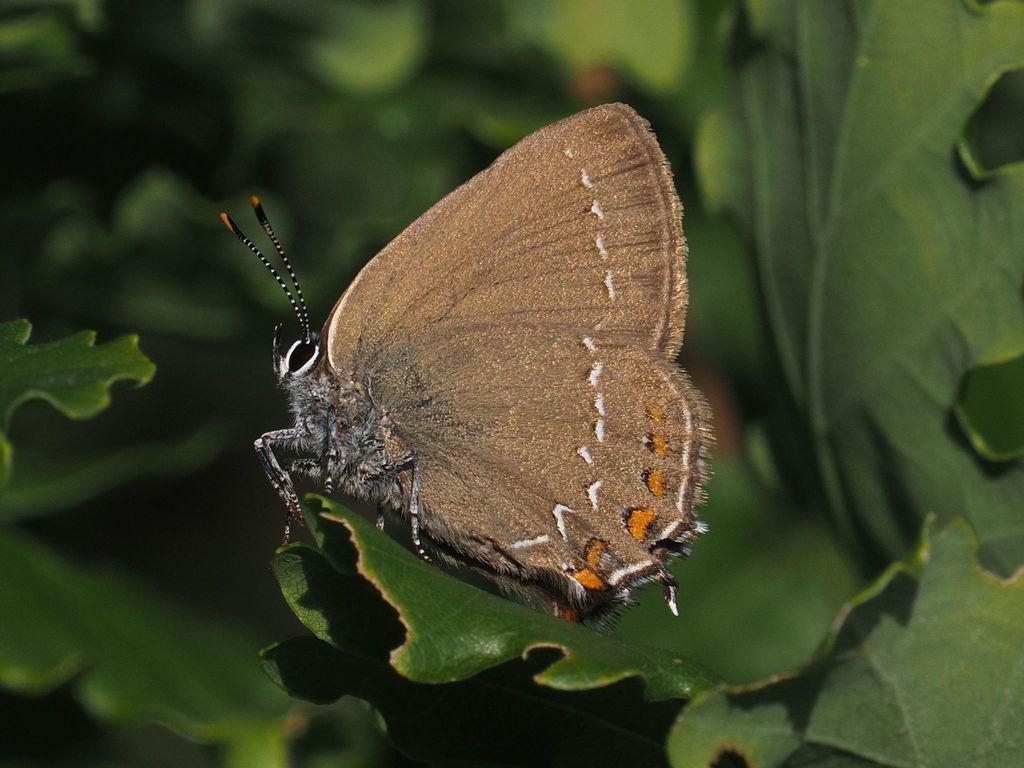
(c) Michael Knapp, some rights reserved (CC BY) · licence
Family: Lycaenidae · Class: Insecta · Order: Lepidoptera
Satyrium fuliginosum (Sooty Hairstreak) is a California animal in the Lycaenidae family.
The Sooty Hairstreak is a small butterfly in the gossamer-winged butterfly family Lycaenidae. Adults have a wingspan of approximately 22 to 30 mm (0.9 to 1.2 inches). The dorsal wing surfaces are dark brown to blackish, giving the species its common name. Males typically display a darker, more uniform coloration than females. The ventral wing surfaces are lighter gray-brown with a series of small white-ringed black spots along the hindwing margins. A distinctive feature is the presence of short, hair-like tails on the hindwings, characteristic of hairstreak butterflies. The wings may show a subtle iridescent quality under direct sunlight. The Sooty Hairstreak occurs from British Columbia south to central California, extending eastward to Wyoming and northern Colorado. Within California, populations are documented in the Sierra Nevada, Cascade Range, and northern coastal mountains. The species distribution is described as local within its overall range, indicating patchy occurrence rather than continuous populations across suitable habitat. This species inhabits mountain meadows, forest openings, and slopes where its host plants occur, typically at elevations from 1,200 to 3,000 meters (4,000 to 10,000 feet). Sooty Hairstreaks are closely associated with areas supporting various lupine species in the pea family. Preferred habitats include subalpine and montane zones with scattered lupine patches, often in proximity to coniferous forests of pine, fir, and spruce. Sooty Hairstreaks have an obligate relationship with lupines as larval host plants. Females deposit eggs singly on lupine flower buds and developing seed pods. Larvae feed within the developing seeds, completing their development before pupating in the soil or leaf litter nearby. Adults typically emerge from late June through August, with peak flight periods varying by elevation and local climate conditions. Males establish territories near lupine patches and engage in aerial courtship displays. Adults nectar on various wildflowers including buckwheat, rabbitbrush, and occasionally on their lupine host plants. The species appears to have a single generation per year in most locations, though this may vary with elevation and latitude. Eggs likely overwinter, hatching the following spring when lupine growth resumes. The close association with lupines makes populations vulnerable to habitat changes that affect these plants, including grazing pressure, invasive plant species, and altered fire regimes. Currently, the Sooty Hairstreak does not appear on federal or California state endangered species lists. However, like many specialist butterflies dependent on specific host plants, populations may face localized threats from habitat modification, recreational activities in mountain areas, and climate change effects on montane ecosystems. The patchy distribution noted for this species suggests that individual populations may be relatively small and potentially vulnerable to local disturbances. Conservation of lupine-rich montane meadows and forest openings would benefit this species and associated butterfly fauna.
Classification
Class: Insecta · Order: Lepidoptera · Family: Lycaenidae
Frequently asked questions
How is Satyrium fuliginosum classified?
Satyrium fuliginosum belongs to class Insecta, order Lepidoptera, family Lycaenidae.
What family does Satyrium fuliginosum belong to?
Satyrium fuliginosum is in the Lycaenidae family.
What is Satyrium fuliginosum?
The Sooty Hairstreak is a small butterfly in the gossamer-winged butterfly family Lycaenidae.
Is Satyrium fuliginosum found in California?
Yes. Satyrium fuliginosum is recorded in California in The California Species Project's catalogue.
Related species
Other California species in the same genus, family, or bioregion.
Data from The California Species Project — 14,000+ California species with verified data from CNPS, CDFW, USFWS, and more.