Satyrium saepium
Hedgerow Hairstreak
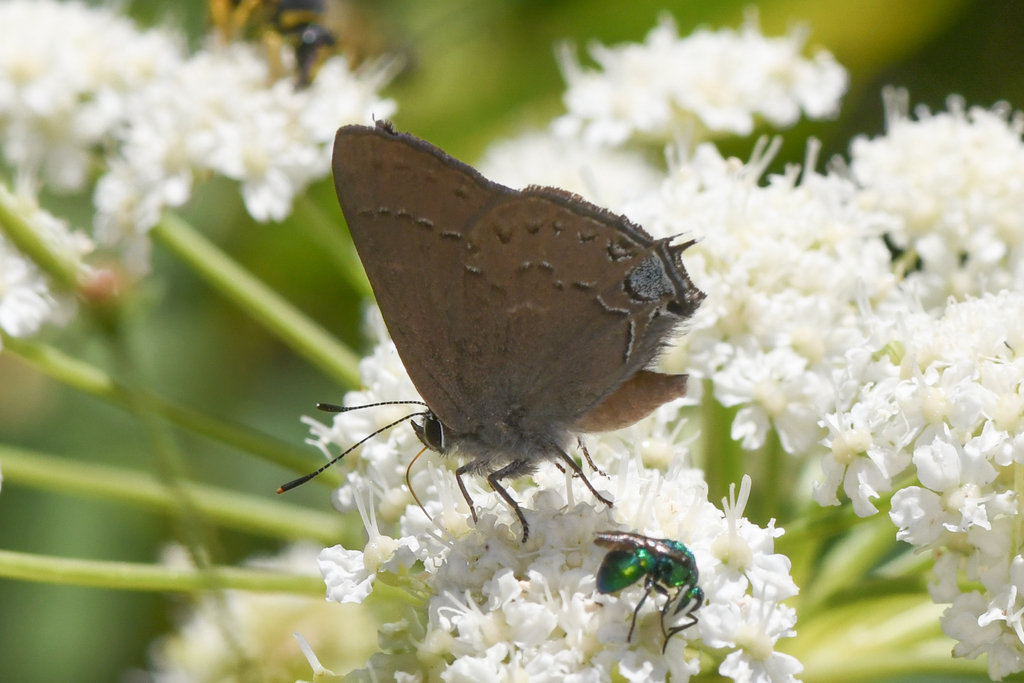
(c) Trevor Van Loon, some rights reserved (CC BY) · licence
Family: Lycaenidae · Class: Insecta · Order: Lepidoptera
Satyrium saepium (Hedgerow Hairstreak) is a California animal in the Lycaenidae family.
The Hedgerow Hairstreak is a small butterfly endemic to western North America, characterized by subtle brown and gray wing patterns typical of the hairstreak family. Adults measure 25 to 30 mm (1.0 to 1.2 inches) in wingspan. The dorsal wing surfaces are dark brown to gray-brown, while the ventral surfaces display a complex pattern of white-edged gray and brown bands. Males possess a distinctive scent patch (androconial patch) on the forewings. The hindwings feature characteristic hairstreak tails and small orange and blue eyespots near the wing margins, which serve to misdirect predator attacks away from vital body parts. The Hedgerow Hairstreak ranges from British Columbia south through California into Baja California, extending eastward through northern Arizona to northern New Mexico, Colorado, and Montana. In California, the species occurs throughout much of the state where suitable host plants are present, from sea level to approximately 2,500 meters (8,200 feet) elevation. Populations are documented from the Pacific Coast ranges, Sierra Nevada, and desert mountain ranges. This species inhabits chaparral, oak woodlands, riparian areas, and mixed coniferous forests where Ceanothus species occur. The butterfly shows a strong association with edges and openings in woodland habitats, including roadsides, trails, and natural clearings. Adults are most commonly observed along hedgerows and shrubland borders where host plants grow in sunny to partially shaded locations. The species demonstrates preference for areas with moderate moisture levels and protection from strong winds. Hedgerow Hairstreaks are univoltine, producing one generation annually. Adults typically fly from late April through July, with peak activity in May and June. Males establish territories on or near host plants, engaging in aerial courtship displays and defending prime mating sites from other males. Females lay single eggs on young Ceanothus shoots and flower buds. Larvae are green with white lateral stripes and feed exclusively on Ceanothus species in the buckthorn family (Rhamnaceae), including buckbrush, deerbrush, and mountain lilac species. Caterpillars are tended by ants, which provide protection in exchange for honeydew secretions. Pupation occurs in leaf litter near the host plant, with pupae overwintering until adult emergence the following spring. The Hedgerow Hairstreak lacks formal conservation listing status at federal or state levels. However, local populations may face pressure from habitat loss due to urban development, fire suppression altering natural disturbance regimes, and invasive plant species displacing native Ceanothus. Climate change potentially affects the species through altered precipitation patterns impacting host plant distribution and phenology. The butterfly's dependence on specific host plants makes it vulnerable to changes in chaparral and woodland ecosystems. Conservation efforts focus on maintaining diverse native plant communities and preserving habitat connectivity across the species' range.
Classification
Class: Insecta · Order: Lepidoptera · Family: Lycaenidae
Frequently asked questions
How is Satyrium saepium classified?
Satyrium saepium belongs to class Insecta, order Lepidoptera, family Lycaenidae.
What family does Satyrium saepium belong to?
Satyrium saepium is in the Lycaenidae family.
What is Satyrium saepium?
The Hedgerow Hairstreak is a small butterfly endemic to western North America, characterized by subtle brown and gray wing patterns typical of the hairstreak family.
Is Satyrium saepium found in California?
Yes. Satyrium saepium is recorded in California in The California Species Project's catalogue.
Related species
Other California species in the same genus, family, or bioregion.
Data from The California Species Project — 14,000+ California species with verified data from CNPS, CDFW, USFWS, and more.