Satyrium tetra
Mountain Mahogany Hairstreak
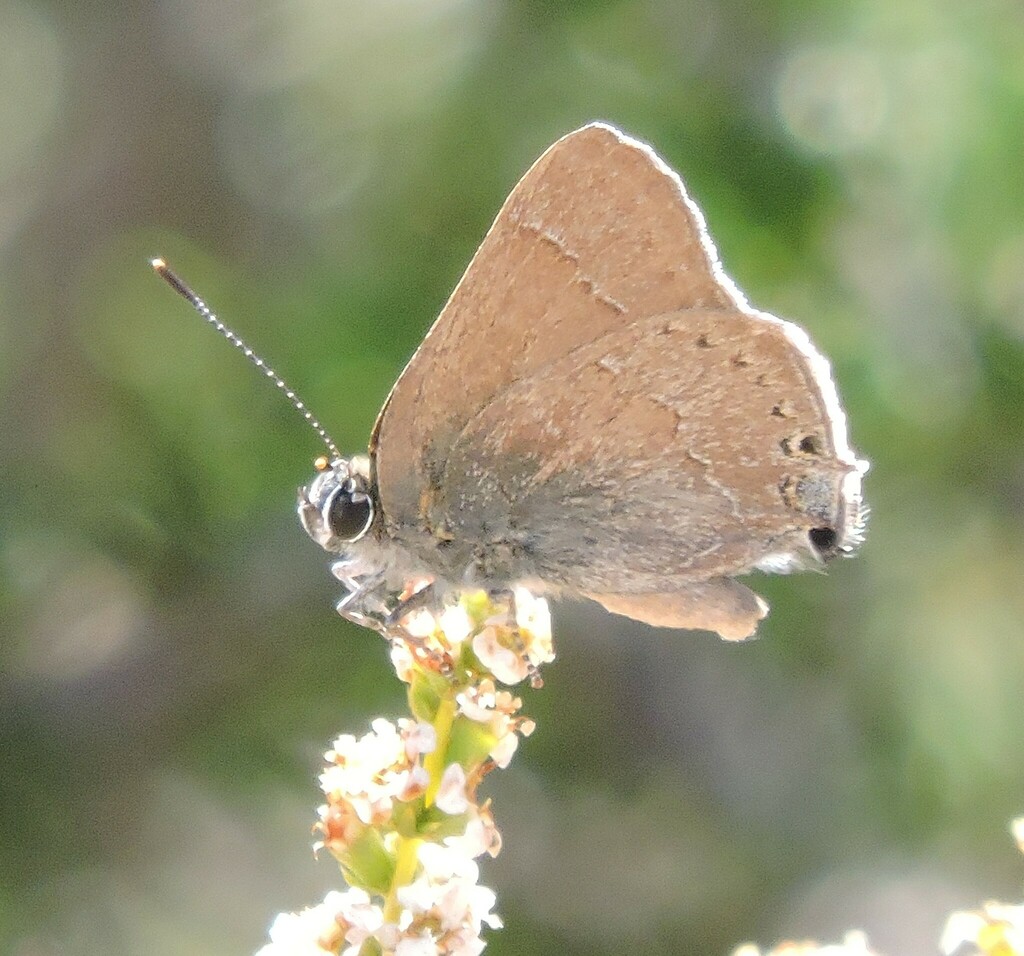
(c) Alex, some rights reserved (CC BY) · licence
Family: Lycaenidae · Class: Insecta · Order: Lepidoptera
Satyrium tetra (Mountain Mahogany Hairstreak) is a California animal in the Lycaenidae family.
The Mountain Mahogany Hairstreak (Satyrium tetra) is a small butterfly in the family Lycaenidae, characterized by the distinctive hair-like tail projections on the hindwings that give hairstreaks their common name. Adults have a wingspan of approximately 25 to 30 mm (1.0 to 1.2 inches). The dorsal wing surfaces are typically gray-brown, while the ventral surfaces display a complex pattern of gray, white, and orange markings with metallic blue spots near the tail projections. Males possess specialized scent patches on their forewings used in courtship behavior. This species occurs in southern Oregon and California west of the deserts through San Diego County, extending into Baja California Norte, Mexico. The range also includes the Carson Range of western Nevada. Within California, populations are documented from the Sierra Nevada, Coast Ranges, and Transverse Ranges, typically at elevations between 1,000 and 2,500 meters (3,300 to 8,200 feet). Mountain Mahogany Hairstreaks inhabit areas where their obligate host plant, mountain-mahogany (Cercocarpus montanus), occurs naturally. This shrub species grows in dry, rocky slopes and canyon walls in chaparral, pinyon-juniper woodland, and montane shrubland communities. The butterflies are closely associated with mature stands of mountain-mahogany that provide both larval food sources and adult nectar resources. Adults are active from late spring through early fall, with peak flight periods typically occurring from May through August depending on elevation and local climate conditions. Males establish territories near host plants and engage in perching behavior, defending suitable egg-laying sites from other males. Females deposit eggs singly on young shoots and leaves of mountain-mahogany. The larvae feed exclusively on the host plant, developing through five instars before pupating in leaf litter or soil beneath the shrubs. The species likely overwinters as eggs or early-instar larvae, completing development the following spring. Mountain Mahogany Hairstreaks demonstrate a close ecological relationship with their host plant, with population distributions closely tracking the occurrence of healthy mountain-mahogany stands. Adults obtain nectar from various flowering plants including buckwheats (Eriogonum species), rabbitbrush (Ericameria species), and the flowers of their host plant. The conservation status of this species has not been formally assessed at federal or state levels. However, habitat quality and availability may be affected by factors including wildfire frequency and intensity, grazing pressure, and climate change impacts on montane shrubland communities. The species' dependence on a single host plant makes populations potentially vulnerable to factors that negatively impact mountain-mahogany stands, such as prolonged drought or altered fire regimes that prevent shrub regeneration.
Classification
Class: Insecta · Order: Lepidoptera · Family: Lycaenidae
Frequently asked questions
How is Satyrium tetra classified?
Satyrium tetra belongs to class Insecta, order Lepidoptera, family Lycaenidae.
What family does Satyrium tetra belong to?
Satyrium tetra is in the Lycaenidae family.
What is Satyrium tetra?
The Mountain Mahogany Hairstreak (Satyrium tetra) is a small butterfly in the family Lycaenidae, characterized by the distinctive hair-like tail projections on the hindwings that give hairstreaks their common name.
Is Satyrium tetra found in California?
Yes. Satyrium tetra is recorded in California in The California Species Project's catalogue.
Related species
Other California species in the same genus, family, or bioregion.
Data from The California Species Project — 14,000+ California species with verified data from CNPS, CDFW, USFWS, and more.