Satyrium titus
Coral Hairstreak
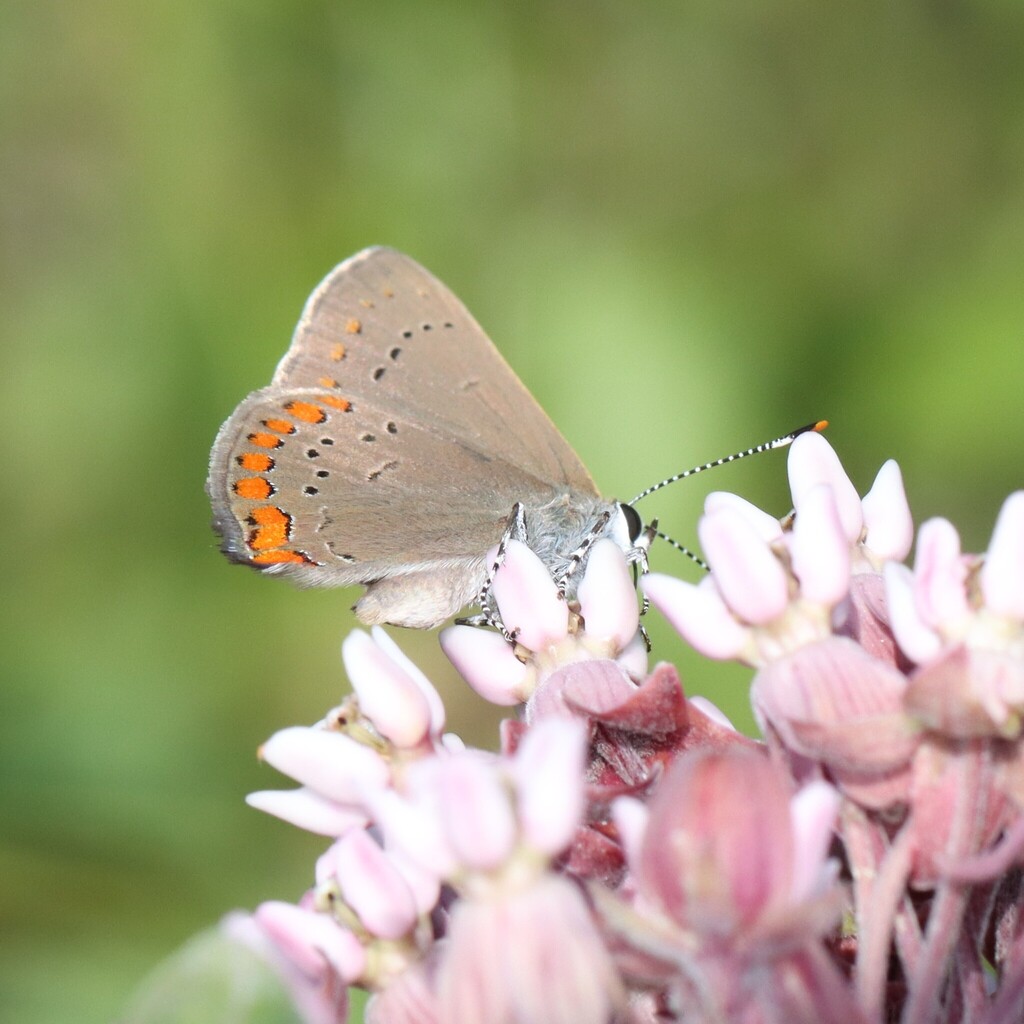
(c) Jake McCumber, some rights reserved (CC BY) · licence
Family: Lycaenidae · Class: Insecta · Order: Lepidoptera
Satyrium titus (Coral Hairstreak) is a California animal in the Lycaenidae family.
The Coral Hairstreak is a small butterfly in the family Lycaenidae, with adults measuring 25 to 32 mm (1.0 to 1.3 inches) in wingspan. The dorsal wing surfaces are dark brown to black without blue iridescence, distinguishing it from many related hairstreak species. The ventral hindwings display the species' diagnostic feature: a row of coral-red to orange-red spots along the outer margin, typically numbering seven to nine spots. These coral spots are bordered inwardly by a white line and may have small black centers. The ventral forewings are grayish-brown with faint postmedial markings. Unlike many hairstreaks, this species lacks hindwing tails, giving the wings a rounded appearance. Males and females are similar in size and coloration, though females may be slightly larger. The Coral Hairstreak ranges from central Canada south to eastern California, extending east across southern Canada to New England, and south to central New Mexico, central Texas, northern Arkansas, and central Georgia. In California, populations occur primarily in the northern and central regions, including the Sierra Nevada foothills and some coastal mountain ranges. The species reaches its western range limit in California, making these populations particularly significant for the species' overall distribution. This butterfly inhabits areas where its host plants occur, including woodland edges, clearings, abandoned fields, and riparian areas. Coral Hairstreaks are typically found at elevations from sea level to approximately 2,100 meters (6,900 feet) in mountainous regions. The species prefers partially open habitats with scattered shrubs and trees rather than dense forest canopy. Adults are often observed on hilltops and ridges, engaging in territorial behavior and mate-seeking activities. Coral Hairstreaks are obligate specialists on Prunus species in the rose family, including wild cherry, wild plum, and chokecherry. Females deposit eggs singly on or near the host plant in late summer, typically on twigs or bark crevices. Eggs overwinter and hatch the following spring when new growth appears. Larvae feed on young leaves and flowers, developing through five instars before pupating in leaf litter or soil. Adults emerge in mid to late summer, typically from July through August, with flight period varying by latitude and elevation. Males establish territories on hilltops and patrol for females. Adults feed on nectar from various flowering plants, including dogbane, milkweed, and sumac. The species is univoltine, producing one generation annually. The Coral Hairstreak is not federally listed and appears to maintain stable populations across much of its range. However, habitat loss and fragmentation pose ongoing threats, particularly in developed areas where host plants are removed. Fire suppression and forest management practices that eliminate the open woodland habitats preferred by this species may contribute to local population declines. Conservation efforts focus on maintaining diverse woodland ecosystems and preserving native Prunus populations. Climate change may affect the species' distribution, particularly at range margins where suitable habitat could become limited.
Classification
Class: Insecta · Order: Lepidoptera · Family: Lycaenidae
Frequently asked questions
How is Satyrium titus classified?
Satyrium titus belongs to class Insecta, order Lepidoptera, family Lycaenidae.
What family does Satyrium titus belong to?
Satyrium titus is in the Lycaenidae family.
What is Satyrium titus?
The Coral Hairstreak is a small butterfly in the family Lycaenidae, with adults measuring 25 to 32 mm (1.0 to 1.3 inches) in wingspan.
Is Satyrium titus found in California?
Yes. Satyrium titus is recorded in California in The California Species Project's catalogue.
Related species
Other California species in the same genus, family, or bioregion.
Data from The California Species Project — 14,000+ California species with verified data from CNPS, CDFW, USFWS, and more.