Saxicola torquatus
Stonechat
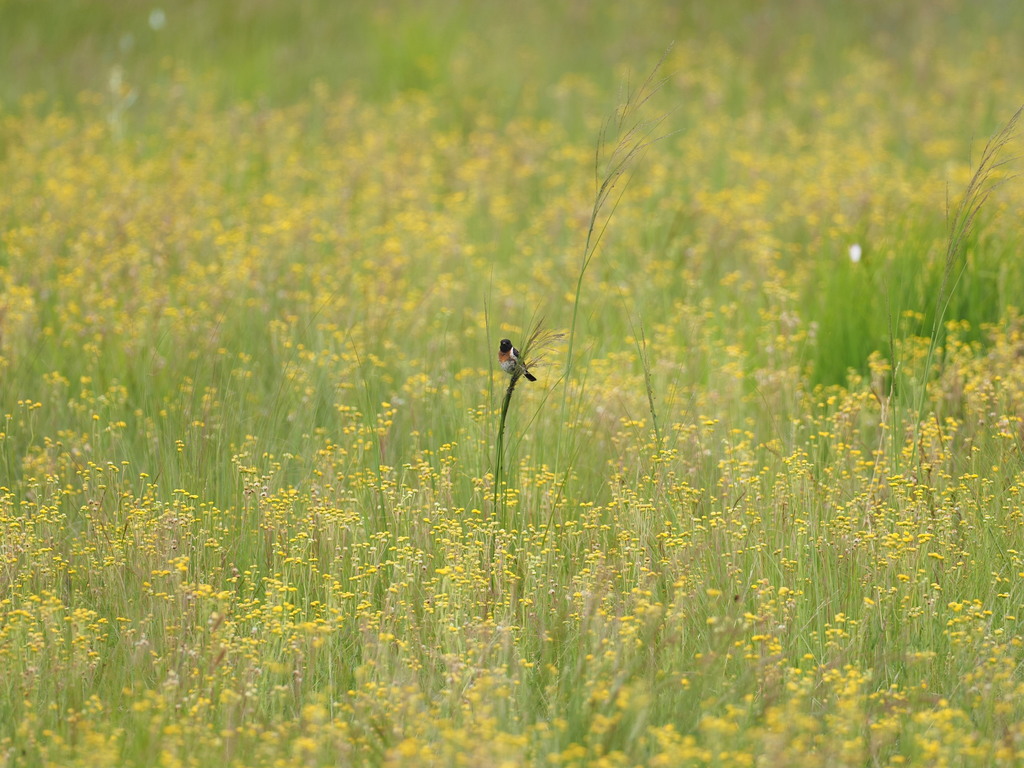
(c) Peter Archdale, some rights reserved (CC BY) · licence
Family: Muscicapidae · Class: Aves · Order: Passeriformes
Saxicola torquatus (Stonechat) is a California animal in the Muscicapidae family.
The Stonechat is a small, compact passerine bird measuring 12 to 14 centimeters (4.7 to 5.5 inches) in length with a wingspan of 18 to 21 centimeters (7.1 to 8.3 inches). Males in breeding plumage display a distinctive black head and throat contrasting sharply with white collar patches on the sides of the neck. The back is dark brown to black with white patches on the wings and rump. The breast and belly are bright orange-rufous, fading to pale buff on the lower belly. Females are more subdued, with brown-streaked upperparts, a pale buff throat, and orange-buff underparts. Both sexes have dark legs and a straight, pointed black bill typical of insectivorous birds. The Stonechat has a nearly cosmopolitan distribution, occurring across Europe, Asia, Africa, and parts of the Pacific. In North America, the species is considered a vagrant, with documented records primarily from Alaska and the western United States. California records are extremely rare, with fewer than ten documented occurrences, primarily along the coast and offshore islands during fall and winter months. Most North American records likely represent birds of the subspecies S. t. stejnegeri from eastern Asia. Stonechats typically inhabit open grasslands, moorland, heathland, and coastal areas with scattered perches such as fence posts, shrubs, or tall herbaceous plants. The species favors areas with short grass for foraging combined with elevated perches for hunting and territorial displays. In their native range, they occur from sea level to elevations exceeding 4,000 meters (13,100 feet) in mountainous regions. During migration and winter, they may utilize agricultural areas, golf courses, and other human-modified habitats that provide suitable foraging opportunities. Stonechats are primarily insectivorous, feeding on beetles, flies, caterpillars, spiders, and other small arthropods. They employ a sit-and-wait hunting strategy, perching conspicuously on elevated positions and making short flights to capture prey on the ground or in vegetation. The species also consumes seeds and berries, particularly during winter months. Breeding occurs from April through August in their native range, with pairs producing two to three broods per season. Females construct cup-shaped nests in dense vegetation, typically laying four to six pale blue eggs with fine reddish-brown spots. Incubation lasts 13 to 14 days, and fledglings leave the nest after 12 to 16 days. The Stonechat is not listed under federal or California state endangered species regulations, as it is not considered a resident breeding species in North America. The species is classified as Least Concern globally by the International Union for Conservation of Nature, with stable populations across most of its range. In California, Stonechats are considered accidental visitors, likely reaching the state through natural vagrancy during migration or weather-related displacement events. Climate change and shifting weather patterns may influence the frequency of such vagrant occurrences in the future.
Classification
Class: Aves · Order: Passeriformes · Family: Muscicapidae
Frequently asked questions
How is Saxicola torquatus classified?
Saxicola torquatus belongs to class Aves, order Passeriformes, family Muscicapidae.
What family does Saxicola torquatus belong to?
Saxicola torquatus is in the Muscicapidae family.
What is Saxicola torquatus?
The Stonechat is a small, compact passerine bird measuring 12 to 14 centimeters (4.7 to 5.5 inches) in length with a wingspan of 18 to 21 centimeters (7.1 to 8.3 inches).
Is Saxicola torquatus found in California?
Yes. Saxicola torquatus is recorded in California in The California Species Project's catalogue.
Related species
Other California species in the same genus, family, or bioregion.
Data from The California Species Project — 14,000+ California species with verified data from CNPS, CDFW, USFWS, and more.