Sayornis nigricans
Black Phoebe
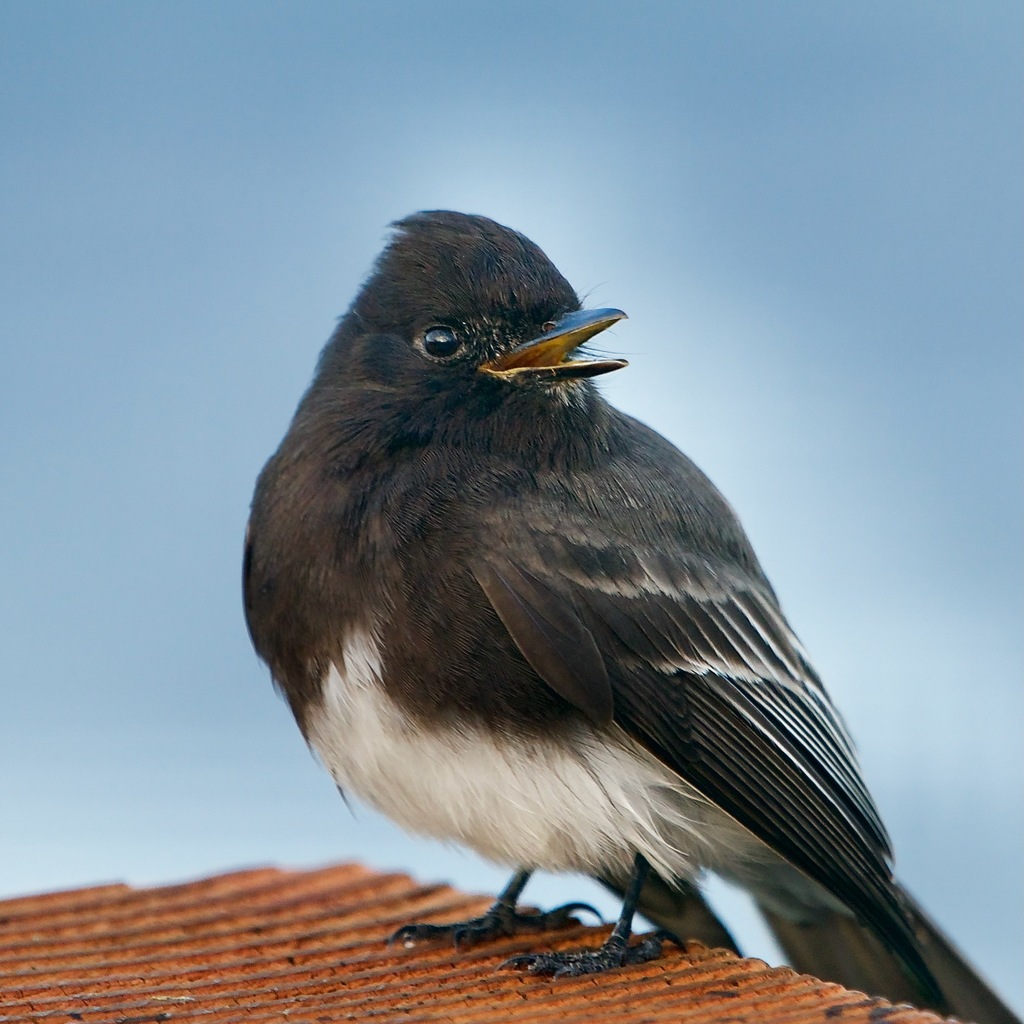
(c) Bill Levine, some rights reserved (CC BY) · licence
Family: Tyrannidae · Class: Aves · Order: Passeriformes
Sayornis nigricans (Black Phoebe) is a California animal in the Tyrannidae family.
The Black Phoebe is a medium-sized flycatcher measuring 16 to 18 cm (6.3 to 7.1 inches) in length with a wingspan of 26 to 28 cm (10.2 to 11.0 inches). The species exhibits distinct sexual monomorphism, with both males and females displaying identical plumage patterns. The head, throat, breast, back, wings, and tail are deep black, contrasting sharply with the white belly and undertail coverts. The bill is straight, black, and slightly hooked at the tip, adapted for aerial insectivory. Juveniles show brownish-black upperparts with cinnamon wing bars and buff-colored underparts. Black Phoebes range from southwestern Oregon through California, Nevada, Arizona, New Mexico, and Texas, extending south through Mexico to northern Argentina. In California, the species is a permanent resident throughout most of the state, from sea level to elevations of 2,100 meters (6,900 feet). They are found in all bioregions except the high Sierra Nevada and are most abundant in coastal and central valley areas. The species has expanded its range northward over the past century, with populations now established in the Pacific Northwest. The species inhabits areas near water sources, including streams, rivers, ponds, lakes, irrigation ditches, and coastal areas. Black Phoebes prefer open woodlands, riparian corridors, parks, residential areas with water features, and agricultural lands. They require nearby water for drinking and foraging, as aquatic insects comprise a significant portion of their diet. Nesting sites are typically located on human-made structures such as bridges, buildings, culverts, and cliff faces, always within 100 meters of water. Black Phoebes are sit-and-wait predators, hunting from exposed perches 1 to 6 meters above ground. They capture insects through aerial sallies, returning to the same or nearby perches. Their diet consists primarily of flying insects including flies, beetles, moths, flying ants, and mosquitoes. During winter months, they supplement their diet with small berries and seeds. The species exhibits strong site fidelity, with pairs often returning to the same territory and nest sites annually. Breeding occurs from February through August, with peak activity from March to July. Females construct cup-shaped nests using mud pellets mixed with plant fibers, moss, and hair, typically attached to vertical surfaces under overhangs. Clutch size ranges from 3 to 6 eggs, with an average of 4. Incubation lasts 15 to 17 days, performed exclusively by females. Nestlings fledge after 14 to 21 days, and pairs may raise 2 to 3 broods per season in favorable conditions. The Black Phoebe is not federally or state listed and maintains stable populations throughout its range. According to North American Breeding Bird Survey data, populations have increased by approximately 1.5% annually since 1966. The species has benefited from human development, which provides nesting structures and water sources. Climate change may affect future distributions, particularly at higher elevations and desert margins where water availability is limited.
Classification
Class: Aves · Order: Passeriformes · Family: Tyrannidae
Frequently asked questions
How is Sayornis nigricans classified?
Sayornis nigricans belongs to class Aves, order Passeriformes, family Tyrannidae.
What family does Sayornis nigricans belong to?
Sayornis nigricans is in the Tyrannidae family.
What is Sayornis nigricans?
The Black Phoebe is a medium-sized flycatcher measuring 16 to 18 cm (6.3 to 7.1 inches) in length with a wingspan of 26 to 28 cm (10.2 to 11.0 inches).
Is Sayornis nigricans found in California?
Yes. Sayornis nigricans is recorded in California in The California Species Project's catalogue.
Related species
Other California species in the same genus, family, or bioregion.
Data from The California Species Project — 14,000+ California species with verified data from CNPS, CDFW, USFWS, and more.