Sayornis saya
Say's Phoebe
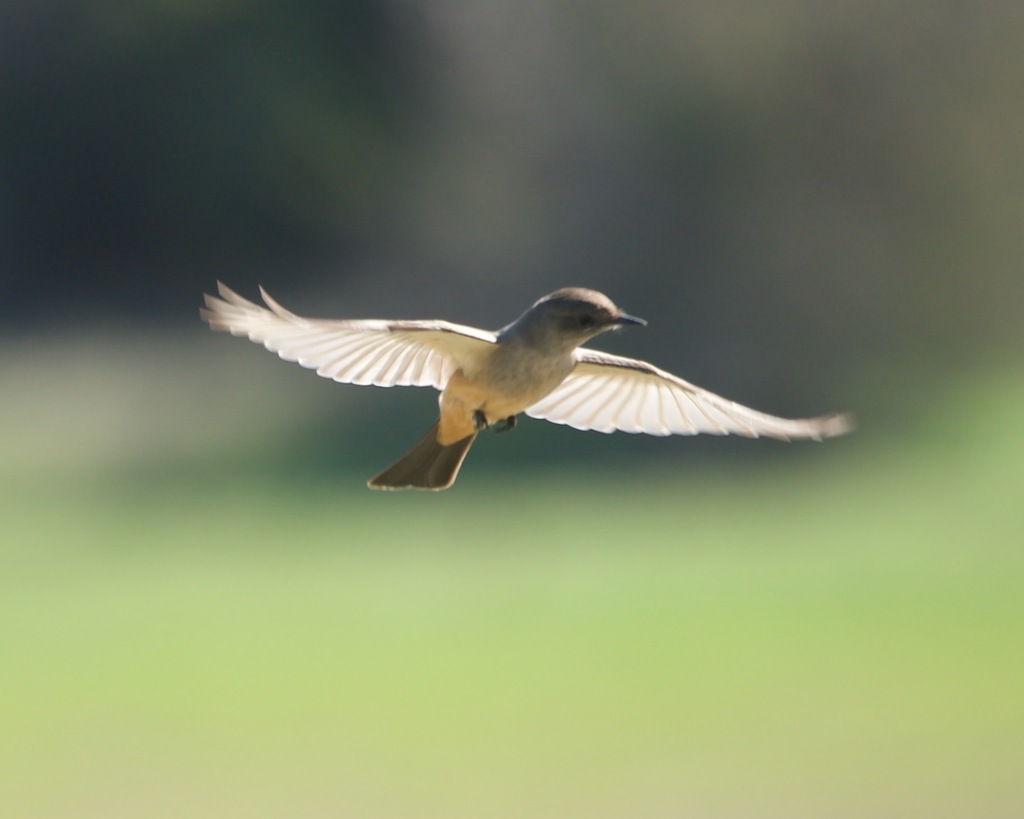
(c) Bill Levine, some rights reserved (CC BY) · licence
Family: Tyrannidae · Class: Aves · Order: Passeriformes
Sayornis saya (Say's Phoebe) is a California animal in the Tyrannidae family.
Say's Phoebe is a medium-sized flycatcher measuring 18 to 20 cm (7.1 to 7.9 inches) in length with a wingspan of 33 cm (13 inches). Adults weigh 19 to 24 grams. The species displays subtle but distinctive plumage with grayish-brown upperparts and pale buff to cinnamon underparts. The head and back are brownish-gray, contrasting with the lighter throat and breast. The tail is dark with white outer edges, and the bill is black and relatively broad, typical of aerial insectivores. Juveniles resemble adults but show more rufous wing bars and slightly brighter underpart coloration. Say's Phoebe has the largest breeding range of any phoebe species, extending from central British Columbia and Alberta south through the western United States to central Mexico. In California, the species breeds throughout much of the state except for the Central Valley and coastal regions north of San Francisco Bay. The breeding range includes the Cascade Range, Sierra Nevada, Coast Ranges, Transverse Ranges, and Peninsular Ranges. Populations are year-round residents in southern California but migrate to Mexico and the southwestern United States from northern breeding areas. This species inhabits open, semi-arid country with scattered perches for hunting. Typical breeding habitats include pinyon-juniper woodlands, oak savannas, chaparral edges, desert scrub, and riparian areas. Say's Phoebe occurs from sea level to 3,050 meters (10,000 feet) elevation but is most common between 1,200 and 2,400 meters (4,000 to 8,000 feet). The species adapts well to human-modified landscapes, frequently nesting on buildings, bridges, and other artificial structures in rural and suburban areas. Say's Phoebe is an aerial insectivore that hunts from exposed perches, making short flights to capture flying insects before returning to the same or nearby perch. The diet consists primarily of flies, bees, wasps, beetles, moths, and other flying insects. Breeding occurs from March through August, with peak activity in May and June. Females construct cup-shaped nests of plant fibers, hair, and feathers, typically placed on cliff ledges, building eaves, or other horizontal surfaces with overhead protection. Clutch size ranges from three to seven eggs, with an average of four to five. Incubation lasts 12 to 14 days, and nestlings fledge after 14 to 16 days. Pairs commonly produce two broods per season in suitable habitat. Say's Phoebe is not federally or state listed and maintains stable populations across most of its range. The species is classified as Least Concern by the International Union for Conservation of Nature. According to the North American Breeding Bird Survey, populations have remained relatively stable from 1966 to 2019, with slight increases in some regions. However, localized declines may occur due to habitat loss from development and changes in fire regimes that affect preferred open woodland habitats. The species' adaptability to human-modified environments and broad habitat tolerance contribute to its overall population stability.
Classification
Class: Aves · Order: Passeriformes · Family: Tyrannidae
Frequently asked questions
How is Sayornis saya classified?
Sayornis saya belongs to class Aves, order Passeriformes, family Tyrannidae.
What family does Sayornis saya belong to?
Sayornis saya is in the Tyrannidae family.
What is Sayornis saya?
Say's Phoebe is a medium-sized flycatcher measuring 18 to 20 cm (7.1 to 7.9 inches) in length with a wingspan of 33 cm (13 inches).
Is Sayornis saya found in California?
Yes. Sayornis saya is recorded in California in The California Species Project's catalogue.
Related species
Other California species in the same genus, family, or bioregion.
Data from The California Species Project — 14,000+ California species with verified data from CNPS, CDFW, USFWS, and more.