Scaeva affinis
White-bowed Smoothwing
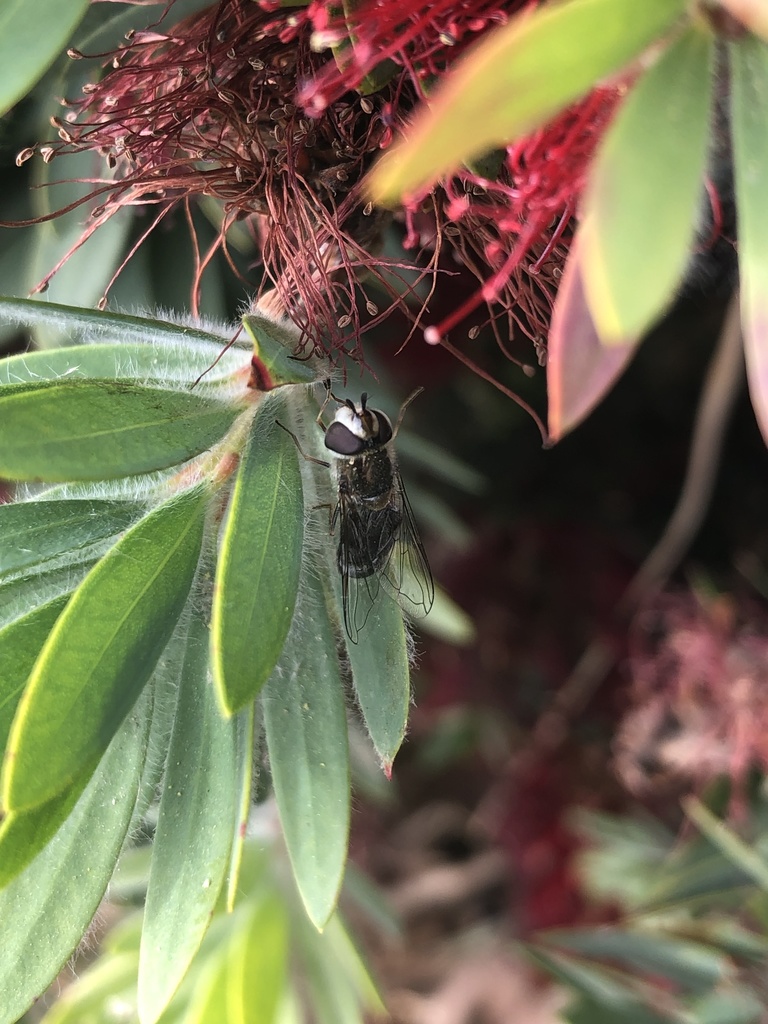
(c) Kyle Elshoff, some rights reserved (CC BY) · licence
Family: Syrphidae · Class: Insecta · Order: Diptera
Scaeva affinis (White-bowed Smoothwing) is a California animal in the Syrphidae family.
The White-bowed Smoothwing (Scaeva affinis) is a hoverfly in the family Syrphidae, characterized by its distinctive yellow and black coloration pattern typical of flower flies. Adults measure approximately 8-12 mm in length with a robust, slightly flattened body. The species displays prominent white or pale yellow markings that form bow-shaped patterns across the dark abdomen, giving rise to its common name. The thorax is typically black with yellow stripes, while the large compound eyes are separated in both sexes, distinguishing it from some closely related Scaeva species. Scaeva affinis has a broad distribution across North America, including California, where it occurs throughout much of the state from coastal areas to inland valleys and foothills. The species extends northward through Oregon and Washington, eastward across the continental United States, and into southern Canada. In California, records exist from sea level to moderate elevations, typically below 2,000 meters. This species inhabits diverse environments including gardens, parks, agricultural areas, meadows, and forest edges. Adults are commonly found in areas with abundant flowering plants, particularly favoring composite flowers, umbellifers, and other nectar sources. The species shows a preference for open or semi-open habitats with mixed vegetation that provides both nectar resources for adults and suitable sites for larval development. Adult White-bowed Smoothwings are active fliers and accomplished hoverers, feeding primarily on nectar and pollen from various flowering plants. They serve as important pollinators for numerous plant species. Females lay eggs singly near aphid colonies, as larvae are predaceous and feed voraciously on soft-bodied insects including aphids, scale insects, and other small arthropods. This predatory behavior makes them valuable biological control agents in agricultural and garden settings. The species typically has multiple generations per year in California, with peak adult activity occurring from late spring through early fall. Adults may be observed basking in sunny locations during cooler parts of the day. Scaeva affinis is not federally or state listed and appears to maintain stable populations throughout its range as of December 2025. The species benefits from its adaptability to human-modified environments and its association with common flowering plants. Urban and suburban landscaping that includes diverse flowering plants supports local populations. Climate change may affect the species' distribution and phenology, though its broad habitat tolerance suggests resilience to moderate environmental changes. Conservation of pollinator habitat through maintenance of flowering plant diversity in agricultural and urban areas supports this species along with other beneficial insects. The species faces typical threats associated with habitat modification, pesticide use, and landscape simplification, but its widespread distribution and ecological flexibility appear to buffer against significant population declines.
Classification
Class: Insecta · Order: Diptera · Family: Syrphidae
Frequently asked questions
How is Scaeva affinis classified?
Scaeva affinis belongs to class Insecta, order Diptera, family Syrphidae.
What family does Scaeva affinis belong to?
Scaeva affinis is in the Syrphidae family.
What is Scaeva affinis?
The White-bowed Smoothwing (Scaeva affinis) is a hoverfly in the family Syrphidae, characterized by its distinctive yellow and black coloration pattern typical of flower flies.
Is Scaeva affinis found in California?
Yes. Scaeva affinis is recorded in California in The California Species Project's catalogue.
Related species
Other California species in the same genus, family, or bioregion.
Data from The California Species Project — 14,000+ California species with verified data from CNPS, CDFW, USFWS, and more.