Scapanus latimanus
Broad-footed Mole
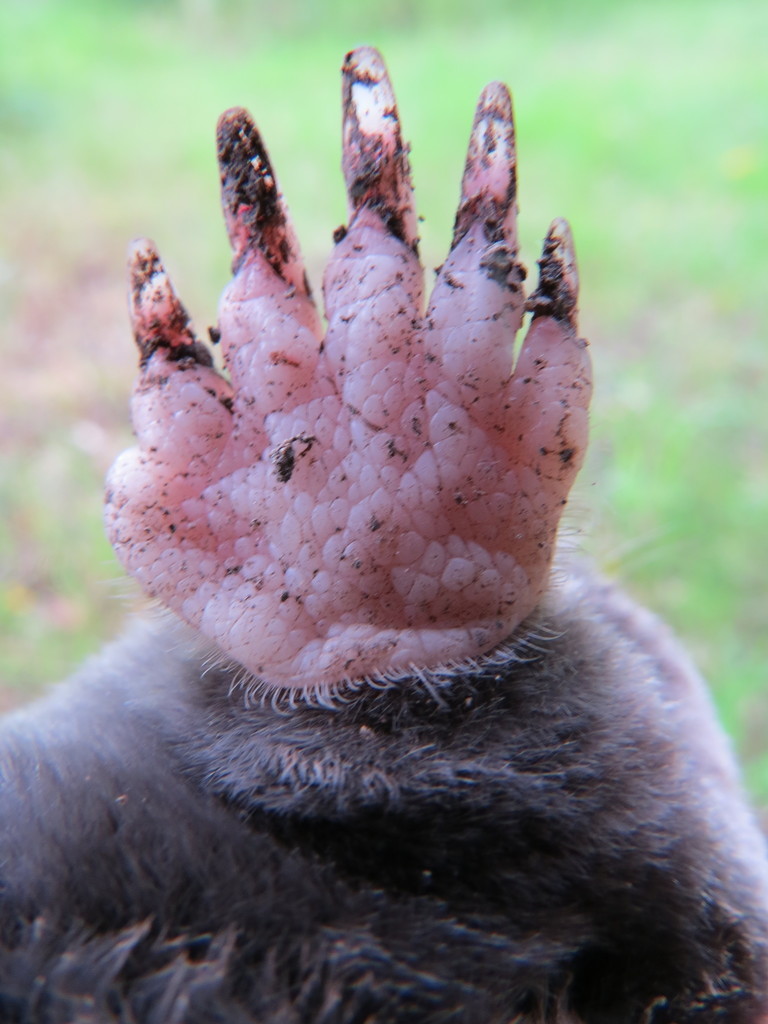
(c) Garth Harwood, some rights reserved (CC BY) · licence
Family: Talpidae · Class: Mammalia · Order: Eulipotyphla
Scapanus latimanus (Broad-footed Mole) is a California animal in the Talpidae family.
The broad-footed mole is a medium-sized fossorial mammal endemic to the western United States. Adults measure 140 to 180 mm (5.5 to 7.1 inches) in total length, with a tail length of 25 to 45 mm (1.0 to 1.8 inches). Body mass ranges from 45 to 85 grams (1.6 to 3.0 ounces). The species is characterized by its velvety, dark gray to black fur that lies flat in any direction, facilitating movement through underground tunnels. The forefeet are notably broad and powerful, equipped with large claws adapted for digging. Eyes are minute and concealed by fur, while external ears are absent. The elongated, flexible snout extends beyond the mouth and is highly sensitive to tactile stimuli. The broad-footed mole occurs along the Pacific Coast from southwestern British Columbia through California to Baja California, Mexico. In California, the species is distributed primarily west of the Sierra Nevada crest, from the Oregon border south to the Mexican border. Populations are documented in the Coast Ranges, Central Valley foothills, and Transverse and Peninsular Ranges. The species is absent from the Mojave and Sonoran deserts and high-elevation alpine zones. This species inhabits areas with loose, well-drained soils that facilitate tunnel construction. Preferred habitats include oak woodlands, mixed coniferous forests, grasslands, and agricultural areas with friable soil. The species occurs from sea level to approximately 2,100 meters (6,900 feet) elevation. Broad-footed moles avoid clay soils, rocky substrates, and areas with high water tables that would flood tunnel systems. They construct extensive burrow networks consisting of shallow foraging tunnels 5 to 10 cm below the surface and deeper permanent tunnels up to 60 cm underground. Broad-footed moles are insectivorous, consuming primarily earthworms, beetle larvae, and other soil invertebrates. Daily food consumption equals 70 to 100 percent of body weight due to high metabolic demands. The species is active year-round, with peak activity occurring during dawn and dusk hours. Breeding takes place from February through April, with females producing a single annual litter of 2 to 5 young after a gestation period of approximately 4 to 6 weeks. Young are weaned at 4 to 5 weeks and reach sexual maturity at 10 to 12 months. The broad-footed mole is not federally or state listed and maintains stable populations throughout most of its range. However, localized declines have occurred in urbanized areas due to habitat conversion and soil compaction. Agricultural practices that maintain loose soil structure generally benefit the species, while intensive development and hardscape installation eliminate suitable habitat. Climate change may affect the species through altered precipitation patterns that influence soil moisture and prey availability. No specific conservation measures are currently in place, though habitat preservation in undeveloped areas supports population maintenance.
Classification
Class: Mammalia · Order: Eulipotyphla · Family: Talpidae
Frequently asked questions
How is Scapanus latimanus classified?
Scapanus latimanus belongs to class Mammalia, order Eulipotyphla, family Talpidae.
What family does Scapanus latimanus belong to?
Scapanus latimanus is in the Talpidae family.
What is Scapanus latimanus?
The broad-footed mole is a medium-sized fossorial mammal endemic to the western United States.
Is Scapanus latimanus found in California?
Yes. Scapanus latimanus is recorded in California in The California Species Project's catalogue.
Related species
Other California species in the same genus, family, or bioregion.
Data from The California Species Project — 14,000+ California species with verified data from CNPS, CDFW, USFWS, and more.