Scathophaga stercoraria
Golden Dung Fly
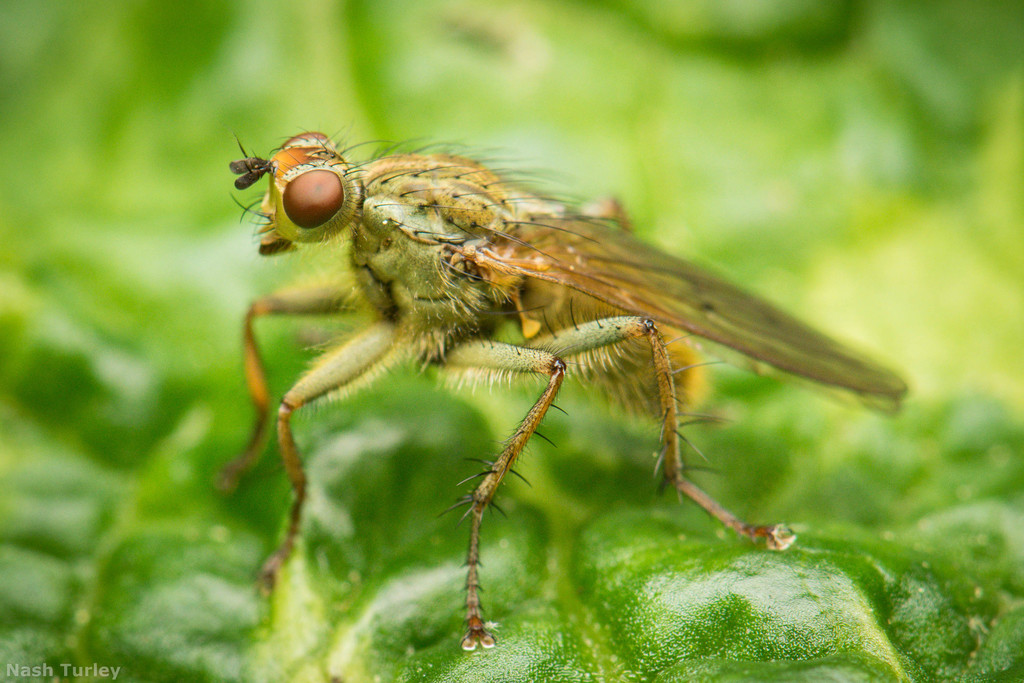
(c) Nash Turley, some rights reserved (CC BY) · licence
Family: Scathophagidae · Class: Insecta · Order: Diptera
Scathophaga stercoraria (Golden Dung Fly) is a California animal in the Scathophagidae family.
The Golden Dung Fly (Scathophaga stercoraria) is a robust dipteran species in the family Scathophagidae, characterized by its distinctive golden-yellow coloration. Males typically measure 6-11 mm in length and display bright golden-yellow fur covering their bodies, while females are slightly larger at 8-12 mm and exhibit duller brownish-yellow coloration. The species possesses prominent compound eyes, well-developed legs adapted for rapid movement, and bristly setae covering the thorax and abdomen. This species exhibits a nearly cosmopolitan distribution, occurring across North America, Europe, and Asia. In California, the Golden Dung Fly can be found throughout various habitats from coastal areas to mountainous regions. The species has been documented at elevations ranging from sea level to over 5,200 feet, as recorded in Park County, Wyoming (BugGuide 2025). Its widespread distribution reflects the species' adaptability to diverse climatic conditions and habitat types. Golden Dung Flies inhabit areas where fresh mammalian dung is available, including agricultural lands, pastures, rangelands, and natural areas frequented by livestock or wild ungulates. Adults are commonly observed on or near fresh cattle, horse, and sheep dung, which serves as both a mating site and larval development medium. The species also occurs in gardens, natural grasslands, and areas adjacent to agricultural fields where organic matter accumulates. The Golden Dung Fly exhibits complex mating behaviors that have made it a model organism for sperm competition research (BugGuide 2025). Males establish territories on fresh dung piles, competing aggressively for access to females and mating sites. Females deposit eggs directly into dung, where larvae develop by feeding on the decomposing organic matter and associated microorganisms. The larval stage typically lasts 2-3 weeks, depending on temperature and moisture conditions. Adults are also predaceous, capturing and consuming smaller flies, including other dung fly species, mosquitoes, and various small dipterans. This dual feeding strategy of larval saprophagy and adult predation contributes to their ecological significance in nutrient cycling and biological control. Development from egg to adult requires approximately 3-4 weeks under optimal conditions, with multiple generations possible per year in favorable climates. Adults are most active during warm, sunny conditions and can be observed throughout the growing season from spring through fall. The species overwinters primarily in the pupal stage within soil or as adults in protected locations. Currently, Scathophaga stercoraria is not listed under federal or state endangered species legislation and appears to maintain stable populations across its range. The species' close association with livestock agriculture and its adaptability to various habitats suggest continued population stability. However, changes in agricultural practices, particularly reduced grazing intensity or increased use of antiparasitic drugs in livestock that may affect dung-associated fauna, could potentially impact local populations. The species' role as both decomposer and predator makes it an important component of agricultural and natural ecosystems.
Classification
Class: Insecta · Order: Diptera · Family: Scathophagidae
Frequently asked questions
How is Scathophaga stercoraria classified?
Scathophaga stercoraria belongs to class Insecta, order Diptera, family Scathophagidae.
What family does Scathophaga stercoraria belong to?
Scathophaga stercoraria is in the Scathophagidae family.
What is Scathophaga stercoraria?
The Golden Dung Fly (Scathophaga stercoraria) is a robust dipteran species in the family Scathophagidae, characterized by its distinctive golden-yellow coloration.
Is Scathophaga stercoraria found in California?
Yes. Scathophaga stercoraria is recorded in California in The California Species Project's catalogue.
Related species
Other California species in the same genus, family, or bioregion.
Data from The California Species Project — 14,000+ California species with verified data from CNPS, CDFW, USFWS, and more.