Sceliphron caementarium
Yellow-legged Mud-dauber Wasp
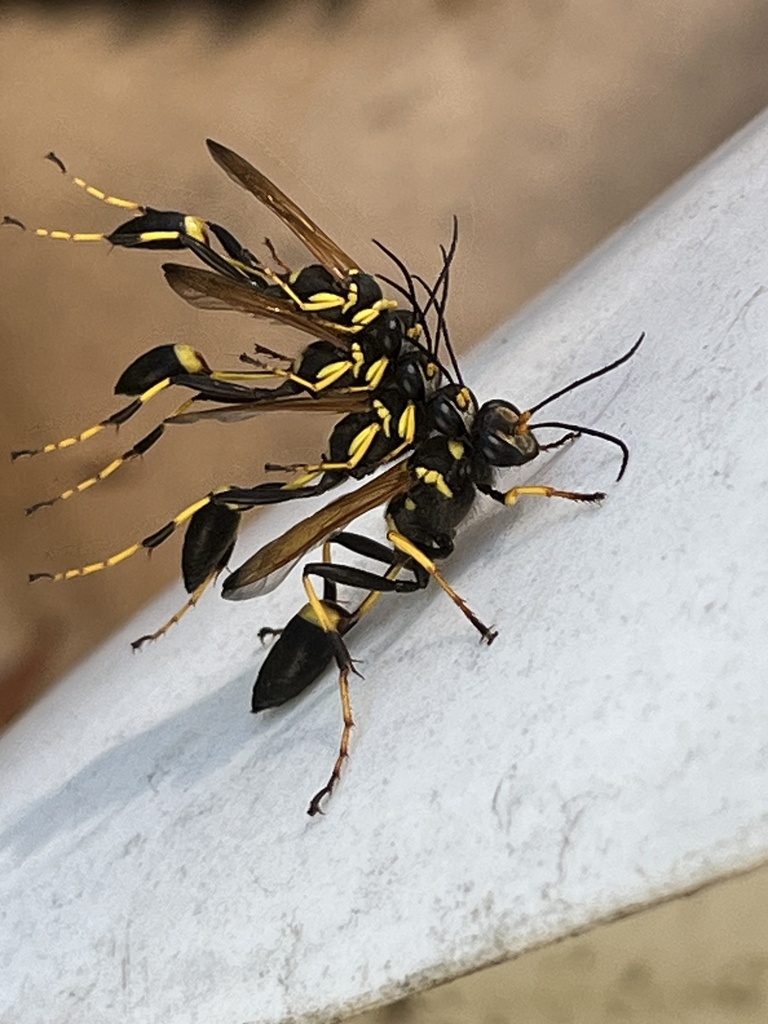
(c) JT Tomaschke, some rights reserved (CC BY) · licence
Family: Sphecidae · Class: Insecta · Order: Hymenoptera
Sceliphron caementarium (Yellow-legged Mud-dauber Wasp) is a California animal in the Sphecidae family.
The Yellow-legged Mud-dauber Wasp is a solitary wasp species in the family Sphecidae, characterized by its distinctive yellow legs and black body with yellow markings. Adults measure 20-25 mm (0.8-1.0 inches) in length, with females slightly larger than males. The species displays a narrow waist typical of sphecid wasps, with the first abdominal segment forming a distinct petiole. The thorax and head are predominantly black, while the legs and portions of the abdomen show bright yellow coloration that gives the species its common name. Sceliphron caementarium has a broad distribution across North America, extending from southern Canada through the United States and into Mexico. In California, the species occurs throughout much of the state, from coastal regions to inland valleys and mountainous areas. The wasp is particularly common in urban and suburban environments, where suitable nesting sites and prey are abundant. Its range extends from sea level to moderate elevations, adapting to diverse climatic conditions across its distribution. This species inhabits a wide variety of habitats, showing particular preference for areas near human structures. Yellow-legged mud-daubers commonly nest under eaves, bridges, porches, and other protected overhangs. They require access to mud sources for nest construction and areas with abundant spider prey. The species thrives in gardens, parks, agricultural areas, and residential zones where both nesting sites and hunting grounds are available. They are frequently observed near water sources, which provide the mud necessary for their construction activities. Yellow-legged mud-daubers are specialized spider hunters, provisioning their nests exclusively with paralyzed spiders. Females construct distinctive cylindrical mud nests, typically 15-25 mm in diameter and 50-100 mm long. The nests consist of multiple cells, each provisioned with several spiders before a single egg is deposited. The female seals each cell with mud, creating a series of chambers within the nest structure. Adults are active during warm months, with peak activity occurring in summer. Males establish territories near nesting areas and engage in aerial courtship displays. The species completes one to two generations per year, depending on local climate conditions. Sceliphron caementarium is not listed under federal or state endangered species legislation and appears to maintain stable populations throughout its range. The species has adapted well to human-modified environments and may have benefited from urbanization, which provides abundant artificial nesting sites. Their role as spider predators makes them beneficial for natural pest control in residential and agricultural settings. No significant conservation concerns have been identified for this species, though local populations may be affected by pesticide use and extreme weather events. The species' adaptability and broad ecological tolerance suggest it will remain common across most of its current range. Climate change may potentially expand suitable habitat northward, though specific population trend data are not currently available.
Classification
Class: Insecta · Order: Hymenoptera · Family: Sphecidae
Frequently asked questions
How is Sceliphron caementarium classified?
Sceliphron caementarium belongs to class Insecta, order Hymenoptera, family Sphecidae.
What family does Sceliphron caementarium belong to?
Sceliphron caementarium is in the Sphecidae family.
What is Sceliphron caementarium?
The Yellow-legged Mud-dauber Wasp is a solitary wasp species in the family Sphecidae, characterized by its distinctive yellow legs and black body with yellow markings.
Is Sceliphron caementarium found in California?
Yes. Sceliphron caementarium is recorded in California in The California Species Project's catalogue.
Related species
Other California species in the same genus, family, or bioregion.
Data from The California Species Project — 14,000+ California species with verified data from CNPS, CDFW, USFWS, and more.