Sceloporus magister
Desert Spiny Lizard
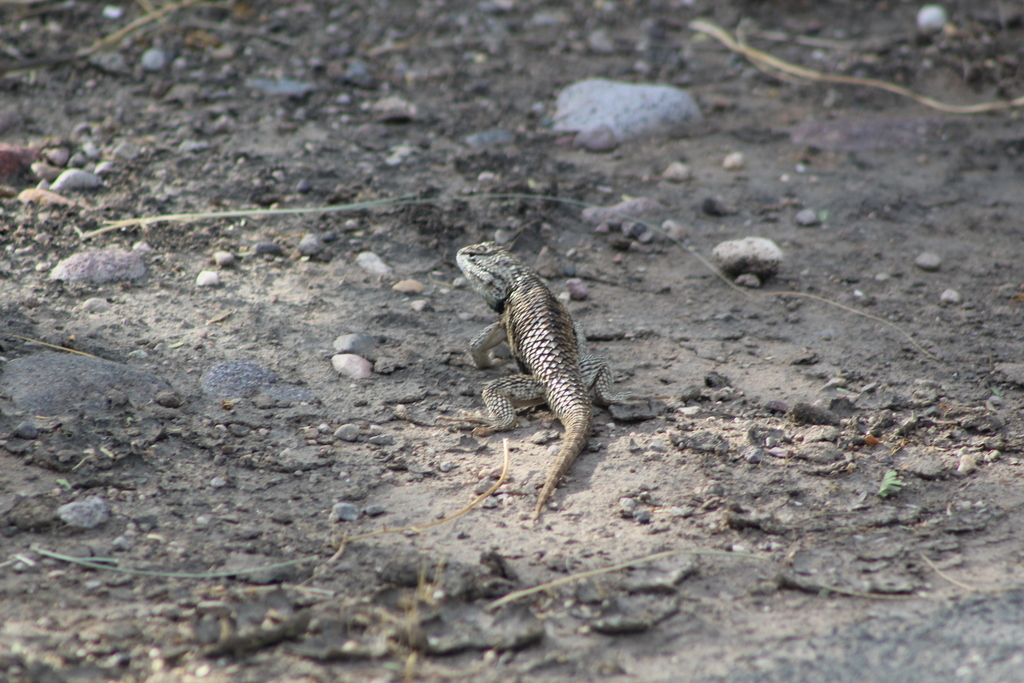
(c) Eliseo D Moreno, some rights reserved (CC BY-SA) · licence
Family: Phrynosomatidae · Class: Reptilia · Order: Squamata
Sceloporus magister (Desert Spiny Lizard) is a California animal in the Phrynosomatidae family.
The Desert Spiny Lizard is a large, robust lizard species native to the southwestern United States and northwestern Mexico. Adults typically measure 76 to 140 mm (3.0 to 5.5 inches) in snout-vent length, with total length including the tail reaching up to 356 mm (14 inches). Males are generally larger than females and develop distinctive breeding coloration. The species is characterized by overlapping, keeled scales that give it a spiny appearance, particularly pronounced along the dorsal surface. Adult males display bright blue patches on the belly and throat during breeding season, while females and juveniles maintain more subdued gray-brown coloration with darker crossbands. The tail is banded with alternating light and dark rings and can be readily autotomized when threatened. In California, the Desert Spiny Lizard occurs primarily in the southeastern desert regions, including the Sonoran and Mojave Desert interface areas. The species is found in Imperial, Riverside, and San Bernardino counties, with populations extending into Arizona, Nevada, Utah, New Mexico, Texas, and Sonora, Mexico. The California populations represent the western edge of the species' range, which extends eastward through much of the southwestern United States. Desert Spiny Lizards inhabit arid and semi-arid environments, showing strong association with rocky outcrops, boulder fields, and desert washes. They are commonly found in creosote bush scrub, desert chaparral, and mixed desert shrub communities. The species is well-adapted for climbing and frequently utilizes vertical rock faces, large boulders, and desert trees such as palo verde and ironwood. Elevation range extends from below sea level in desert valleys to approximately 1,220 meters (4,000 feet) in mountainous terrain. This species is diurnal and heliothermic, actively thermoregulating by moving between sun and shade throughout the day. Diet consists primarily of insects, spiders, and other arthropods, though larger individuals may consume plant material including flowers, fruits, and leaves. Breeding occurs from April through July, with females laying 4 to 20 eggs in sandy or loose soil deposits. Eggs incubate for 60 to 90 days depending on temperature conditions. Juveniles emerge in late summer and early fall, measuring approximately 25 mm snout-vent length. Desert Spiny Lizards exhibit territorial behavior, with males defending prime basking and foraging sites. They are capable of rapid color change in response to temperature and social interactions. When threatened, individuals typically flee to rock crevices or climb vertically on rock faces, using their specialized toe scales for enhanced grip. The Desert Spiny Lizard is not federally listed and maintains stable populations throughout most of its range. In California, the species is not state-listed and appears secure in suitable habitat. Primary threats include habitat loss from urban development and renewable energy projects in desert areas. Climate change may affect the species through altered precipitation patterns and increased temperatures, though the species' thermal tolerance suggests moderate resilience to temperature increases.
Classification
Class: Reptilia · Order: Squamata · Family: Phrynosomatidae
Frequently asked questions
How is Sceloporus magister classified?
Sceloporus magister belongs to class Reptilia, order Squamata, family Phrynosomatidae.
What family does Sceloporus magister belong to?
Sceloporus magister is in the Phrynosomatidae family.
What is Sceloporus magister?
The Desert Spiny Lizard is a large, robust lizard species native to the southwestern United States and northwestern Mexico.
Is Sceloporus magister found in California?
Yes. Sceloporus magister is recorded in California in The California Species Project's catalogue.
Related species
Other California species in the same genus, family, or bioregion.
Data from The California Species Project — 14,000+ California species with verified data from CNPS, CDFW, USFWS, and more.