Sceloporus occidentalis
Western Fence Lizard
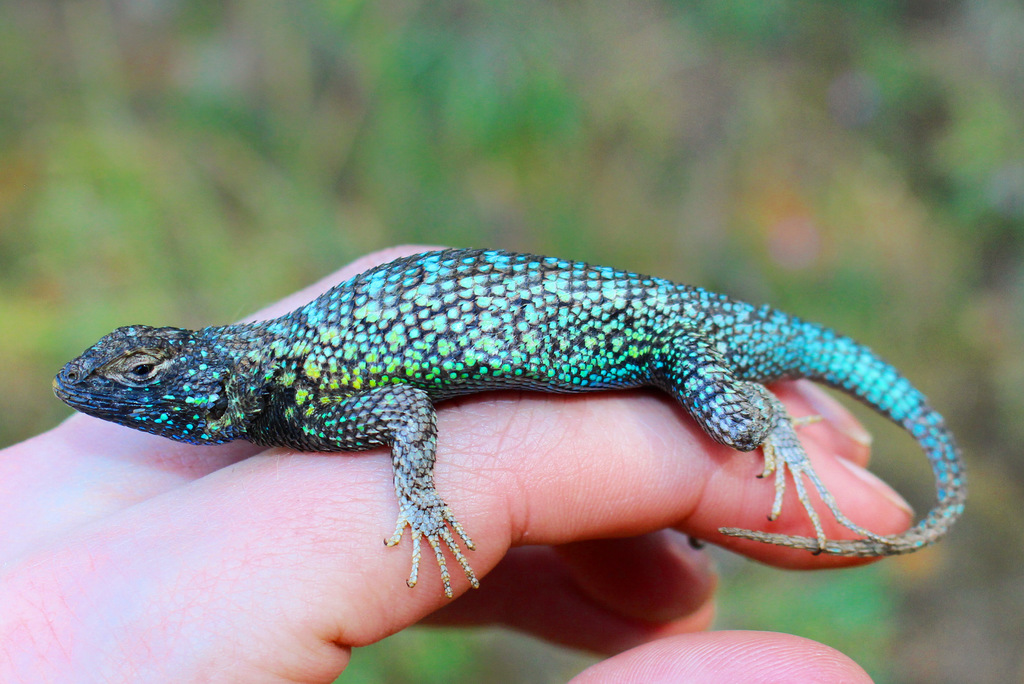
(c) Connor Long, some rights reserved (CC BY-SA) · licence
Family: Phrynosomatidae · Class: Reptilia · Order: Squamata
Sceloporus occidentalis (Western Fence Lizard) is a California animal in the Phrynosomatidae family.
The western fence lizard is a medium-sized spiny lizard measuring 57 to 89 mm (2.2 to 3.5 inches) in snout-to-vent length, with a total length including tail of 152 to 229 mm (6 to 9 inches). Adults display sexual dimorphism in coloration and size patterns. Males exhibit bright blue patches on the throat and belly, with blue coloration extending along the sides of the belly and onto the chest. Females typically lack the prominent blue ventral coloration or display it only faintly. The dorsal surface is brown to gray with darker crossbands or spots, and the scales are keeled and pointed, giving the lizard its characteristic spiny appearance. A distinctive black bar often appears on the shoulder region. The species ranges throughout California from sea level to elevations of approximately 3,300 meters (10,800 feet). The distribution extends from northern Baja California north through Oregon and Washington, and eastward into Idaho, Nevada, and Utah. In California, western fence lizards occur in multiple subspecies across different geographic regions, including the Coast Range, Sierra Nevada, and Great Basin areas. The species occupies nearly every county in the state, making it one of California's most widespread reptiles. Western fence lizards inhabit diverse open, sunny environments including oak woodlands, grasslands, chaparral, scrubland, coniferous forests, riparian areas, and suburban settings. They require suitable basking and perching structures such as fences, walls, rock outcrops, fallen logs, woodpiles, and tree branches. The species demonstrates significant habitat flexibility, adapting to elevations from coastal areas to high mountain regions, though they consistently select areas with adequate sun exposure and vertical perching opportunities. These lizards are primarily insectivorous, feeding on beetles, ants, flies, caterpillars, spiders, and other small arthropods. They are sit-and-wait predators that hunt from elevated perches, darting down to capture prey before returning to their basking sites. Breeding occurs from March through July, with females laying clutches of 3 to 17 eggs in sandy or loose soil. Eggs incubate for 60 to 75 days, with hatchlings emerging in late summer or early fall. Western fence lizards are active during daylight hours and enter brumation during winter months, seeking shelter under rocks, logs, or in rodent burrows. The species serves a notable ecological function as a reservoir host that helps control Lyme disease transmission. When western black-legged ticks (Ixodes pacificus) feed on western fence lizards, proteins in the lizard's blood kill Borrelia burgdorferi bacteria, effectively cleansing infected ticks. Research indicates that when juvenile ticks cannot access fence lizards as hosts, 95 percent fail to find alternative hosts to complete their life cycle. Currently, the western fence lizard has no federal or state conservation listing status and maintains stable populations throughout its range. The species' adaptability to human-modified landscapes and broad habitat tolerance contribute to its conservation security. Local population declines may occur due to habitat fragmentation and urbanization, but the species' widespread distribution and reproductive success maintain overall population stability across California.
Classification
Class: Reptilia · Order: Squamata · Family: Phrynosomatidae
Frequently asked questions
How is Sceloporus occidentalis classified?
Sceloporus occidentalis belongs to class Reptilia, order Squamata, family Phrynosomatidae.
What family does Sceloporus occidentalis belong to?
Sceloporus occidentalis is in the Phrynosomatidae family.
What is Sceloporus occidentalis?
The western fence lizard is a medium-sized spiny lizard measuring 57 to 89 mm (2.2 to 3.5 inches) in snout-to-vent length, with a total length including tail of 152 to 229 mm (6 to 9 inches).
Is Sceloporus occidentalis found in California?
Yes. Sceloporus occidentalis is recorded in California in The California Species Project's catalogue.
Related species
Other California species in the same genus, family, or bioregion.
Data from The California Species Project — 14,000+ California species with verified data from CNPS, CDFW, USFWS, and more.