Sceloporus orcutti
Granite Spiny Lizard
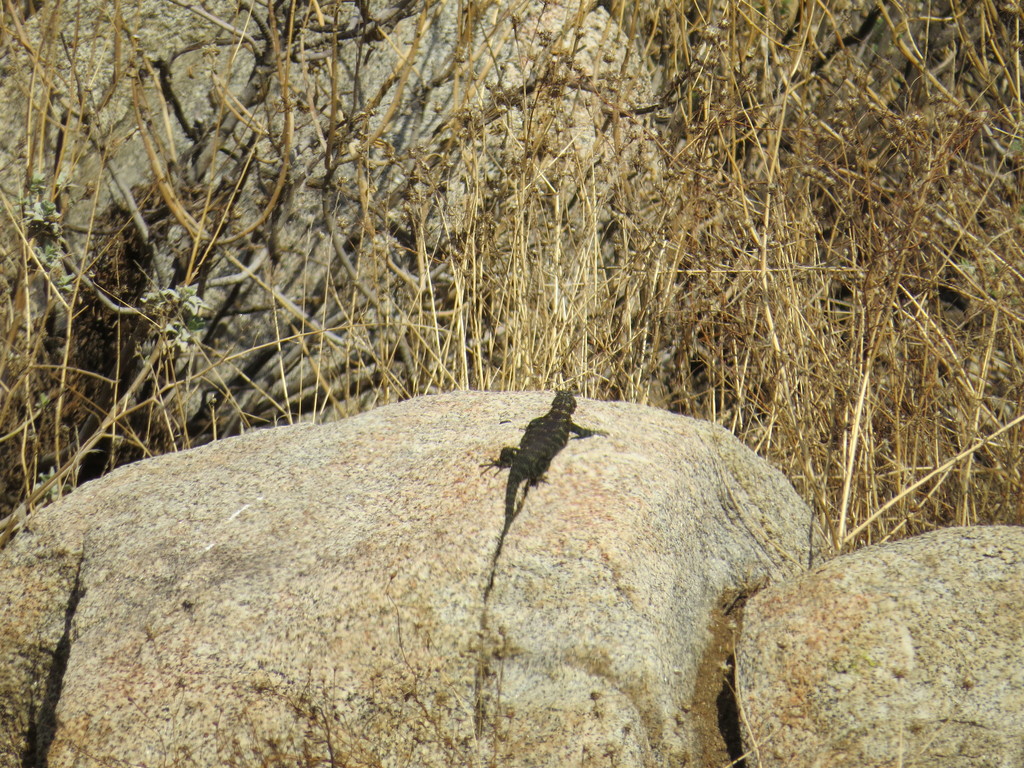
no rights reserved · CC0
Family: Phrynosomatidae · Class: Reptilia · Order: Squamata
Sceloporus orcutti (Granite Spiny Lizard) is a California animal in the Phrynosomatidae family.
The granite spiny lizard is a large, robust lizard endemic to coastal Southern California and Baja California. Adults measure 76 to 127 mm (3.0 to 5.0 inches) in snout-vent length, reaching total lengths of up to 279 mm (11 inches) including the tail. The species exhibits pronounced sexual dimorphism, with males displaying darker coloration and more prominent dorsal banding. Both sexes possess large, keeled scales that give the species its characteristic spiny appearance, and adults typically range from dark rusty copper-brown to nearly black in color. Males develop distinctive dark wedge-shaped markings on the sides of the neck during breeding season, while females tend to be lighter with more pronounced banding across the body and tail. The granite spiny lizard ranges from the northern side of San Gorgonio Pass in Riverside County south along the lower slopes of the Peninsular Ranges into Baja California, extending nearly to the cape. The species occurs on both the desert slopes of mountains where sufficient plant cover exists and on the coastal side from near the Pacific Ocean inland, with the northern limit extending to the Santa Ana River in Orange County. Populations are documented in Riverside, San Diego, Orange, and Imperial counties in California. This species inhabits rocky terrain characterized by large granite boulders, cliff faces, and boulder fields within mixed vegetation communities. Habitat types include coastal sage scrub, chaparral, mesquite scrubland, pine-oak woodlands, and areas with palm oases. The lizards show strong fidelity to granite formations and are rarely found far from suitable rocky microhabitat. Elevational range extends from near sea level to approximately 1,219 meters (4,000 feet) in mountainous areas. Granite spiny lizards are diurnal and heliothermic, spending much of their time basking on sun-exposed rock surfaces to regulate body temperature. They are highly territorial, with males defending prime basking and foraging areas through aggressive displays and physical confrontations. The species exhibits typical lacertilian reproductive patterns, with females laying clutches of eggs from May through September. Eggs are deposited in crevices or soil beneath rocks, hatching approximately 45 days after laying. Juveniles emerge in late summer and early fall. The diet consists primarily of arthropods, including insects, spiders, and other small invertebrates, with adults occasionally consuming plant material and smaller lizards. Currently, the granite spiny lizard is designated as a Species of Concern by the U.S. Fish and Wildlife Service but holds no federal protection status. The species faces habitat fragmentation and loss due to urban development throughout its coastal Southern California range, particularly in Riverside, Orange, and San Diego counties where human population growth continues to impact native habitats. Climate change may pose additional challenges through altered precipitation patterns affecting vegetation communities within the species' rocky habitat requirements.
Classification
Class: Reptilia · Order: Squamata · Family: Phrynosomatidae
Frequently asked questions
How is Sceloporus orcutti classified?
Sceloporus orcutti belongs to class Reptilia, order Squamata, family Phrynosomatidae.
What family does Sceloporus orcutti belong to?
Sceloporus orcutti is in the Phrynosomatidae family.
What is Sceloporus orcutti?
The granite spiny lizard is a large, robust lizard endemic to coastal Southern California and Baja California.
Is Sceloporus orcutti found in California?
Yes. Sceloporus orcutti is recorded in California in The California Species Project's catalogue.
Related species
Other California species in the same genus, family, or bioregion.
Data from The California Species Project — 14,000+ California species with verified data from CNPS, CDFW, USFWS, and more.