Schinia argentifascia
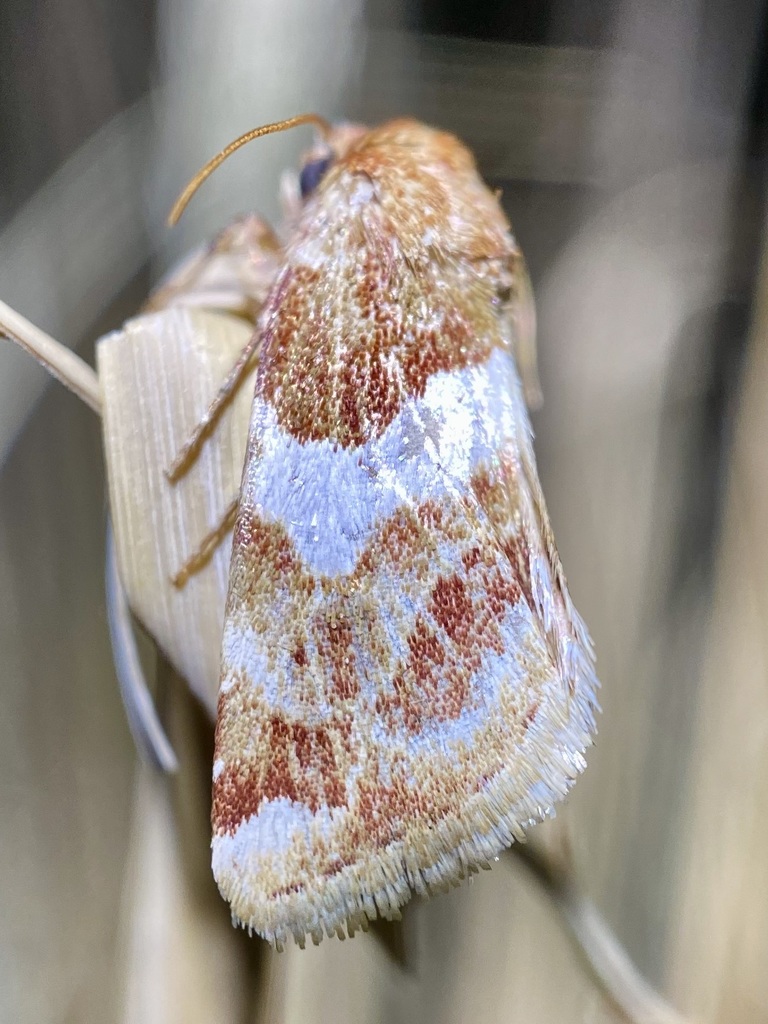
(c) Sue Carnahan, some rights reserved (CC BY) · licence
Family: Noctuidae · Class: Insecta · Order: Lepidoptera
Schinia argentifascia is a California animal in the Noctuidae family.
Schinia argentifascia is a moth species in the family Noctuidae, commonly known as flower moths or heliothine moths. This nocturnal lepidopteran belongs to a genus of moths that typically exhibit specialized relationships with specific host plants, often feeding exclusively on flowers and developing seeds of their preferred species. Physical characteristics of S. argentifascia follow the general morphology of Schinia moths, with adults typically measuring 12-18 mm in forewing length. The forewings display cryptic coloration patterns that provide camouflage when resting on host plants during daylight hours. The hindwings are generally paler than the forewings, with reduced patterning. Sexual dimorphism is present, with males possessing more feathered antennae compared to females. The larvae are typically cylindrical caterpillars that feed within flower heads or seed pods of their host plants. The range and distribution of Schinia argentifascia in California requires verification from current taxonomic databases and museum records. Many Schinia species have restricted distributions tied to the availability of their specific host plants. The species' occurrence may be limited to areas where suitable host vegetation persists, potentially including grasslands, chaparral, or desert regions depending on host plant requirements. Habitat preferences for S. argentifascia are likely closely tied to the distribution and phenology of its host plants. Schinia moths typically inhabit open areas where their host species occur, including native grasslands, shrublands, coastal sage scrub, or desert communities. Adults require access to flowering plants for nectar sources, while larvae develop within the reproductive structures of specific host plants. Elevation range and specific habitat requirements for this species require confirmation from field studies and museum specimens. The behavior and ecology of S. argentifascia likely follows patterns typical of the genus. Adults are nocturnal and attracted to lights. Mating occurs during evening hours, with females releasing pheromones to attract males. After mating, females locate appropriate host plants for oviposition, often laying eggs directly on or near flower buds. Larvae bore into flowers or developing seeds, completing their development within these structures. Pupation typically occurs in soil or plant debris. Flight periods are synchronized with host plant flowering, which may result in one or two generations per year depending on host plant phenology and local climate conditions. The conservation status of Schinia argentifascia has not been formally assessed at state or federal levels. Many Schinia species face potential threats from habitat loss, invasive plant species that displace native hosts, pesticide applications, and climate change effects on host plant phenology. Urban development and agricultural conversion of native habitats may impact populations by eliminating host plants or fragmenting suitable habitat. Light pollution can also affect nocturnal moths by disrupting natural behavior patterns and increasing predation risk. Without current population data or trend information, the species' conservation needs remain uncertain and would benefit from systematic surveys and ecological research.
Classification
Class: Insecta · Order: Lepidoptera · Family: Noctuidae
Frequently asked questions
How is Schinia argentifascia classified?
Schinia argentifascia belongs to class Insecta, order Lepidoptera, family Noctuidae.
What family does Schinia argentifascia belong to?
Schinia argentifascia is in the Noctuidae family.
What is Schinia argentifascia?
Schinia argentifascia is a moth species in the family Noctuidae, commonly known as flower moths or heliothine moths.
Is Schinia argentifascia found in California?
Yes. Schinia argentifascia is recorded in California in The California Species Project's catalogue.
Related species
Other California species in the same genus, family, or bioregion.
Data from The California Species Project — 14,000+ California species with verified data from CNPS, CDFW, USFWS, and more.