Schinia florida
Primrose Moth
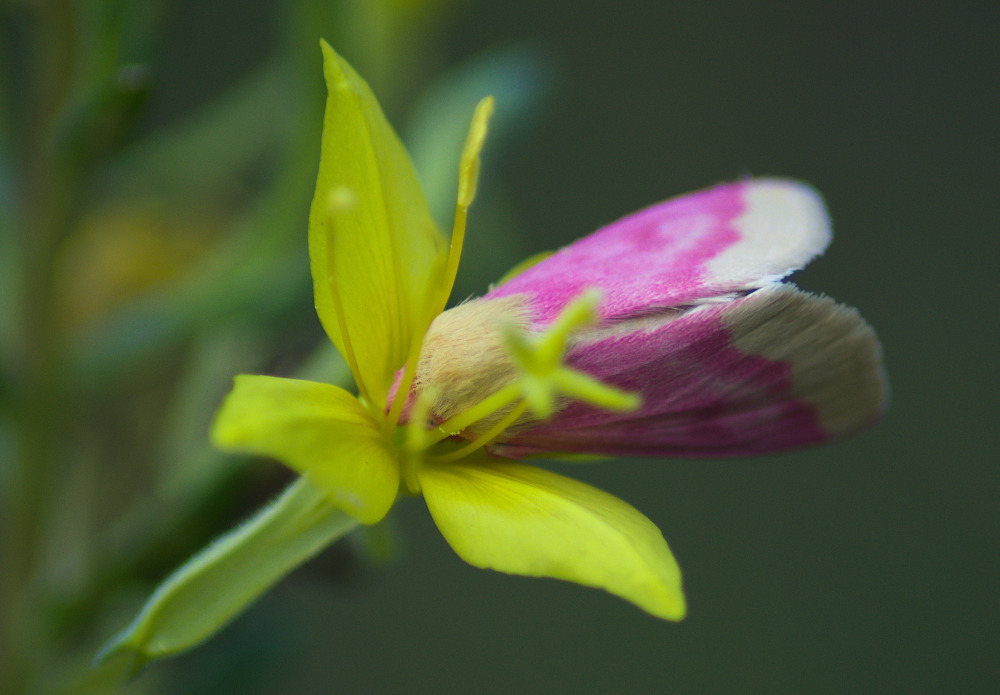
(c) psweet, some rights reserved (CC BY-SA) · licence
Family: Noctuidae · Class: Insecta · Order: Lepidoptera
Schinia florida (Primrose Moth) is a California animal in the Noctuidae family.
The Primrose Moth (Schinia florida) is a member of the Noctuidae family, commonly known as owlet moths or cutworm moths. This species represents one of the more abundant and well-documented flower moths in North America, particularly noted for its specialized relationship with evening primrose plants (Xerces Society). The Primrose Moth exhibits the typical noctuid body plan with forewings that often display cryptic coloration patterns. Like other Schinia species, adults are generally small to medium-sized moths with forewings adapted for concealment during daylight hours. Specific measurements and detailed wing patterns for S. florida require further documentation in the scientific literature. This species has an extensive North American range, occurring from Nova Scotia to northern Florida and extending westward across the continent. According to BugGuide, the range extends from Newfoundland to northern Florida, west to eastern California, and north to Alberta, indicating a broader distribution than initially documented. This wide distribution suggests the species is well-adapted to various climatic conditions across temperate North America. Primrose Moths inhabit fields, clearings, and waste places where their host plants grow (BugGuide). The species demonstrates a specialized ecological relationship with evening primrose family plants (Onagraceae). Host plants include biennial guara and other species of evening-primrose, indicating the moth has evolved specific adaptations for utilizing these plant species. This host plant specialization is typical of many Schinia species, which are known as flower moths due to their close associations with specific flowering plants. The ecology of S. florida centers around its relationship with evening primrose plants, which serve both as larval food sources and adult nectar sources. Larvae likely feed on flowers, buds, and developing seeds of their host plants, a feeding strategy common among Schinia species. Adults are presumably active during evening and nighttime hours when evening primrose flowers are typically open, suggesting co-evolutionary timing between moth and plant. The species' abundance in areas where host plants occur indicates successful adaptation to this specialized niche. Currently, Schinia florida appears to have no special conservation status at federal or state levels. The species' wide distribution and apparent abundance, particularly in the eastern United States where it is described as 'perhaps the most abundant and well-known example of owlet flower moths' (Xerces Society), suggests stable populations. However, like many specialized herbivorous insects, the species could be vulnerable to habitat loss affecting evening primrose populations. The conversion of natural fields and waste areas to development or intensive agriculture could impact local populations by reducing host plant availability. Scientific documentation for this species remains limited regarding specific life history details, flight periods, and detailed ecological requirements. The information presented here is based on available sources including BugGuide, Butterflies and Moths of North America, and the Xerces Society. If you have additional verified information about this species' biology, distribution, or ecology, please contact us to help improve this species account.
Classification
Class: Insecta · Order: Lepidoptera · Family: Noctuidae
Frequently asked questions
How is Schinia florida classified?
Schinia florida belongs to class Insecta, order Lepidoptera, family Noctuidae.
What family does Schinia florida belong to?
Schinia florida is in the Noctuidae family.
What is Schinia florida?
The Primrose Moth (Schinia florida) is a member of the Noctuidae family, commonly known as owlet moths or cutworm moths.
Is Schinia florida found in California?
Yes. Schinia florida is recorded in California in The California Species Project's catalogue.
Related species
Other California species in the same genus, family, or bioregion.
Data from The California Species Project — 14,000+ California species with verified data from CNPS, CDFW, USFWS, and more.