Schinia perminuta
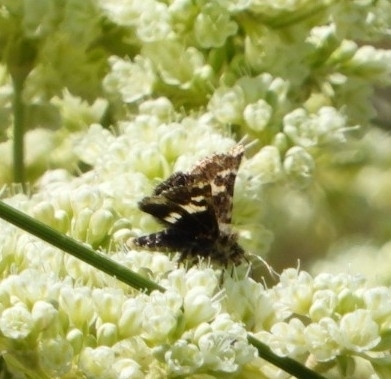
(c) Brodie Cass Talbott, some rights reserved (CC BY) · licence
Family: Noctuidae · Class: Insecta · Order: Lepidoptera
Schinia perminuta is a California animal in the Noctuidae family.
Schinia perminuta is a small moth in the family Noctuidae, subfamily Heliothinae. This species belongs to a genus of specialized flower moths that are typically associated with specific host plants in the sunflower family (Asteraceae). Adult moths are characterized by forewings that measure approximately 8-12 mm in length, with cryptic coloration patterns that provide camouflage when resting on their host plants. The forewings typically display mottled brown and gray markings with subtle darker banding, while the hindwings are generally paler with reduced patterning. The antennae are thread-like in both sexes, and the eyes are well-developed for nocturnal activity. The current distribution and range of Schinia perminuta in California remains poorly documented in accessible literature. Like many Schinia species, this moth likely has a restricted range tied to the distribution of its specific host plant requirements. The genus Schinia includes numerous species with highly localized distributions, often occurring in specialized habitats where their host plants thrive. Many species in this genus are known from only a few localities, suggesting S. perminuta may have similarly limited distribution patterns. Habitat preferences for Schinia perminuta are presumed to align with those of related species in the genus, which typically inhabit areas supporting their specific Asteraceae host plants. These environments may include grasslands, chaparral margins, desert washes, or other open habitats where composite flowers are abundant. The species likely requires areas with minimal disturbance to maintain stable populations of both the moth and its host plants. Elevation preferences and specific microhabitat requirements remain undocumented for this species. As with other Schinia moths, S. perminuta likely exhibits nocturnal flight activity with adults attracted to lights during appropriate seasonal periods. The larvae are presumed to be specialists, feeding on flowers and developing seeds of specific Asteraceae host plants. This feeding strategy is characteristic of the genus, with caterpillars typically consuming the reproductive structures of their hosts rather than leaves. The species probably completes one generation annually, with timing synchronized to the flowering period of its host plant. Adult emergence likely coincides with peak bloom periods to ensure optimal mating and oviposition opportunities. The conservation status of Schinia perminuta is not well-established, as the species lacks formal state or federal protection status. The limited available information suggests this moth may be uncommon or have restricted distribution patterns typical of specialized Asteraceae-feeding Noctuidae. Potential threats likely include habitat loss through development, agricultural conversion, and altered fire regimes that affect host plant communities. Climate change may pose additional risks by shifting suitable habitat zones or altering the phenological synchrony between the moth and its host plants. Given the apparent rarity and specialized ecology typical of Schinia species, S. perminuta may warrant further survey efforts to determine its true conservation needs and distribution in California.
Classification
Class: Insecta · Order: Lepidoptera · Family: Noctuidae
Frequently asked questions
How is Schinia perminuta classified?
Schinia perminuta belongs to class Insecta, order Lepidoptera, family Noctuidae.
What family does Schinia perminuta belong to?
Schinia perminuta is in the Noctuidae family.
What is Schinia perminuta?
Schinia perminuta is a small moth in the family Noctuidae, subfamily Heliothinae.
Is Schinia perminuta found in California?
Yes. Schinia perminuta is recorded in California in The California Species Project's catalogue.
Related species
Other California species in the same genus, family, or bioregion.
Data from The California Species Project — 14,000+ California species with verified data from CNPS, CDFW, USFWS, and more.