Schizura apicalis
Plain Schizura
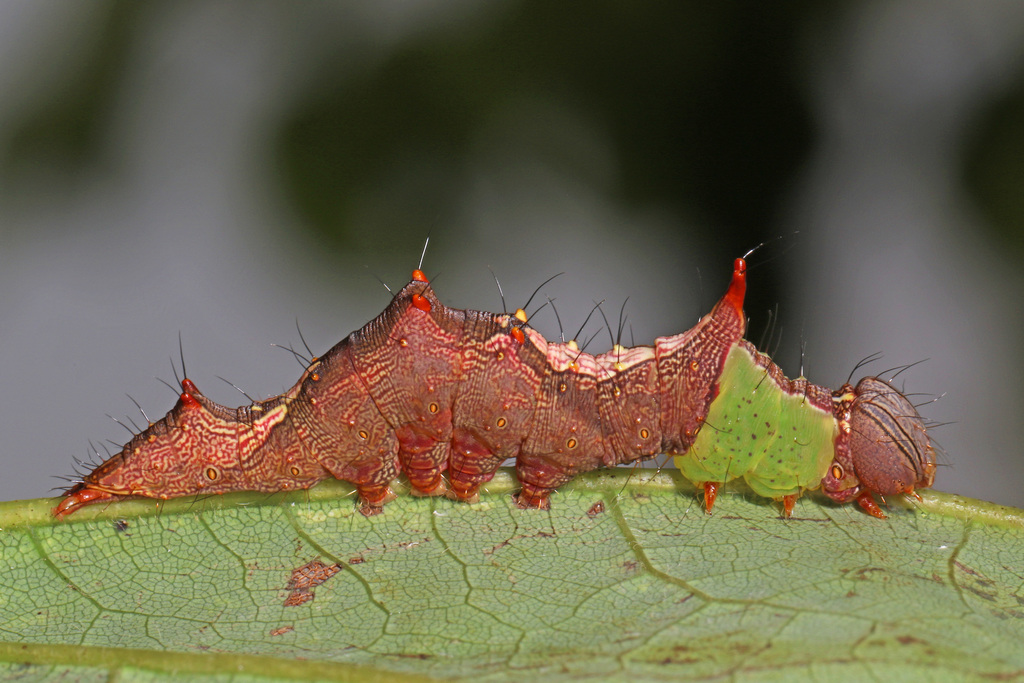
(c) Judy Gallagher, some rights reserved (CC BY-SA) · licence
Family: Notodontidae · Class: Insecta · Order: Lepidoptera
Schizura apicalis (Plain Schizura) is a California animal in the Notodontidae family.
The Plain Schizura (Schizura apicalis) is a medium-sized moth in the family Notodontidae, commonly known as prominent moths. Adults typically measure 25 to 35 mm (1.0 to 1.4 inches) in wingspan. The forewings are predominantly gray to brown with subtle patterning that includes darker cross-lines and a distinctive white or pale spot near the apex, which gives the species its common name. The hindwings are typically paler, ranging from light gray to whitish. Males can be distinguished from females by their more feathery antennae and slightly smaller size. At rest, the moth holds its wings in a tent-like position over the body, characteristic of the Notodontidae family. Schizura apicalis is distributed across eastern North America, with its range extending from southeastern Canada south to Florida and west to the Great Plains. In California, the species represents a significant range extension from its typical eastern distribution, though specific California occurrence records are limited and require verification. The species appears to be most commonly recorded from deciduous forest regions and areas with suitable host plants. The Plain Schizura inhabits deciduous and mixed forests, woodland edges, and suburban areas with mature trees. Adults are typically found in areas supporting their larval host plants, which include various hardwood species. The species shows preference for habitats with oak, cherry, and other members of the Rosaceae and Fagaceae families. Elevation preferences vary across the range but generally occur from sea level to moderate elevations in mountainous regions. Adults are nocturnal and attracted to lights, making them occasionally observed at porch lights and moth sheets used by researchers. The flight period typically extends from late spring through early fall, with peak activity occurring during summer months. Larvae, known as prominents, are distinctive caterpillars that feed on the foliage of their host plants. When disturbed, larvae often rear up their front segments in a defensive posture, a behavior characteristic of many notodontid species. The species is univoltine in northern portions of its range but may produce two generations annually in warmer southern areas. Eggs are laid singly on host plant foliage, and larvae undergo five instars before pupating in the soil. The Plain Schizura currently lacks formal conservation status designations at federal or state levels. Population trends are not well documented, though the species is generally considered stable across most of its range. However, habitat loss from deforestation and urban development may impact local populations, particularly in areas where deciduous forests are being converted to other land uses. Climate change may also affect the species' distribution and phenology. In California, if confirmed as resident, the species would represent an important biogeographic record requiring monitoring to understand population establishment and trends. The species' dependence on mature deciduous trees makes it potentially vulnerable to forest management practices that favor coniferous species or remove old-growth hardwood components.
Classification
Class: Insecta · Order: Lepidoptera · Family: Notodontidae
Frequently asked questions
How is Schizura apicalis classified?
Schizura apicalis belongs to class Insecta, order Lepidoptera, family Notodontidae.
What family does Schizura apicalis belong to?
Schizura apicalis is in the Notodontidae family.
What is Schizura apicalis?
The Plain Schizura (Schizura apicalis) is a medium-sized moth in the family Notodontidae, commonly known as prominent moths.
Is Schizura apicalis found in California?
Yes. Schizura apicalis is recorded in California in The California Species Project's catalogue.
Related species
Other California species in the same genus, family, or bioregion.
Data from The California Species Project — 14,000+ California species with verified data from CNPS, CDFW, USFWS, and more.