Schizura concinna
Red-humped Caterpillar Moth
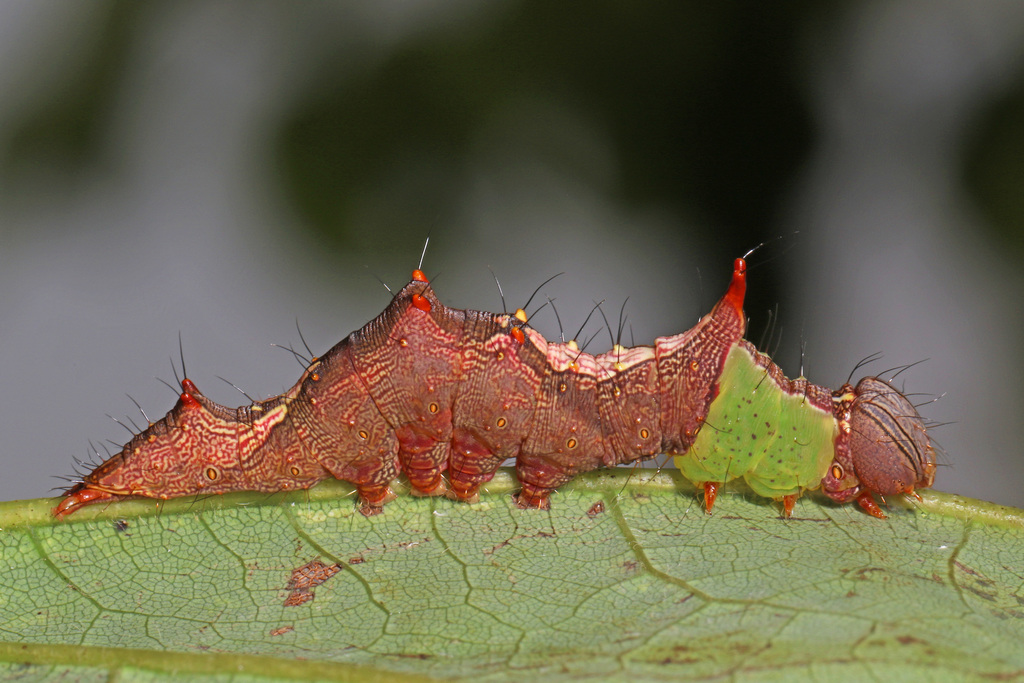
(c) Judy Gallagher, some rights reserved (CC BY-SA) · licence
Family: Notodontidae · Class: Insecta · Order: Lepidoptera
Schizura concinna (Red-humped Caterpillar Moth) is a California animal in the Notodontidae family.
The Red-humped Caterpillar Moth (Schizura concinna) is a medium-sized moth in the family Notodontidae, distinguished by its mottled brown and gray forewings with subtle darker markings. Adults have a wingspan of 25 to 40 mm (1.0 to 1.6 inches), with forewings displaying a complex pattern of brown, gray, and rust-colored scales that provide effective camouflage against tree bark. The hindwings are typically lighter, appearing pale gray to white with minimal markings. Males possess feathery antennae, while females have simpler, thread-like antennae. This species exhibits a transcontinental distribution across North America, ranging from Nova Scotia to western Ontario in Canada, and from Maine south to Florida and west to Illinois and eastern Texas in the United States. A disjunct western population occurs in Colorado, Utah, and Arizona, with the range possibly continuous through the northern Rocky Mountains or across the Great Plains. This broad distribution reflects the moth's adaptability to various climatic conditions and host plant availability. Red-humped Caterpillar Moths inhabit deciduous and mixed forests, woodland edges, parks, and residential areas with suitable host trees. The species occurs from sea level to moderate elevations, typically below 2,000 meters (6,500 feet). Adults are attracted to artificial lights and can be found in suburban environments where ornamental trees provide larval food sources. The species is univoltine in northern regions and bivoltine in southern areas, with adults flying from May through August depending on latitude. Females deposit eggs in clusters on the undersides of host plant leaves. The distinctive caterpillars are responsible for the moth's common name, featuring a prominent red-orange hump on the fourth abdominal segment, along with black and yellow stripes running longitudinally along the body. Mature larvae reach 35 to 50 mm (1.4 to 2.0 inches) in length. Host plants include various hardwood trees, particularly apple (Malus species), cherry (Prunus species), plum, willow (Salix species), elm (Ulmus species), and maple (Acer species). Caterpillars feed gregariously in early instars before dispersing as they mature. Pupation occurs in shallow soil chambers or leaf litter, with northern populations overwintering as pupae. Adult moths are primarily nocturnal, with peak activity occurring during the first few hours after sunset. Mating typically takes place during the night, with females releasing pheromones to attract males from considerable distances. The Red-humped Caterpillar Moth is not federally or state-listed and appears to maintain stable populations throughout its range. The species benefits from its broad host plant range and tolerance for human-modified landscapes. Climate change may potentially affect the northern extent of its range, though the species' adaptability suggests resilience to moderate environmental changes. In some regions, the caterpillars are considered minor agricultural pests on fruit trees, though they rarely cause significant economic damage.
Classification
Class: Insecta · Order: Lepidoptera · Family: Notodontidae
Frequently asked questions
How is Schizura concinna classified?
Schizura concinna belongs to class Insecta, order Lepidoptera, family Notodontidae.
What family does Schizura concinna belong to?
Schizura concinna is in the Notodontidae family.
What is Schizura concinna?
The Red-humped Caterpillar Moth (Schizura concinna) is a medium-sized moth in the family Notodontidae, distinguished by its mottled brown and gray forewings with subtle darker markings.
Is Schizura concinna found in California?
Yes. Schizura concinna is recorded in California in The California Species Project's catalogue.
Related species
Other California species in the same genus, family, or bioregion.
Data from The California Species Project — 14,000+ California species with verified data from CNPS, CDFW, USFWS, and more.