Schizura unicornis
Unicorn Caterpillar Moth
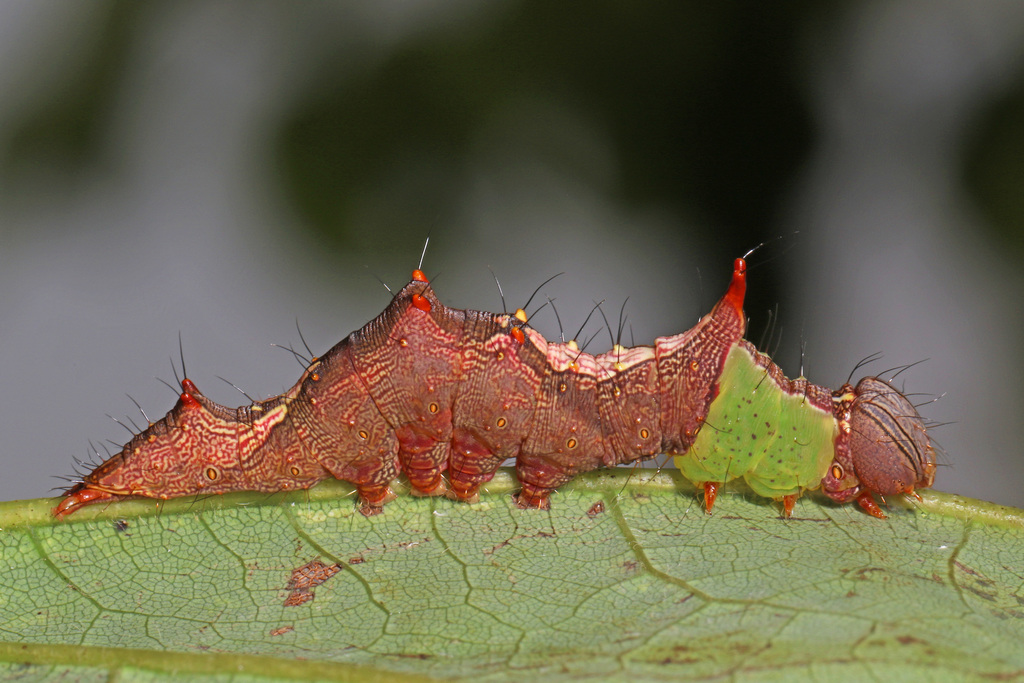
(c) Judy Gallagher, some rights reserved (CC BY-SA) · licence
Family: Notodontidae · Class: Insecta · Order: Lepidoptera
Schizura unicornis (Unicorn Caterpillar Moth) is a California animal in the Notodontidae family.
The Unicorn Caterpillar Moth (Schizura unicornis) is a medium-sized moth in the family Notodontidae, distinguished by its distinctive larval stage and cryptic adult coloration. Adults have a wingspan ranging from 30 to 45 mm (1.2 to 1.8 inches). The forewings display mottled gray-brown coloration with darker transverse lines and subtle white markings that provide effective camouflage against tree bark. The hindwings are lighter, typically pale gray to whitish. Males can be distinguished from females by their more feathered antennae and slightly smaller size. This species occurs across much of North America, with its range extending from southern Canada through the United States to northern Mexico. In California, Schizura unicornis is documented from various regions including coastal areas, the Central Valley, and montane forests up to moderate elevations. The species shows broad distributional tolerance across diverse climatic zones within the state. Unicorn Caterpillar Moths inhabit deciduous and mixed forests, woodland edges, parks, and suburban areas with suitable host plants. The species demonstrates adaptability to human-modified landscapes and can be found in urban environments where host trees are present. Elevation range extends from sea level to approximately 2,000 meters (6,600 feet), though populations are most abundant at lower elevations with diverse hardwood communities. The species derives its common name from the distinctive larval stage, which features a prominent horn-like projection on the eighth abdominal segment. Mature caterpillars reach 35 to 40 mm (1.4 to 1.6 inches) in length and display variable coloration ranging from green to reddish-brown with longitudinal stripes. Larvae feed on a diverse array of deciduous trees including willows (Salix spp.), poplars and aspens (Populus spp.), birches (Betula spp.), and various fruit trees in the family Rosaceae. This polyphagous feeding habit contributes to the species' widespread distribution and ecological success. Schizura unicornis produces one to two generations annually, depending on local climate conditions. Adults are active from late spring through early fall, with peak flight periods typically occurring in June and August. Females deposit eggs singly or in small clusters on host plant foliage. Larvae undergo five instars before pupating in soil or leaf litter. The species overwinters as pupae in earthen cells. The Unicorn Caterpillar Moth is not listed under federal or California endangered species legislation and appears to maintain stable populations throughout its range. The species benefits from its broad host plant usage and adaptability to various habitat types. While localized populations may fluctuate due to natural factors such as weather patterns and parasitoid pressure, no significant conservation concerns have been identified. The moth's tolerance for human-modified environments and diverse host plant requirements contribute to its continued persistence across California's varied landscapes.
Classification
Class: Insecta · Order: Lepidoptera · Family: Notodontidae
Frequently asked questions
How is Schizura unicornis classified?
Schizura unicornis belongs to class Insecta, order Lepidoptera, family Notodontidae.
What family does Schizura unicornis belong to?
Schizura unicornis is in the Notodontidae family.
What is Schizura unicornis?
The Unicorn Caterpillar Moth (Schizura unicornis) is a medium-sized moth in the family Notodontidae, distinguished by its distinctive larval stage and cryptic adult coloration.
Is Schizura unicornis found in California?
Yes. Schizura unicornis is recorded in California in The California Species Project's catalogue.
Related species
Other California species in the same genus, family, or bioregion.
Data from The California Species Project — 14,000+ California species with verified data from CNPS, CDFW, USFWS, and more.