Schreckensteinia festaliella
Blackberry Skeletonizer
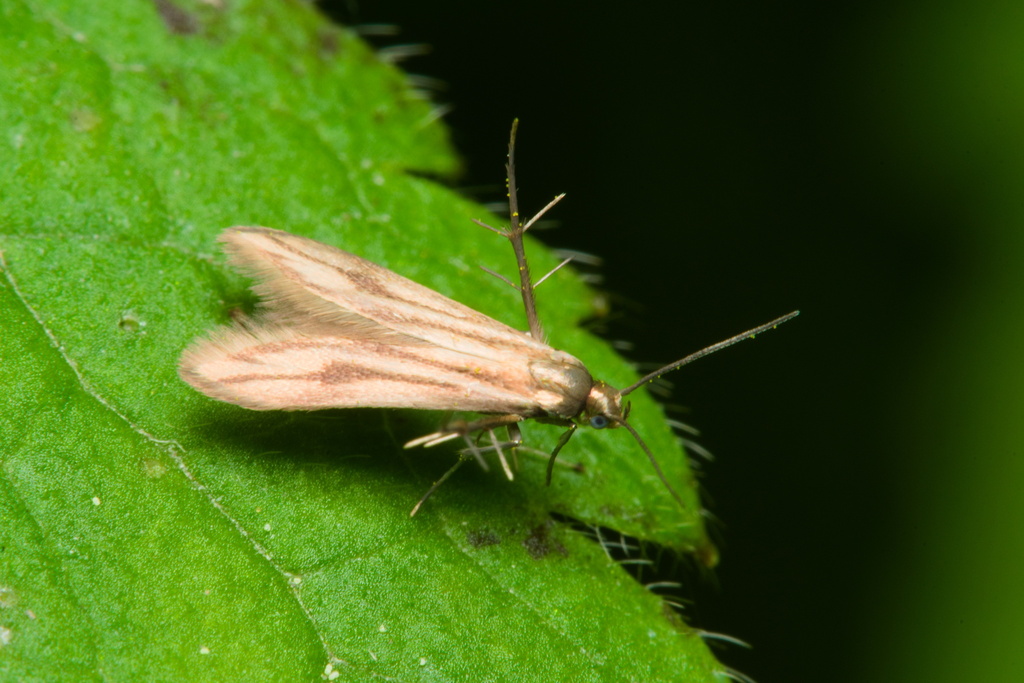
no rights reserved · CC0
Family: Schreckensteiniidae · Class: Insecta · Order: Lepidoptera
Schreckensteinia festaliella (Blackberry Skeletonizer) is a California animal in the Schreckensteiniidae family.
The Blackberry Skeletonizer is a small moth in the family Schreckensteiniidae, with adults measuring 10 to 12 mm wingspan (BugGuide). The forewings are slender with pointed triangular tips, while the hindwings are lanceolate and pointed with very long fringe. Adults display distinctive whorls of spines on the hindleg tibia and tarsus, and when at rest, the hindlegs are held elevated above the body (BugGuide). The forewings typically appear brownish with subtle markings that help distinguish this species from related moths. Schreckensteinia festaliella is not native to North America, having been introduced from Eurasia. According to BugGuide, the species is now widespread across the continent, ranging from California and Alberta to at least Quebec and the northeastern United States. This broad distribution indicates successful establishment following its introduction, with populations documented across multiple ecological zones from Pacific coastal regions to northeastern deciduous forests. The species inhabits areas where its host plants occur, particularly locations supporting Rubus species (blackberries and raspberries). Adults are nocturnal and are commonly attracted to artificial lights (BugGuide). The moth's distribution pattern suggests adaptation to diverse habitat types, from urban and suburban gardens where blackberry plants grow as ornamentals or escaped cultivars, to natural areas with native Rubus populations. Adults exhibit seasonal flight patterns, with activity documented from March to September in California, indicating an extended flight period that likely represents multiple generations annually (BugGuide). The species name "Blackberry Skeletonizer" refers to the larval feeding behavior, where caterpillars consume leaf tissue while leaving the leaf veins intact, creating a characteristic skeletonized appearance. This feeding pattern can cause significant defoliation of host plants when larval populations are high. Adults are primarily nocturnal, becoming active after sunset and readily coming to UV and mercury vapor lights used by moth researchers and enthusiasts. Larvae feed specifically on plants in the genus Rubus, which includes blackberries, raspberries, and related species. The skeletonizing feeding behavior distinguishes this species from other moth larvae that might feed on the same host plants. Larval development involves multiple instars, with pupation likely occurring in leaf litter or soil near host plants, though detailed life cycle information requires further documentation. As an introduced species, Schreckensteinia festaliella does not have formal conservation status listings. The moth appears to be well-established across its introduced range, suggesting successful adaptation to North American environmental conditions. Its association with widely distributed Rubus species provides abundant host plant resources across diverse habitats. The species may have minor economic significance in commercial berry production, though comprehensive impact assessments are lacking. Population monitoring occurs primarily through moth survey programs and citizen science initiatives rather than targeted conservation efforts. The successful establishment and expansion of this introduced species demonstrates the potential for non-native Lepidoptera to colonize new geographic regions when suitable host plants and environmental conditions are available.
Classification
Class: Insecta · Order: Lepidoptera · Family: Schreckensteiniidae
Frequently asked questions
How is Schreckensteinia festaliella classified?
Schreckensteinia festaliella belongs to class Insecta, order Lepidoptera, family Schreckensteiniidae.
What family does Schreckensteinia festaliella belong to?
Schreckensteinia festaliella is in the Schreckensteiniidae family.
What is Schreckensteinia festaliella?
The Blackberry Skeletonizer is a small moth in the family Schreckensteiniidae, with adults measuring 10 to 12 mm wingspan (BugGuide).
Is Schreckensteinia festaliella found in California?
Yes. Schreckensteinia festaliella is recorded in California in The California Species Project's catalogue.
More California species
This species has no close relatives in our California data — here are other species to explore.
Data from The California Species Project — 14,000+ California species with verified data from CNPS, CDFW, USFWS, and more.