Sciota bifasciella
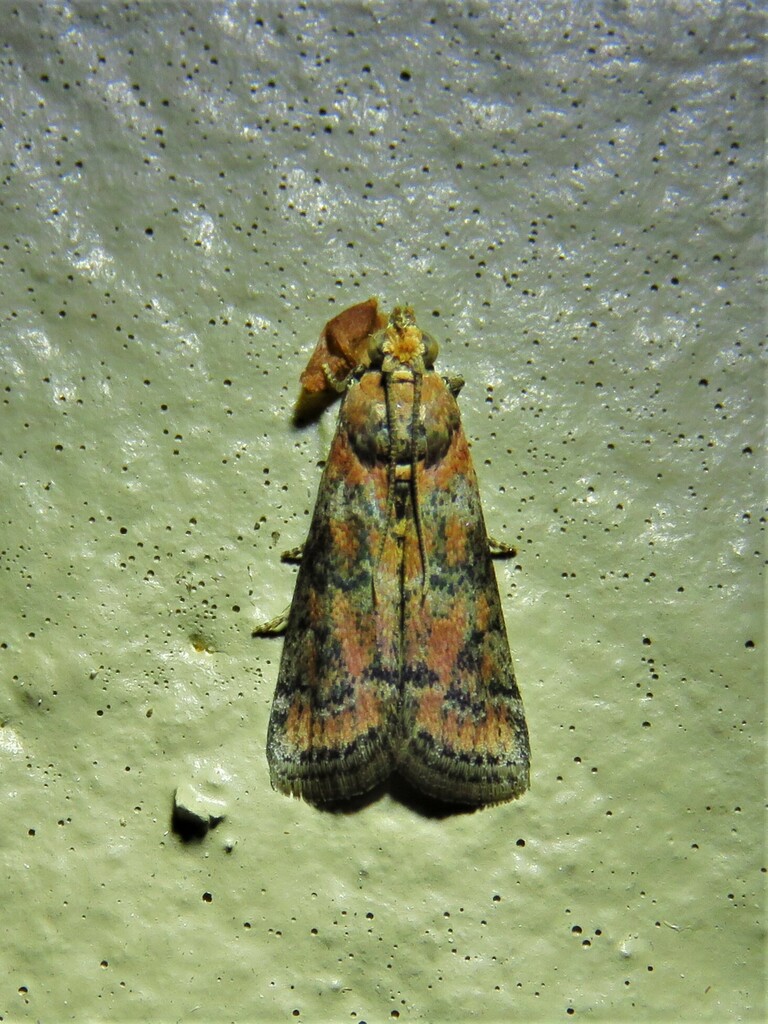
(c) Annika Lindqvist, some rights reserved (CC BY) · licence
Family: Pyralidae · Class: Insecta · Order: Lepidoptera
Sciota bifasciella is a California animal in the Pyralidae family.
Sciota bifasciella is a small moth in the family Pyralidae, commonly known as the two-banded snout moth or stored grain moth. Adults typically measure 12-16 mm (0.47-0.63 inches) in wingspan. The forewings are pale yellowish-brown to tan with two distinct darker brown transverse bands crossing the wing surface, giving the species its common name. The hindwings are lighter, appearing whitish to pale yellow with darker marginal areas. The head bears prominent labial palps that project forward, characteristic of snout moths. This species has a widespread distribution across North America, extending from southern Canada through the United States to Mexico. In California, Sciota bifasciella occurs throughout much of the state, from coastal areas to inland valleys and foothills. The species is found at elevations ranging from sea level to approximately 1,500 meters (4,900 feet). Records exist from multiple California counties including Los Angeles, Riverside, San Bernardino, Kern, Fresno, and Tulare counties. Sciota bifasciella inhabits diverse environments but shows particular association with areas containing stored grain products, granaries, warehouses, and food processing facilities. In natural settings, larvae develop in various plant materials including dried seeds, fruits, and organic debris. The species adapts well to human-modified environments and is frequently encountered in agricultural areas, particularly those with grain storage or processing operations. The species exhibits multiple generations per year in warmer climates, with continuous breeding possible under favorable conditions. Females deposit eggs on or near suitable larval food sources. Larvae feed within stored grain products, dried fruits, nuts, and similar organic materials, creating silk-lined galleries as they feed. Development from egg to adult typically requires 4-6 weeks under optimal conditions, though this varies with temperature and food quality. Adults are primarily nocturnal and are attracted to artificial lights. Larvae of Sciota bifasciella can cause economic damage in stored grain facilities by feeding on wheat, corn, rice, oats, and processed grain products. The species also infests dried fruits, nuts, pet food, and bird seed. In natural environments, larvae utilize various seeds and plant materials, contributing to decomposition processes. Adults serve as food sources for nocturnal predators including spiders, bats, and other insectivorous animals. Sciota bifasciella is not considered a species of conservation concern and lacks formal conservation status designations. The species appears stable across its range and may have benefited from human activities that provide abundant stored food sources. Population trends are not systematically monitored, but the species remains commonly encountered throughout its distribution. Management efforts focus primarily on pest control in commercial and residential settings rather than conservation measures.
Classification
Class: Insecta · Order: Lepidoptera · Family: Pyralidae
Frequently asked questions
How is Sciota bifasciella classified?
Sciota bifasciella belongs to class Insecta, order Lepidoptera, family Pyralidae.
What family does Sciota bifasciella belong to?
Sciota bifasciella is in the Pyralidae family.
What is Sciota bifasciella?
Sciota bifasciella is a small moth in the family Pyralidae, commonly known as the two-banded snout moth or stored grain moth.
Is Sciota bifasciella found in California?
Yes. Sciota bifasciella is recorded in California in The California Species Project's catalogue.
Related species
Other California species in the same genus, family, or bioregion.
Data from The California Species Project — 14,000+ California species with verified data from CNPS, CDFW, USFWS, and more.