Sciurus carolinensis
Eastern Gray Squirrel
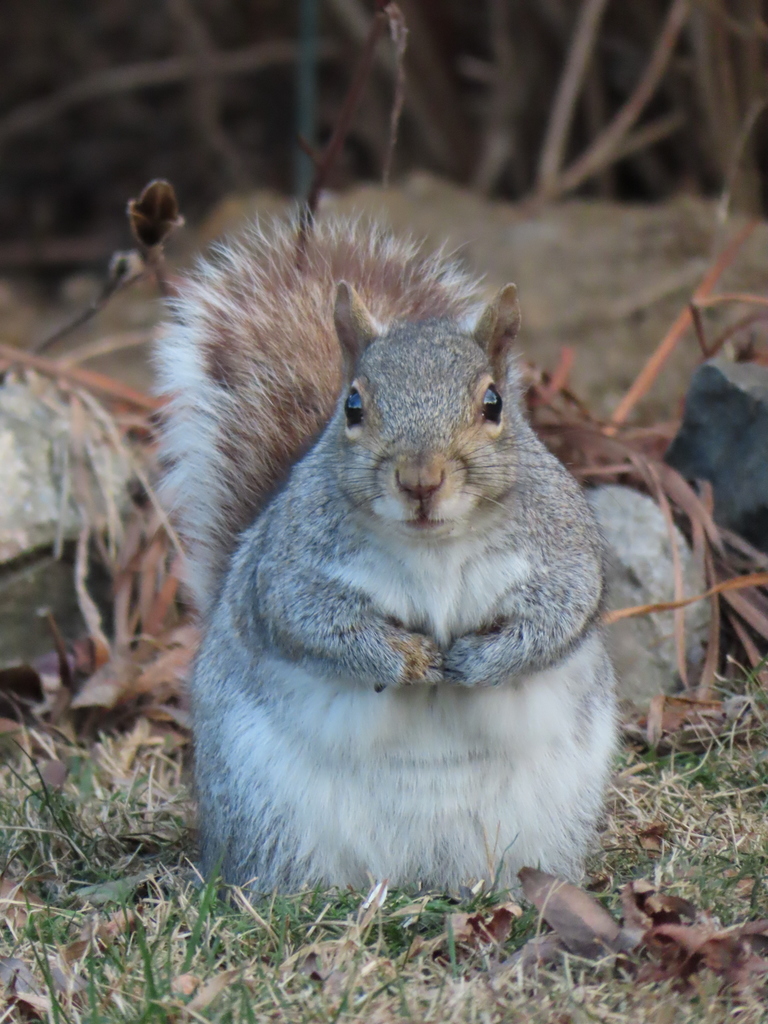
(c) Mila C., some rights reserved (CC BY) · licence
Family: Sciuridae · Class: Mammalia · Order: Rodentia
Sciurus carolinensis (Eastern Gray Squirrel) is a California animal in the Sciuridae family.
The Eastern Gray Squirrel is a medium-sized tree squirrel measuring 230 to 300 mm (9.1 to 11.8 inches) in total length, with a tail length of 190 to 250 mm (7.5 to 9.8 inches). Adults typically weigh between 400 to 600 grams (14 to 21 ounces). The species exhibits predominantly gray dorsal fur with white underparts, though color variations include melanistic (black) and leucistic (white) morphs. The tail is bushy and flattened, with individual hairs banded in gray, brown, and white. Ears are relatively small and pointed, and the species has prominent dark eyes. Native to eastern North America from southern Canada to northern Florida and west to the Great Plains, Eastern Gray Squirrels have been introduced to numerous locations outside their natural range, including parts of California. In California, established populations occur primarily in urban and suburban areas of major metropolitan regions, including the San Francisco Bay Area, Los Angeles Basin, and Central Valley cities. These populations originated from deliberate introductions beginning in the late 1800s and early 1900s. Eastern Gray Squirrels inhabit deciduous and mixed forests, urban parks, suburban neighborhoods, and college campuses. They show strong preference for areas with mature trees, particularly oak, hickory, maple, and walnut species that provide both nesting sites and food sources. The species adapts readily to human-modified landscapes and thrives in areas with scattered trees and supplemental food sources. They construct nests (dreys) in tree cavities or build leaf nests in branch forks, typically 6 to 15 meters (20 to 49 feet) above ground. Eastern Gray Squirrels are primarily granivorous, feeding on nuts, seeds, buds, and fruits. Their diet includes acorns, walnuts, hickory nuts, maple seeds, and pine cones. They exhibit scatter-hoarding behavior, burying individual nuts and seeds for later retrieval. This caching behavior makes them important seed dispersers in forest ecosystems. Breeding occurs twice annually, with mating seasons in late winter (December-February) and mid-summer (May-July). Gestation lasts approximately 44 days, and females produce litters of 2 to 6 young. Juveniles remain in the nest for 10 to 12 weeks before becoming independent. The Eastern Gray Squirrel is not federally or state listed in California and maintains stable populations throughout its introduced range in the state. However, the species is considered a non-native invasive species that may compete with native squirrel species, particularly the Western Gray Squirrel. Eastern Gray Squirrels are generally more aggressive and adaptable to urban environments than their native counterparts. Management concerns focus on preventing further range expansion and protecting native squirrel habitat rather than conservation of the Eastern Gray Squirrel itself. The species has successfully established self-sustaining populations in California urban areas and continues to expand its range through natural dispersal and human-mediated transport.
Classification
Class: Mammalia · Order: Rodentia · Family: Sciuridae
Frequently asked questions
How is Sciurus carolinensis classified?
Sciurus carolinensis belongs to class Mammalia, order Rodentia, family Sciuridae.
What family does Sciurus carolinensis belong to?
Sciurus carolinensis is in the Sciuridae family.
What is Sciurus carolinensis?
The Eastern Gray Squirrel is a medium-sized tree squirrel measuring 230 to 300 mm (9.1 to 11.8 inches) in total length, with a tail length of 190 to 250 mm (7.5 to 9.8 inches).
Is Sciurus carolinensis found in California?
Yes. Sciurus carolinensis is recorded in California in The California Species Project's catalogue.
Related species
Other California species in the same genus, family, or bioregion.
Data from The California Species Project — 14,000+ California species with verified data from CNPS, CDFW, USFWS, and more.