Sciurus griseus
Western Gray Squirrel
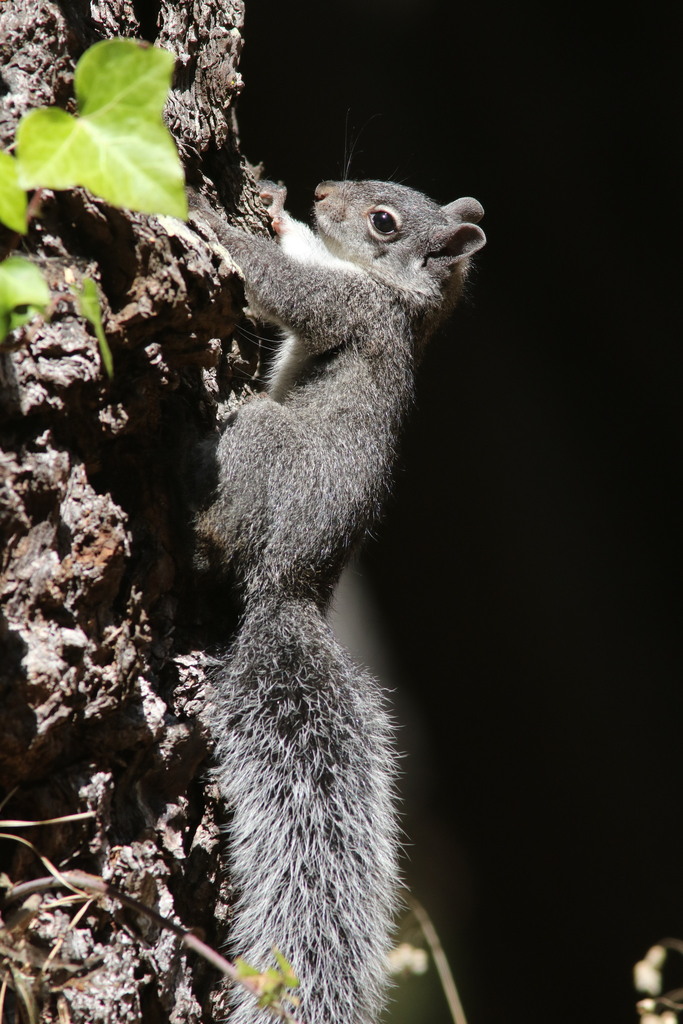
(c) Cricket Raspet, some rights reserved (CC BY) · licence
Family: Sciuridae · Class: Mammalia · Order: Rodentia
Sciurus griseus (Western Gray Squirrel) is a California animal in the Sciuridae family.
The western gray squirrel is a large arboreal rodent native to the Pacific Coast region. Adults measure 46 to 61 cm (18 to 24 inches) in total length, including a bushy tail that accounts for nearly half the body length. Body weight ranges from 350 to 900 grams (0.8 to 2.0 pounds), with males typically larger than females. The dorsal pelage is steel gray with white-tipped hairs, while the ventral surface is white to cream-colored. The tail displays alternating bands of gray, black, and white, with white-tipped hairs creating a frosted appearance. The ears are relatively large and lack prominent tufts, distinguishing this species from other western squirrels. Historically, western gray squirrels ranged from Baja California north to Washington state, primarily west of the Sierra Nevada and Cascade mountain ranges. In California, the species occurs from sea level to approximately 2,100 meters (6,900 feet) elevation, inhabiting coastal counties from San Diego to Del Norte, as well as the western slopes of the Sierra Nevada. Populations extend through the Coast Ranges, including the Santa Cruz Mountains, and into the southern Cascades. The species has experienced range contractions in some areas, particularly in Southern California urbanized regions. Western gray squirrels inhabit oak woodlands, mixed coniferous-deciduous forests, and riparian areas. The species shows strong association with oak trees, particularly coast live oak, valley oak, and blue oak, which provide essential food resources and nesting sites. Suitable habitat includes open canopy forests with 40 to 70 percent tree cover, allowing for aerial movement between trees while maintaining ground visibility for predator detection. Douglas fir, ponderosa pine, and madrone are also important habitat components, especially at higher elevations. This primarily diurnal species exhibits pronounced seasonal activity patterns. Western gray squirrels are scatter-hoarders, caching acorns and pine seeds in numerous small deposits throughout their territory. Diet consists mainly of tree seeds, particularly acorns, pine nuts, and walnuts, supplemented by fungi, berries, and occasionally bird eggs. Breeding occurs once annually, typically from February through June depending on latitude and elevation. After a 44-day gestation period, females produce litters of two to five young in tree cavities or large stick nests called dreys. Home ranges vary from 0.4 to 4.0 hectares depending on habitat quality and population density. The western gray squirrel is not federally listed but faces population pressure from habitat fragmentation, urbanization, and competition with introduced eastern gray squirrels. Oak woodland conversion for agriculture and development has reduced available habitat throughout the species' range. Fire suppression has altered forest structure, potentially reducing habitat suitability in some areas. Eastern gray squirrels, introduced to urban parks and residential areas, compete for food resources and nesting sites. Climate change may further impact oak productivity and distribution patterns. Several California counties maintain local protection measures for oak woodlands that benefit this species.
Classification
Class: Mammalia · Order: Rodentia · Family: Sciuridae
Frequently asked questions
How is Sciurus griseus classified?
Sciurus griseus belongs to class Mammalia, order Rodentia, family Sciuridae.
What family does Sciurus griseus belong to?
Sciurus griseus is in the Sciuridae family.
What is Sciurus griseus?
The western gray squirrel is a large arboreal rodent native to the Pacific Coast region.
Is Sciurus griseus found in California?
Yes. Sciurus griseus is recorded in California in The California Species Project's catalogue.
Related species
Other California species in the same genus, family, or bioregion.
Data from The California Species Project — 14,000+ California species with verified data from CNPS, CDFW, USFWS, and more.