Sciurus niger
Eastern Fox Squirrel
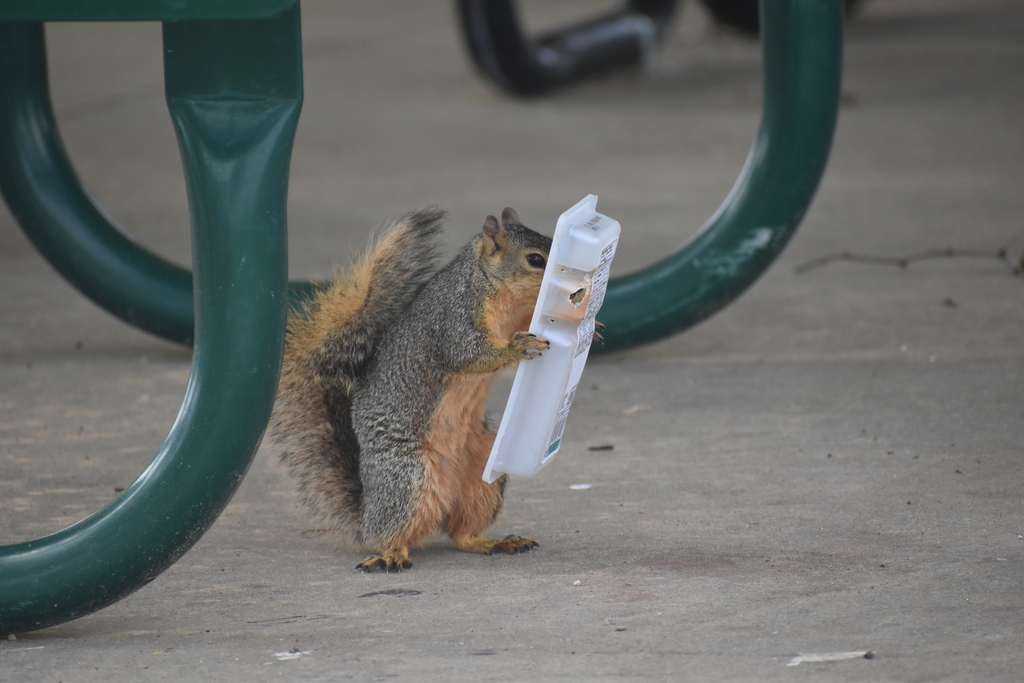
(c) davis0117, some rights reserved (CC BY) · licence
Family: Sciuridae · Class: Mammalia · Order: Rodentia
Sciurus niger (Eastern Fox Squirrel) is a California animal in the Sciuridae family.
The Eastern Fox Squirrel (Sciurus niger) is North America's largest tree squirrel, measuring 45 to 70 cm (18 to 28 inches) in total length, with the tail accounting for approximately half of this measurement. Adults typically weigh 500 to 1,000 grams (1.1 to 2.2 pounds). The species exhibits considerable color variation across its range, with pelage ranging from rusty orange to grayish-brown dorsally, while the underside is typically lighter, ranging from cream to pale orange. The bushy tail displays prominent black and orange banding. Ears are relatively small and rounded, and the species lacks the prominent ear tufts characteristic of some other squirrel species. Historically, Eastern Fox Squirrels were native to the eastern and central United States, ranging from the Atlantic coast westward to the Great Plains. Their natural range extended from southeastern Canada south to northern Florida and west to eastern Colorado and New Mexico. However, the species has been widely introduced outside its native range, including extensive introductions throughout California beginning in the early 1900s. In California, established populations now occur in urban and suburban areas throughout the Central Valley, Los Angeles Basin, San Francisco Bay Area, and numerous other metropolitan regions. Eastern Fox Squirrels inhabit mature deciduous and mixed forests in their native range, showing particular affinity for oak-hickory associations. They require large trees for nesting and food storage, preferring open woodland with scattered large trees rather than dense forest. In California, introduced populations have adapted to urban environments, thriving in parks, residential areas with mature trees, and riparian corridors. The species constructs leaf nests (dreys) in tree forks 6 to 15 meters above ground, typically using multiple nests within a home range of 1 to 10 hectares. Eastern Fox Squirrels are primarily granivorous, with acorns, hickory nuts, walnuts, and other tree nuts comprising the bulk of their diet. They exhibit scatter-hoarding behavior, burying individual nuts in shallow caches for later retrieval. Breeding occurs twice annually, in late winter and mid-summer, with females producing litters of 2 to 4 young after a 44-day gestation period. Young are born altricial and remain in the nest for 10 to 12 weeks. The species is diurnal and semi-arboreal, spending considerable time foraging on the ground while maintaining strong climbing abilities. The Eastern Fox Squirrel holds no federal or state conservation listing and is considered a species of least concern globally. In their native range, populations remain stable or have recovered from historical declines caused by habitat loss and overhunting. However, in California, the species is considered an invasive species that may compete with native squirrels, particularly the Western Gray Squirrel. California populations continue to expand, aided by deliberate introductions and natural dispersal through urban corridors. Management efforts focus on preventing further establishment rather than population recovery.
Classification
Class: Mammalia · Order: Rodentia · Family: Sciuridae
Frequently asked questions
How is Sciurus niger classified?
Sciurus niger belongs to class Mammalia, order Rodentia, family Sciuridae.
What family does Sciurus niger belong to?
Sciurus niger is in the Sciuridae family.
What is Sciurus niger?
The Eastern Fox Squirrel (Sciurus niger) is North America's largest tree squirrel, measuring 45 to 70 cm (18 to 28 inches) in total length, with the tail accounting for approximately half of this measurement.
Is Sciurus niger found in California?
Yes. Sciurus niger is recorded in California in The California Species Project's catalogue.
Related species
Other California species in the same genus, family, or bioregion.
Data from The California Species Project — 14,000+ California species with verified data from CNPS, CDFW, USFWS, and more.