Scolopax minor
American Woodcock
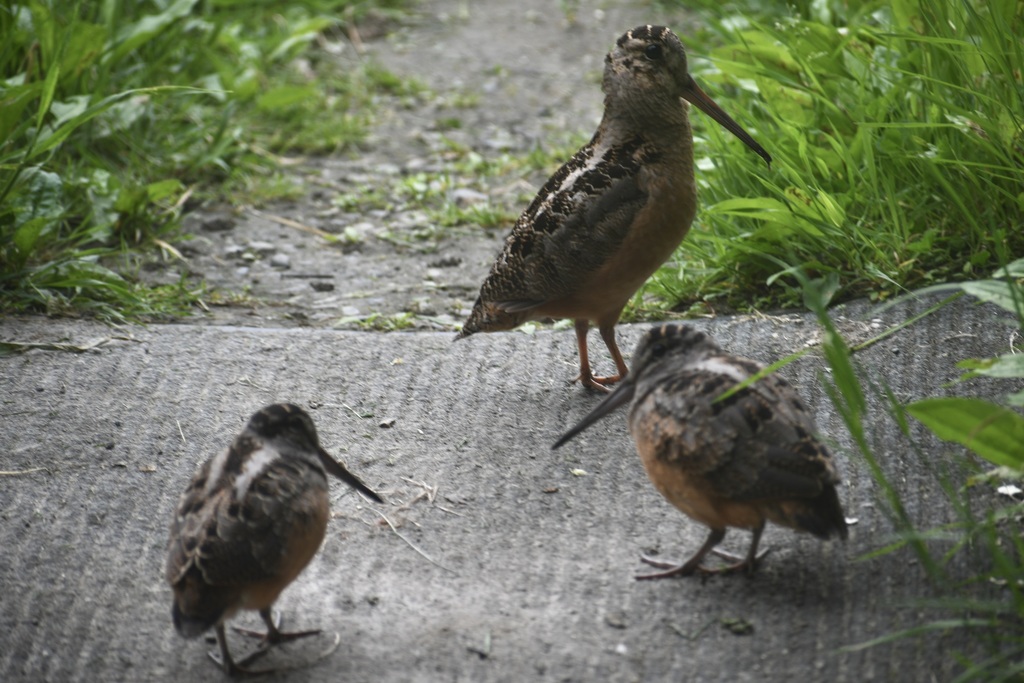
(c) Jason Hill, some rights reserved (CC BY) · licence
Family: Scolopacidae · Class: Aves · Order: Charadriiformes
Scolopax minor (American Woodcock) is a California animal in the Scolopacidae family.
The American Woodcock is a medium-sized shorebird with distinctive adaptations for its terrestrial lifestyle. Adults measure 25 to 31 cm (10 to 12 inches) in length and weigh 140 to 280 grams (5 to 10 ounces), with females typically larger than males. The species exhibits cryptic plumbing with mottled brown, black, and gray upperparts that provide excellent camouflage against forest floor debris. The underparts are buff to pale orange. Most distinctive is the bird's extremely long, straight bill measuring 6.5 to 7.5 cm (2.6 to 3.0 inches), specialized for probing soft soil. The eyes are positioned high on the head, allowing 360-degree vision while the bill remains buried in substrate. Historically, American Woodcock occurred throughout eastern North America from southeastern Canada to the Gulf Coast. In California, the species is considered a rare vagrant, with scattered records primarily from the Central Valley and coastal regions during fall and winter months. Most California observations occur between October and March, suggesting birds that have strayed from normal migration routes. The species' core breeding range encompasses the Great Lakes region eastward to the Atlantic Coast, with wintering grounds concentrated in the southeastern United States. American Woodcock inhabit young forest stands, forest edges, and brushy areas with moist, organic soils. Preferred habitats include alder thickets, aspen stands, and areas recovering from logging or natural disturbance. The species requires a mosaic of cover types: dense woody cover for daytime roosting, openings for courtship displays, and soft soils rich in earthworms for foraging. Suitable habitat typically occurs below 1,500 meters (4,900 feet) elevation. The species exhibits crepuscular and nocturnal activity patterns, spending daylight hours motionless in dense cover. Woodcock are specialized earthworm predators, using their flexible bill tips to detect and extract prey from soil. The bill contains specialized nerve endings called Herbst corpuscles that detect vibrations and pressure changes. Males perform elaborate courtship flights called "sky dancing" during spring, spiraling upward while producing twittering sounds with specialized wing feathers, then diving earthward with distinctive vocalizations. Females nest on the ground, laying four buff-colored eggs with dark spots. Incubation lasts 20 to 22 days, and precocial young leave the nest within hours of hatching. The American Woodcock is not federally listed but has experienced significant population declines. According to the North American Breeding Bird Survey, populations have declined approximately 1.1% annually since 1966. Primary threats include habitat loss due to forest maturation, urbanization, and changes in forest management practices. The species requires early successional forest habitat that has become increasingly scarce across its range. Climate change may affect soil moisture and earthworm availability. In California, the species' vagrant status means no specific conservation measures are implemented, though maintaining diverse forest age classes benefits the broader ecosystem.
Classification
Class: Aves · Order: Charadriiformes · Family: Scolopacidae
Frequently asked questions
How is Scolopax minor classified?
Scolopax minor belongs to class Aves, order Charadriiformes, family Scolopacidae.
What family does Scolopax minor belong to?
Scolopax minor is in the Scolopacidae family.
What is Scolopax minor?
The American Woodcock is a medium-sized shorebird with distinctive adaptations for its terrestrial lifestyle.
Is Scolopax minor found in California?
Yes. Scolopax minor is recorded in California in The California Species Project's catalogue.
Related species
Other California species in the same genus, family, or bioregion.
Data from The California Species Project — 14,000+ California species with verified data from CNPS, CDFW, USFWS, and more.