Scolopendra polymorpha
Common Desert Centipede
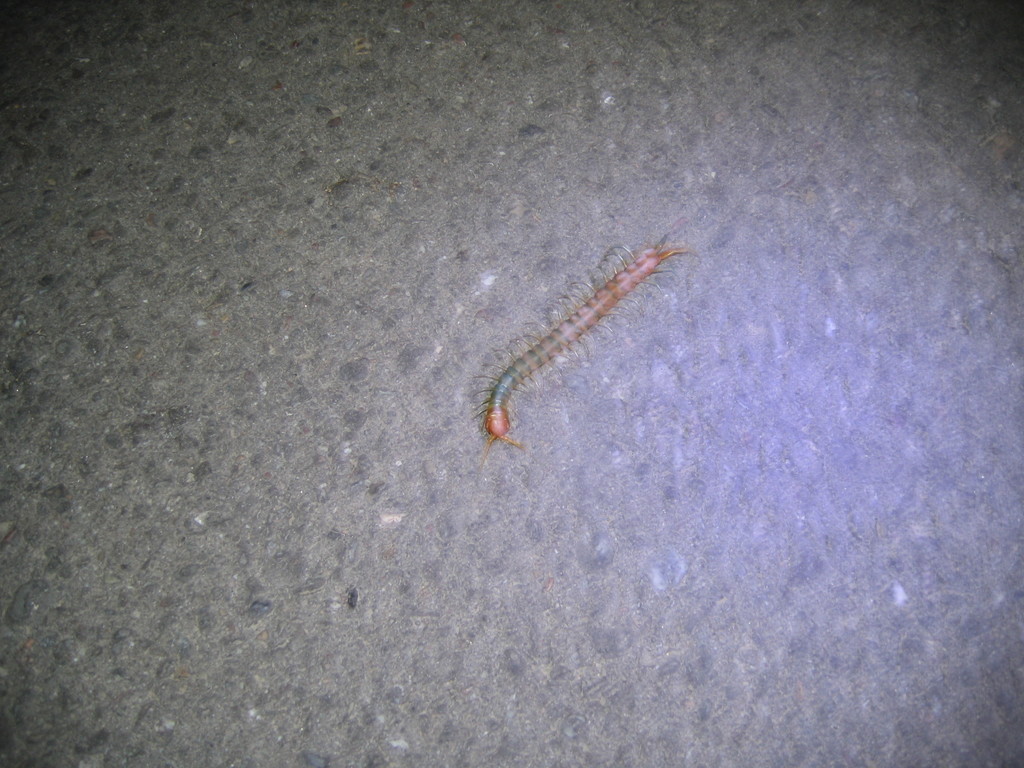
no rights reserved · CC0
Family: Scolopendridae · Class: Chilopoda · Order: Scolopendromorpha
Scolopendra polymorpha (Common Desert Centipede) is a California animal in the Scolopendridae family.
The Common Desert Centipede is a large arthropod belonging to the order Scolopendromorpha, characterized by its segmented body and numerous pairs of legs. Adults typically measure 76 to 152 mm (3 to 6 inches) in length, with some specimens reaching up to 203 mm (8 inches). The species exhibits considerable color variation, ranging from reddish-brown to dark brown or nearly black, with distinctive blue to purple legs that give rise to its alternate common name "blue leg centipede." The body consists of 21 segments, each bearing a pair of walking legs, plus a pair of modified front legs called forcipules that function as venomous fangs. Scolopendra polymorpha has the most extensive distribution of any North American centipede species, ranging throughout the western United States, British Columbia, and Mexico. In California, the species occurs primarily in the southern and central regions, extending north into the Central Valley and coastal areas. Documented occurrences include San Diego County, where specimens have been observed in urban areas such as Carlsbad, and extends northward through much of the state's arid and semi-arid regions. This centipede inhabits diverse environments including desert scrublands, chaparral, grasslands, and oak woodlands. The species shows extensive habitat flexibility, occurring from sea level to moderate elevations in mountainous terrain. It seeks shelter under rocks, logs, bark, and debris during daylight hours, and readily adapts to human-modified landscapes including suburban areas where it may be found under landscaping materials or occasionally entering buildings. Common Desert Centipedes are nocturnal predators that emerge at night to hunt for prey including insects, spiders, small reptiles, and other arthropods. They are aggressive hunters that use their venomous forcipules to subdue prey larger than themselves. Reproduction occurs through indirect sperm transfer, with males depositing spermatophores that females collect. Females guard their eggs and newly hatched young in underground chambers, exhibiting parental care behaviors documented in various Scolopendra species (Lewis 2010). The species can live several years under favorable conditions. When threatened, they can deliver a painful bite to humans through their venomous forcipules, typically causing localized pain, swelling, and redness lasting several hours, though reactions are generally not medically significant (BugGuide 2025). Currently, Scolopendra polymorpha has no federal or state conservation listing status and appears to maintain stable populations throughout its range. The species demonstrates considerable ecological adaptability and tolerance for habitat modification, allowing it to persist in both natural and disturbed environments. Its widespread distribution and habitat flexibility suggest the species faces no immediate conservation concerns. However, like many arthropods, comprehensive population monitoring data is limited, and the species' status in specific localities may vary based on local habitat conditions and human activities.
Classification
Class: Chilopoda · Order: Scolopendromorpha · Family: Scolopendridae
Frequently asked questions
How is Scolopendra polymorpha classified?
Scolopendra polymorpha belongs to class Chilopoda, order Scolopendromorpha, family Scolopendridae.
What family does Scolopendra polymorpha belong to?
Scolopendra polymorpha is in the Scolopendridae family.
What is Scolopendra polymorpha?
The Common Desert Centipede is a large arthropod belonging to the order Scolopendromorpha, characterized by its segmented body and numerous pairs of legs.
Is Scolopendra polymorpha found in California?
Yes. Scolopendra polymorpha is recorded in California in The California Species Project's catalogue.
More California species
This species has no close relatives in our California data — here are other species to explore.
Data from The California Species Project — 14,000+ California species with verified data from CNPS, CDFW, USFWS, and more.