Scolopocryptops spinicaudus
Thorn-tailed Bark Centipede
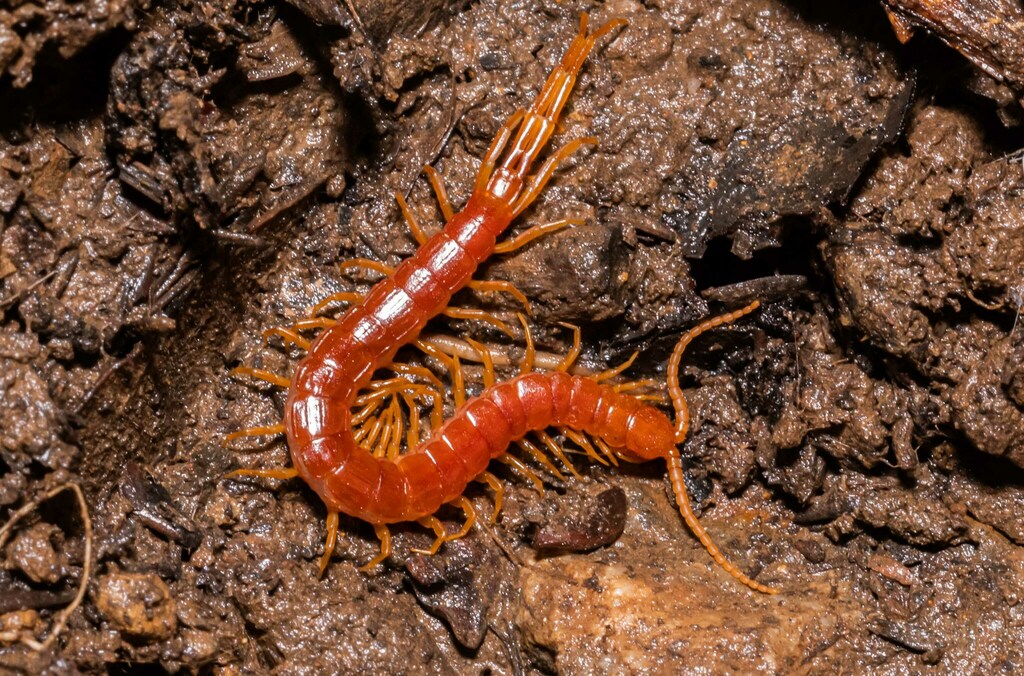
(c) Jeremiah Degenhardt, some rights reserved (CC BY) · licence
Family: Scolopocryptopidae · Class: Chilopoda · Order: Scolopendromorpha
Scolopocryptops spinicaudus (Thorn-tailed Bark Centipede) is a California animal in the Scolopocryptopidae family.
Scolopocryptops spinicaudus, commonly known as the thorn-tailed bark centipede, is a member of the family Scolopocryptopidae within the order Scolopendromorpha. As a scolopendromorph centipede, this species possesses 21 or 23 pairs of legs and displays the characteristic body plan of this order, with a flattened appearance adapted for life in confined spaces. The common name 'thorn-tailed' suggests the presence of distinctive spines or projections on the posterior segments, though specific morphological details require further documentation. The genus Scolopocryptops is represented in North America by several species, though comprehensive distributional data for S. spinicaudus remains limited. Based on the genus's general distribution patterns, this species likely occurs in western North America, potentially including California, though specific locality records require verification through systematic surveys. Many scolopocryptopid centipedes have restricted ranges and patchy distributions, making accurate range mapping challenging without extensive field work. Scolopocryptopid centipedes typically inhabit cryptic microhabitats, living under bark, in rotting logs, beneath stones, and in leaf litter. The family name itself reflects this bark-dwelling tendency. These centipedes prefer moist conditions and are commonly found in forest environments where decomposing organic matter provides suitable shelter and hunting grounds. They avoid direct sunlight and are most active during nighttime hours when humidity levels are higher. As predatory arthropods, scolopendromorph centipedes including S. spinicaudus are equipped with venomous forcipules (modified first legs) that they use to capture and subdue prey. Their diet likely consists of small invertebrates such as insects, spiders, and other soft-bodied arthropods encountered in their bark and litter habitats. Reproduction in scolopocryptopids typically involves indirect sperm transfer, with males depositing spermatophores that females subsequently pick up. Females may exhibit brooding behavior, guarding eggs and early-stage juveniles. Currently, S. spinicaudus has no formal conservation status at federal or state levels. The species does not appear on endangered species lists or conservation priority rankings as of December 2025. However, the lack of comprehensive biological data makes it difficult to assess population trends or conservation needs. Many invertebrate species, particularly those with cryptic lifestyles and limited distributions, remain poorly studied despite potentially facing habitat pressures from urban development, forest management practices, and climate change. Scientific documentation for this species remains extremely limited. Systematic studies of scolopocryptopid biology, distribution, and ecology in North America are needed to better understand species boundaries, habitat requirements, and conservation status. The information presented here represents the current state of available knowledge, highlighting the need for additional research on this and related centipede species.
Classification
Class: Chilopoda · Order: Scolopendromorpha · Family: Scolopocryptopidae
Frequently asked questions
How is Scolopocryptops spinicaudus classified?
Scolopocryptops spinicaudus belongs to class Chilopoda, order Scolopendromorpha, family Scolopocryptopidae.
What family does Scolopocryptops spinicaudus belong to?
Scolopocryptops spinicaudus is in the Scolopocryptopidae family.
What is Scolopocryptops spinicaudus?
Scolopocryptops spinicaudus, commonly known as the thorn-tailed bark centipede, is a member of the family Scolopocryptopidae within the order Scolopendromorpha.
Is Scolopocryptops spinicaudus found in California?
Yes. Scolopocryptops spinicaudus is recorded in California in The California Species Project's catalogue.
More California species
This species has no close relatives in our California data — here are other species to explore.
Data from The California Species Project — 14,000+ California species with verified data from CNPS, CDFW, USFWS, and more.