Scolops californicus
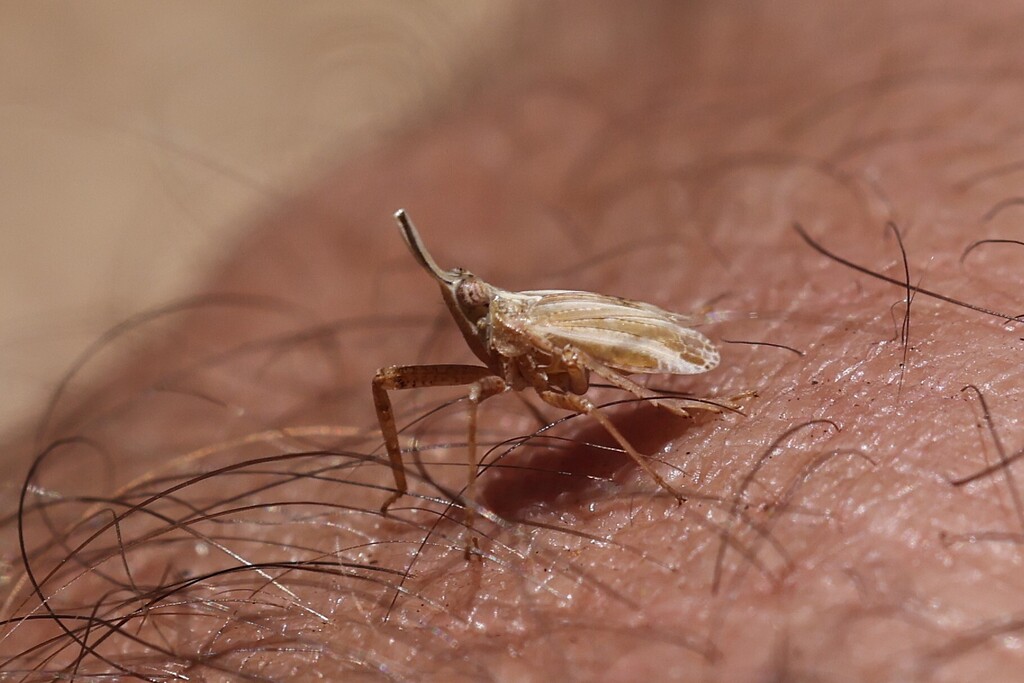
(c) nmoorhatch, some rights reserved (CC BY) · licence
Family: Dictyopharidae · Class: Insecta · Order: Hemiptera
Scolops californicus is a California animal in the Dictyopharidae family.
Scolops californicus is a planthopper species in the family Dictyopharidae, order Hemiptera. Like other members of this family, it is characterized by a distinctive cone-shaped head projection and membranous wings held tent-like over the body when at rest. Adult planthoppers in this group typically measure 4-8 mm in length, though specific morphometric data for S. californicus has not been well documented. The species exhibits the typical hemipteran piercing-sucking mouthparts adapted for feeding on plant fluids. The distribution of Scolops californicus appears to be restricted to California, as indicated by its specific epithet, though detailed range maps and locality records are not readily available in current literature. The genus Scolops contains several North American species, with various taxa distributed across different regions of the continent. Specific county-level distribution data and elevational ranges for S. californicus require further documentation. Habitat preferences for this species have not been thoroughly studied or published in accessible scientific literature. Members of the family Dictyopharidae are generally associated with herbaceous plants and grasses, often found in meadows, grasslands, and forest understory environments. Many dictyopharid planthoppers show preferences for specific host plant families, though the particular plant associations of S. californicus remain undocumented. The life cycle of S. californicus follows the typical hemimetabolous development pattern of planthoppers, with eggs, five nymphal instars, and adults. Nymphs and adults both feed by inserting their stylet-like mouthparts into plant tissues to extract phloem or xylem fluids. Seasonal activity patterns, reproductive timing, and overwintering strategies for this species have not been described in available literature. Like other dictyopharids, adults are likely capable of jumping and short-distance flight when disturbed. The conservation status of Scolops californicus has not been formally assessed by state or federal agencies. The species does not appear on current lists of threatened or endangered insects maintained by the California Department of Fish and Wildlife or the U.S. Fish and Wildlife Service as of December 2025. This lack of formal status likely reflects insufficient data on population trends, distribution, and ecological requirements rather than confirmed population stability. Comprehensive ecological studies of S. californicus are lacking in the scientific literature. The taxonomic validity and current systematic position of this species may require verification through modern morphological and molecular analyses. Many planthopper species described in earlier taxonomic works have undergone subsequent revision or synonymization. Additional field surveys, host plant studies, and life history research would significantly enhance understanding of this species' biology and conservation needs. Scientific documentation for this species remains limited. The information presented here synthesizes available taxonomic and distributional data. If you have additional verified information about this species' biology, distribution, or ecology, please contact us to help improve this species account.
Classification
Class: Insecta · Order: Hemiptera · Family: Dictyopharidae
Frequently asked questions
How is Scolops californicus classified?
Scolops californicus belongs to class Insecta, order Hemiptera, family Dictyopharidae.
What family does Scolops californicus belong to?
Scolops californicus is in the Dictyopharidae family.
What is Scolops californicus?
Scolops californicus is a planthopper species in the family Dictyopharidae, order Hemiptera.
Is Scolops californicus found in California?
Yes. Scolops californicus is recorded in California in The California Species Project's catalogue.
More California species
This species has no close relatives in our California data — here are other species to explore.
Data from The California Species Project — 14,000+ California species with verified data from CNPS, CDFW, USFWS, and more.