Scudderia furcata
Fork-tailed Bush Katydid
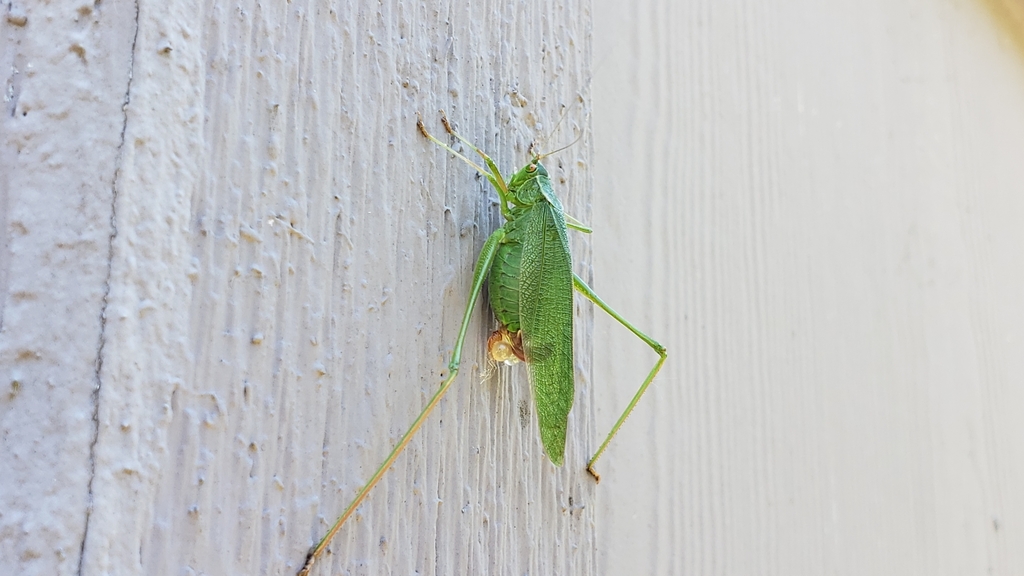
(c) Gavin Slater, some rights reserved (CC BY) · licence
Family: Tettigoniidae · Class: Insecta · Order: Orthoptera
Scudderia furcata (Fork-tailed Bush Katydid) is a California animal in the Tettigoniidae family.
The Fork-tailed Bush Katydid is a medium-sized orthopteran insect in the family Tettigoniidae. Adults typically measure 15-25 mm in body length, with females generally larger than males. The species displays predominantly green coloration that provides effective camouflage among vegetation. Males are distinguished by their characteristic supra-anal plate, which is large and inflated with lobes that form a deep U-shaped fork, giving the species its common name (BugGuide). This feature separates S. furcata from the closely related S. fasciata, which has dark striping on the tegmina. Scudderia furcata occurs throughout most of the United States and extends into southern Canada (BugGuide). The species is replaced in southern California, southern Arizona, and parts of west Texas by the closely related Scudderia mexicana. Regional color variations exist, with individuals from Texas, Louisiana, and Arkansas often displaying darker coloration or even pink hues. This broad distribution reflects the species' adaptability to diverse environmental conditions across temperate North America. The Fork-tailed Bush Katydid inhabits weedy fields, thickets, forest edges, and meadows (BugGuide). The species shows preference for areas with dense herbaceous vegetation that provides both food resources and shelter. These katydids are commonly found in transitional zones between forested and open areas, where they utilize both woody and herbaceous plants. Their habitat selection appears closely tied to the availability of suitable host plants and egg-laying sites. Adults and nymphs are omnivorous, feeding on a variety of plant materials including leaves, flowers, and occasionally other insects. Nymphs are frequently observed feeding on flowers of various herbaceous plants (BugGuide). The species exhibits typical katydid reproductive behavior, with males producing characteristic calls to attract females. Eggs are typically laid singly or in rows along leaf edges, with at least the base inserted within the leaf tissue for protection. Eggs overwinter and hatch in spring, producing one generation per year. This univoltine life cycle is well-adapted to temperate climates where winter conditions preclude year-round activity. The Fork-tailed Bush Katydid currently has no special conservation status listings at federal or state levels. According to NatureServe, the species maintains a Global Status of G5, indicating it is secure globally with no immediate conservation concerns. This status reflects the species' wide distribution, habitat generalist tendencies, and stable populations across its range. The species appears to tolerate moderate levels of habitat disturbance and may even benefit from edge habitats created by human activities. However, like many insects dependent on native plant communities, populations may face localized pressures from intensive agriculture, urbanization, and invasive plant species that alter natural vegetation structure and composition.
Classification
Class: Insecta · Order: Orthoptera · Family: Tettigoniidae
Frequently asked questions
How is Scudderia furcata classified?
Scudderia furcata belongs to class Insecta, order Orthoptera, family Tettigoniidae.
What family does Scudderia furcata belong to?
Scudderia furcata is in the Tettigoniidae family.
What is Scudderia furcata?
The Fork-tailed Bush Katydid is a medium-sized orthopteran insect in the family Tettigoniidae.
Is Scudderia furcata found in California?
Yes. Scudderia furcata is recorded in California in The California Species Project's catalogue.
Related species
Other California species in the same genus, family, or bioregion.
Data from The California Species Project — 14,000+ California species with verified data from CNPS, CDFW, USFWS, and more.