Scutigera coleoptrata
House Centipede
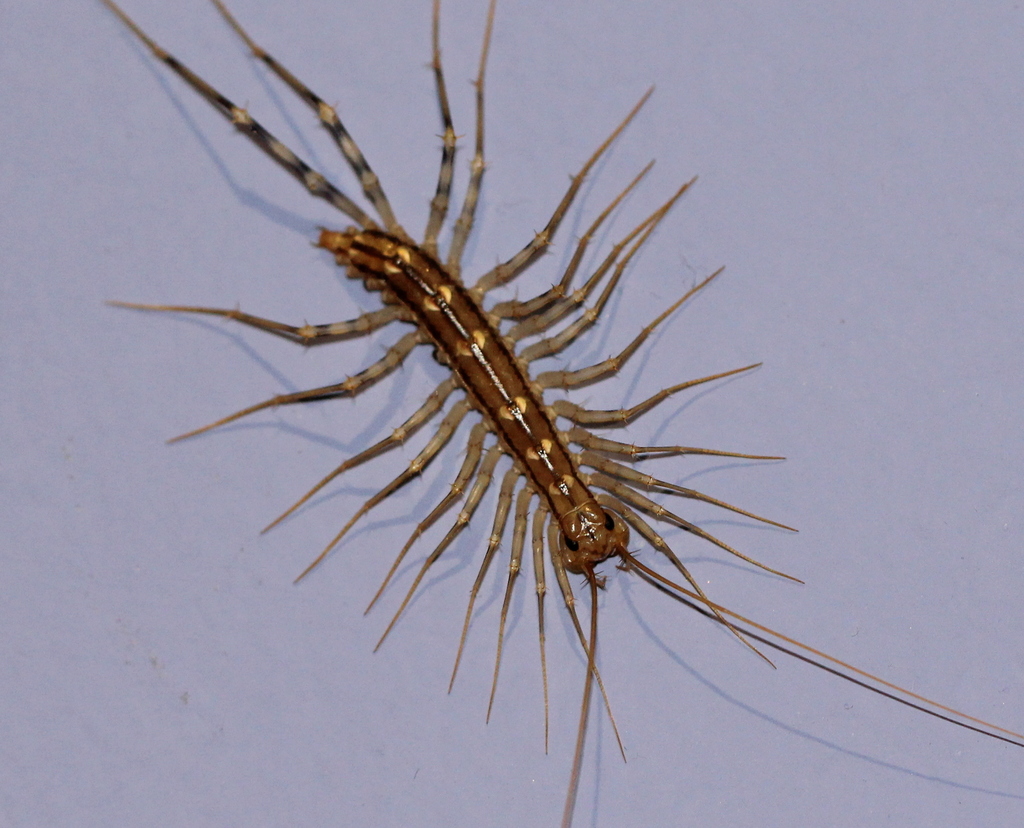
(c) Cecile Roux, some rights reserved (CC BY-SA) · licence
Family: Scutigeridae · Class: Chilopoda · Order: Scutigeromorpha
Scutigera coleoptrata (House Centipede) is a California animal in the Scutigeridae family.
The house centipede is a distinctive arthropod measuring 25 to 50 millimeters (1.0 to 2.0 inches) in body length, with extremely long legs that can span up to 76 millimeters (3 inches). The body is yellowish-gray to brown with three dark longitudinal stripes running along the dorsal surface. Fifteen pairs of progressively longer legs extend from the body, with the posterior legs being approximately twice the body length. The antennae are exceptionally long, often exceeding body length, and consist of numerous segments that give them a thread-like appearance. Native to the Mediterranean region, Scutigera coleoptrata has become cosmopolitan through human transport and is now established throughout much of North America, including California. According to BugGuide observations, the species occurs across California from coastal areas to inland valleys, with documented records from Yolo County and other regions throughout the state. The species has successfully colonized urban and suburban environments across temperate regions worldwide. House centipedes require consistently moist environments and are typically found in basements, bathrooms, cellars, and other humid areas of buildings. They prefer temperatures between 15 and 25 degrees Celsius (59 to 77 degrees Fahrenheit) and relative humidity above 75 percent. Outdoors, they inhabit leaf litter, under stones, in rotting logs, and similar protected microhabitats. Their bodies desiccate rapidly in dry conditions, making moisture availability a critical habitat requirement (BugGuide). This species is a nocturnal predator that feeds on various household arthropods including spiders, silverfish, cockroaches, flies, moths, and other small invertebrates. House centipedes are exceptionally fast runners, capable of moving at speeds up to 0.4 meters per second (1.3 feet per second), using their long legs to pursue prey across walls and ceilings. They capture prey using their modified front legs called forcipules, which inject venom to immobilize victims. Reproduction involves indirect sperm transfer through spermatophores, with females laying 60 to 150 eggs in soil or other protected locations. The species exhibits anamorphic development, hatching with fewer leg pairs and adding segments through successive molts over 2 to 3 years to reach sexual maturity. Scutigera coleoptrata has no conservation status designation and is not considered threatened or endangered. As a non-native species that has adapted well to anthropogenic environments, populations appear stable and may be increasing in urban areas. The species is generally beneficial to humans as it controls pest insects, though many people find their appearance alarming. While capable of biting if handled, house centipedes are not considered dangerous to humans, with bites typically causing only minor local irritation similar to a bee sting. Their presence in buildings often indicates adequate moisture levels and prey availability rather than any conservation concern.
Classification
Class: Chilopoda · Order: Scutigeromorpha · Family: Scutigeridae
Frequently asked questions
How is Scutigera coleoptrata classified?
Scutigera coleoptrata belongs to class Chilopoda, order Scutigeromorpha, family Scutigeridae.
What family does Scutigera coleoptrata belong to?
Scutigera coleoptrata is in the Scutigeridae family.
What is Scutigera coleoptrata?
The house centipede is a distinctive arthropod measuring 25 to 50 millimeters (1.0 to 2.0 inches) in body length, with extremely long legs that can span up to 76 millimeters (3 inches).
Is Scutigera coleoptrata found in California?
Yes. Scutigera coleoptrata is recorded in California in The California Species Project's catalogue.
More California species
This species has no close relatives in our California data — here are other species to explore.
Data from The California Species Project — 14,000+ California species with verified data from CNPS, CDFW, USFWS, and more.