Sebastes miniatus
Vermilion Rockfish
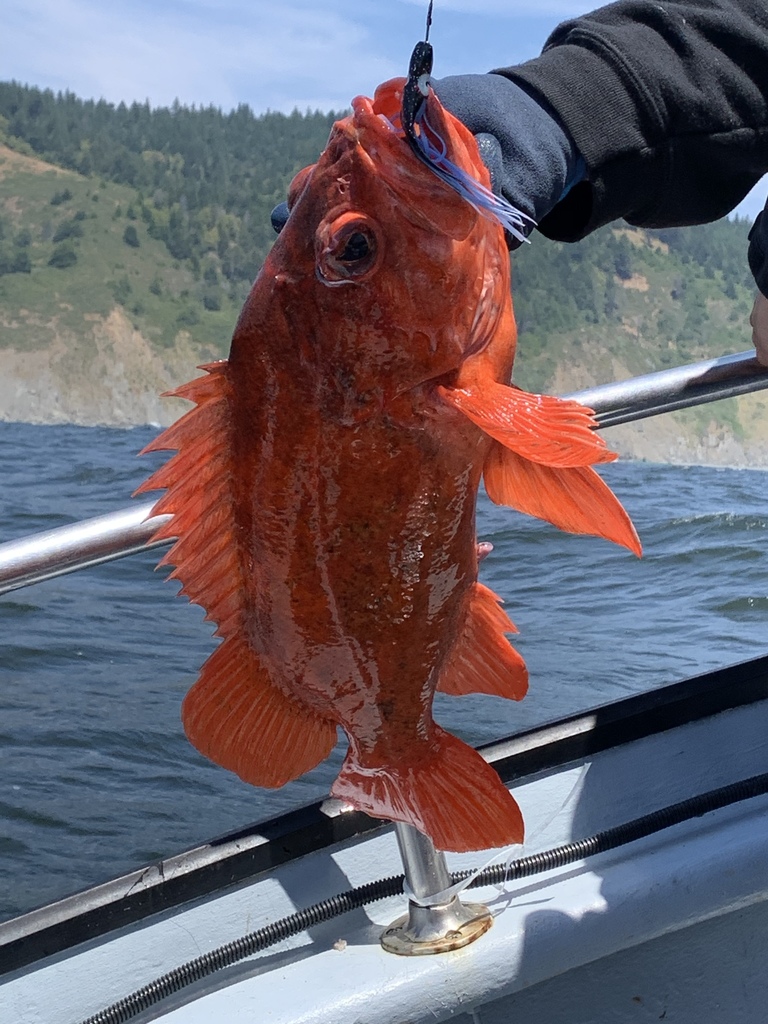
(c) Brook, some rights reserved (CC BY) · licence
Family: Scorpaenidae · Class: Actinopterygii · Order: Scorpaeniformes
Sebastes miniatus (Vermilion Rockfish) is a California animal in the Scorpaenidae family.
The vermilion rockfish is a medium-sized marine fish that can reach lengths of up to 76 centimeters (30 inches) and weights exceeding 6.8 kilograms (15 pounds). Adults display bright orange to red coloration with darker mottling along the back and sides, while juveniles often exhibit more pronounced yellow tones. The species has a robust, laterally compressed body with a large mouth, prominent lower jaw, and spiny dorsal fin. Three to five orange stripes radiate from each eye, and the fins are typically orange to red with dusky margins. Vermilion rockfish occur along the Pacific Coast from British Columbia to Baja California, Mexico. In California waters, the species is distributed from the Oregon border south to Point Conception, with populations extending into Southern California waters. According to California Department of Fish and Wildlife documentation, vermilion rockfish are present in marine protected areas including Carmel Pinnacles State Marine Reserve, Point Conception State Marine Reserve, Vandenberg State Marine Reserve, and Harris Point State Marine Reserve. This species inhabits rocky reefs, kelp forests, and rocky pinnacles from nearshore waters to depths of approximately 300 meters (984 feet), though most commonly found between 50 and 150 meters (164 to 492 feet). Vermilion rockfish prefer areas with complex bottom structure, including rocky outcroppings, boulder fields, and kelp forest edges. Adults are typically associated with deeper rocky reefs, while juveniles often utilize shallow kelp beds and rocky intertidal areas as nursery habitat. Vermilion rockfish are opportunistic predators feeding primarily on small fish, squid, octopus, and crustaceans. Their diet includes anchovies, sardines, juvenile rockfish, market squid, and various crab species. The species exhibits slow growth and late sexual maturity, with females reaching reproductive age between 5 and 20 years depending on location and environmental conditions. Spawning occurs from winter through early summer, with females releasing larvae into the water column where they develop in the plankton for several months before settling to suitable bottom habitat. Vermilion rockfish are managed as part of the Pacific Coast groundfish complex under the Pacific Fishery Management Council. The species is not federally listed under the Endangered Species Act as of December 2025, but populations have experienced significant fishing pressure historically. Current management measures include size limits, bag limits, and seasonal closures designed to protect spawning aggregations and allow population recovery. In California, the species benefits from protection within the state's network of marine protected areas, where fishing is prohibited or restricted. Stock assessments indicate that vermilion rockfish populations north of Point Conception are in better condition than those in Southern California, where intensive fishing pressure and habitat degradation have contributed to population decline. The species' slow growth rate, late maturity, and longevity make it particularly vulnerable to overfishing, requiring careful management to ensure sustainable harvest levels.
Classification
Class: Actinopterygii · Order: Scorpaeniformes · Family: Scorpaenidae
Frequently asked questions
How is Sebastes miniatus classified?
Sebastes miniatus belongs to class Actinopterygii, order Scorpaeniformes, family Scorpaenidae.
What family does Sebastes miniatus belong to?
Sebastes miniatus is in the Scorpaenidae family.
What is Sebastes miniatus?
The vermilion rockfish is a medium-sized marine fish that can reach lengths of up to 76 centimeters (30 inches) and weights exceeding 6.8 kilograms (15 pounds).
Is Sebastes miniatus found in California?
Yes. Sebastes miniatus is recorded in California in The California Species Project's catalogue.
Related species
Other California species in the same genus, family, or bioregion.
Data from The California Species Project — 14,000+ California species with verified data from CNPS, CDFW, USFWS, and more.