Selasphorus calliope
Calliope Hummingbird
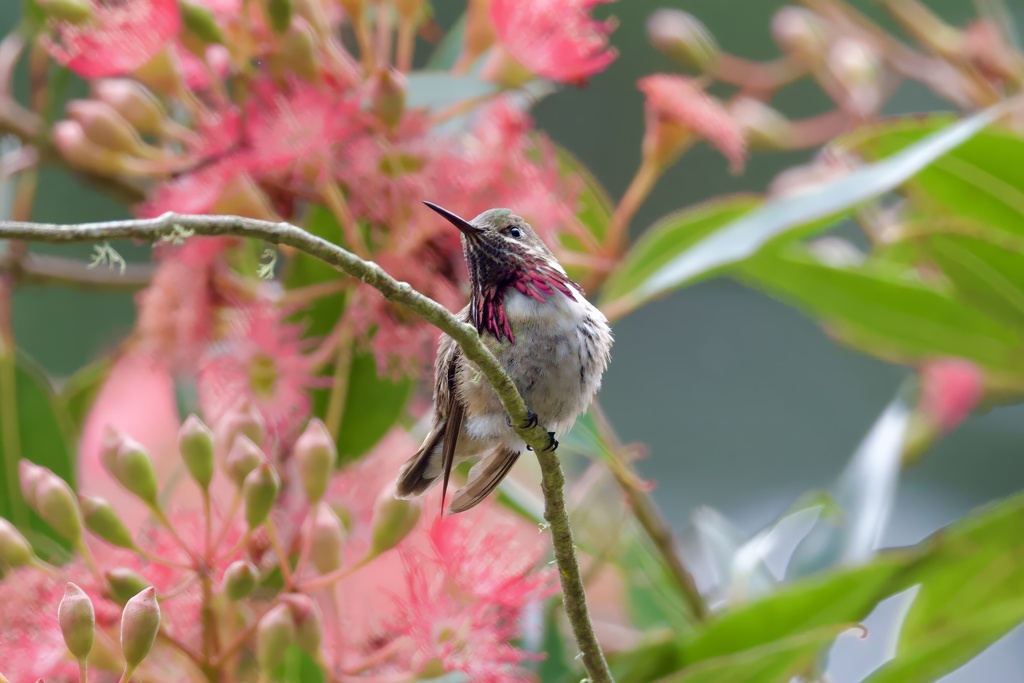
no rights reserved · CC0
Family: Trochilidae · Class: Aves · Order: Apodiformes
Selasphorus calliope (Calliope Hummingbird) is a California animal in the Trochilidae family.
The Calliope Hummingbird is North America's smallest breeding bird, measuring 7.5 to 10 cm (3.0 to 3.9 inches) in length with a wingspan of 11 cm (4.3 inches). Adult males weigh 2.3 to 2.9 grams, while females weigh 2.4 to 3.4 grams. Males display distinctive magenta-purple streaks radiating from the throat onto a white base, creating a striking gorget pattern. The upperparts are metallic green, and the tail is relatively short with white-tipped outer feathers. Females lack the colorful throat markings, instead showing white underparts with buff flanks and a greenish back. Both sexes have straight, thin bills adapted for nectar feeding. The species breeds across mountainous regions of western North America, from southern British Columbia through the western United States to Baja California. In California, breeding populations occur primarily in the Sierra Nevada, Cascade Range, and northern Coast Ranges. During migration, the species travels through lower elevation areas and can be observed throughout much of the state. Winter range extends from central Mexico to southern Mexico, with the species completing one of the longest migrations relative to body size of any bird. Calliope Hummingbirds inhabit montane forests and woodland edges at elevations ranging from 1,200 to 3,200 meters (4,000 to 10,500 feet). Preferred breeding habitat includes open coniferous forests dominated by Douglas fir, ponderosa pine, and lodgepole pine, often near meadows, clearings, or riparian areas. The species shows strong association with areas containing abundant flowering plants, particularly red-flowered species such as Indian paintbrush, penstemon, and currant. During migration, they utilize a broader range of habitats including oak woodlands, chaparral, and desert areas with blooming plants. Diet consists primarily of nectar from tubular flowers, supplemented with small insects and spiders for protein. Males establish feeding territories around nectar sources during the breeding season, aggressively defending these areas from other hummingbirds and insects. Breeding occurs from May through July, with females constructing cup-shaped nests on horizontal conifer branches, typically 1.5 to 25 meters above ground. The nest, built with plant down, lichens, and spider webs, measures approximately 3.2 cm in diameter. Females lay two white eggs measuring about 12.9 by 8.5 mm and incubate them for 15 to 16 days. Young fledge after 18 to 23 days. The Calliope Hummingbird is not federally or state listed and maintains stable populations across most of its range. According to the North American Breeding Bird Survey, populations have remained relatively stable since 1970, though some localized declines have been documented. Primary conservation concerns include habitat loss from logging, development, and climate change effects on montane ecosystems. Wildfire management practices that maintain natural forest openings may benefit the species by preserving the mosaic of forest and meadow habitats it requires.
Classification
Class: Aves · Order: Apodiformes · Family: Trochilidae
Frequently asked questions
How is Selasphorus calliope classified?
Selasphorus calliope belongs to class Aves, order Apodiformes, family Trochilidae.
What family does Selasphorus calliope belong to?
Selasphorus calliope is in the Trochilidae family.
What is Selasphorus calliope?
The Calliope Hummingbird is North America's smallest breeding bird, measuring 7.5 to 10 cm (3.0 to 3.9 inches) in length with a wingspan of 11 cm (4.3 inches).
Is Selasphorus calliope found in California?
Yes. Selasphorus calliope is recorded in California in The California Species Project's catalogue.
Related species
Other California species in the same genus, family, or bioregion.
Data from The California Species Project — 14,000+ California species with verified data from CNPS, CDFW, USFWS, and more.