Selasphorus platycercus
Broad-tailed Hummingbird
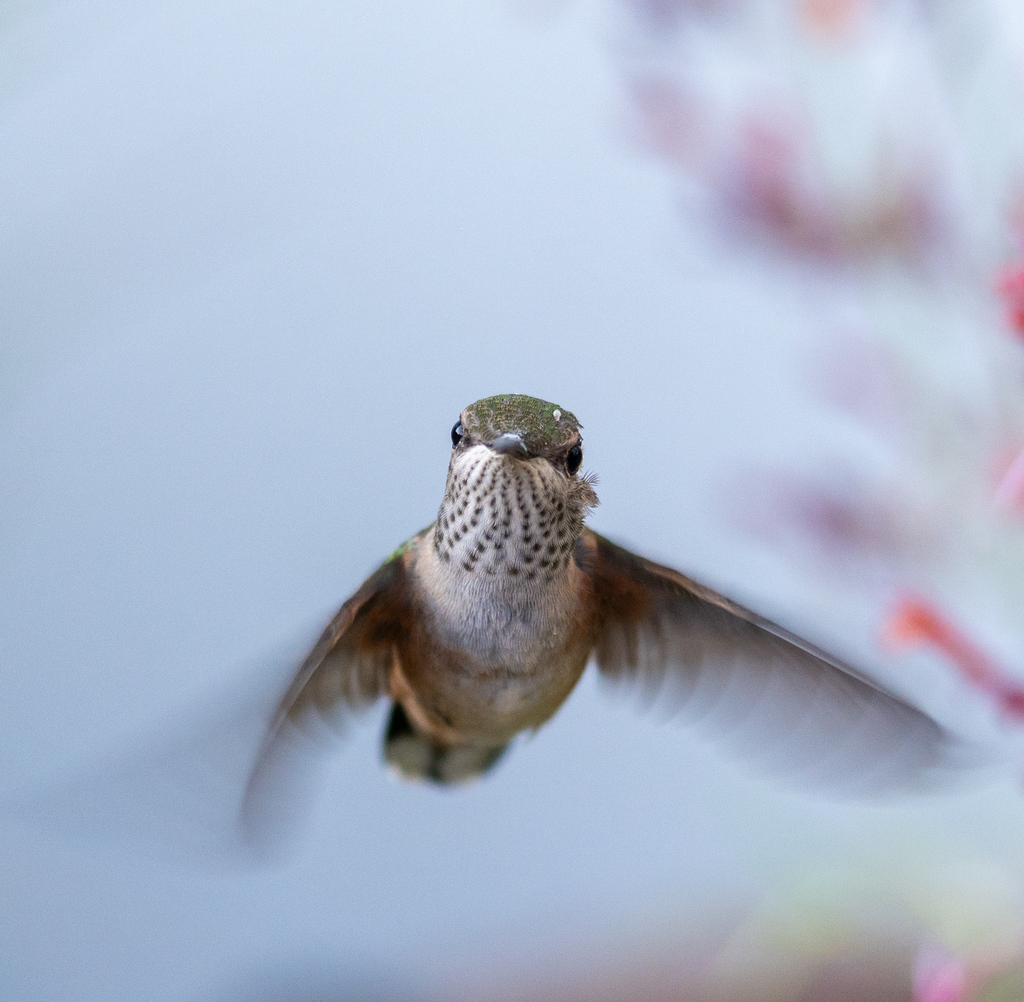
(c) Bob Walker, some rights reserved (CC BY) · licence
Family: Trochilidae · Class: Aves · Order: Apodiformes
Selasphorus platycercus (Broad-tailed Hummingbird) is a California animal in the Trochilidae family.
The Broad-tailed Hummingbird is a medium-sized hummingbird measuring 8.9 to 10.2 cm (3.5 to 4.0 inches) in length with a wingspan of 13 cm (5.1 inches). Adult males weigh 3.1 to 4.0 grams, while females are slightly heavier at 3.2 to 4.8 grams. Males display iridescent rose-red gorgets that appear black in poor lighting, emerald-green backs and crowns, and distinctive broad, rounded tail feathers with dark tips. The species' namesake tail creates a distinctive metallic trilling sound during flight, produced by air passing through specialized outer tail feathers. Females lack the colorful gorget, instead showing white throats with fine dark speckling, green backs, and white-tipped outer tail feathers with rufous, green, and black banding. Broad-tailed Hummingbirds breed primarily in montane regions of the western United States, with California representing the northwestern edge of their range. In California, they occur mainly in the Sierra Nevada, particularly in the eastern slopes and southern Cascade Range. Their breeding range extends from central Idaho and western Montana south through the Rocky Mountains to Guatemala. During winter, most populations migrate to Mexico, though some individuals remain in the southwestern United States. This species inhabits montane coniferous and mixed forests, mountain meadows, and riparian areas at elevations ranging from 1,200 to 3,400 meters (3,900 to 11,200 feet). They show strong preference for areas with abundant flowering plants, particularly favoring habitats with a mix of forest openings and meadows. Key habitat features include proximity to water sources and diverse nectar-producing plants such as paintbrush, penstemon, larkspur, and various composites. During migration, they utilize lower elevation habitats including desert regions and foothills. Broad-tailed Hummingbirds are highly territorial during breeding season, with males establishing and defending feeding territories around clusters of flowers. Their diet consists primarily of nectar from tubular flowers, supplemented by small arthropods including gnats, midges, aphids, and spiders, which provide essential proteins for growth and reproduction. Breeding occurs from late May through July, with females constructing small cup-shaped nests of plant down, spider silk, and lichen on horizontal branches 1.5 to 4.6 meters above ground. Clutch size is typically two white eggs, measuring approximately 12.9 by 8.6 mm. Incubation lasts 14 to 17 days, with fledging occurring 21 to 26 days after hatching. The species is not federally or state-listed and maintains stable populations throughout most of its range. Climate change poses potential long-term threats through shifts in flowering phenology and suitable habitat elevation zones. Habitat loss from development and altered fire regimes in montane forests represent additional conservation concerns. According to the North American Breeding Bird Survey, populations have remained relatively stable from 1966 to 2019, though some regional variations exist. The species benefits from habitat management that maintains diverse flowering plant communities in montane ecosystems.
Classification
Class: Aves · Order: Apodiformes · Family: Trochilidae
Frequently asked questions
How is Selasphorus platycercus classified?
Selasphorus platycercus belongs to class Aves, order Apodiformes, family Trochilidae.
What family does Selasphorus platycercus belong to?
Selasphorus platycercus is in the Trochilidae family.
What is Selasphorus platycercus?
The Broad-tailed Hummingbird is a medium-sized hummingbird measuring 8.9 to 10.2 cm (3.5 to 4.0 inches) in length with a wingspan of 13 cm (5.1 inches).
Is Selasphorus platycercus found in California?
Yes. Selasphorus platycercus is recorded in California in The California Species Project's catalogue.
Related species
Other California species in the same genus, family, or bioregion.
Data from The California Species Project — 14,000+ California species with verified data from CNPS, CDFW, USFWS, and more.