Selasphorus sasin
Allen's Hummingbird
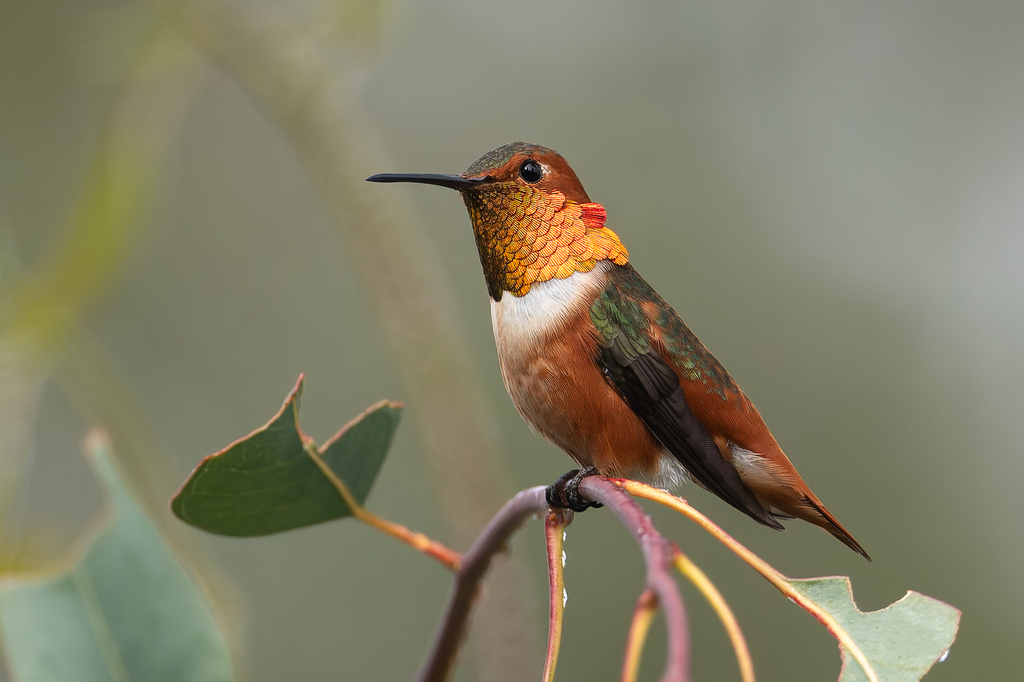
no rights reserved · CC0
Family: Trochilidae · Class: Aves · Order: Apodiformes
Selasphorus sasin (Allen's Hummingbird) is a California animal in the Trochilidae family.
Allen's Hummingbird is a small, sexually dimorphic hummingbird species endemic to western North America. Adult males measure 7.5 to 9 cm (3.0 to 3.5 inches) in length with a wingspan of 11 cm (4.3 inches) and weigh 2 to 4 grams. Males display iridescent orange-red throats (gorgets) that extend onto the sides of the neck, bronze-green backs, and rufous flanks and tail. The outer tail feathers are notably narrow and pointed. Females are larger, measuring 8.5 to 9.5 cm (3.3 to 3.7 inches), with green backs, white underparts spotted with rufous on the flanks, and rufous-based outer tail feathers with white tips. Both sexes have straight, needle-like bills adapted for nectar feeding. Allen's Hummingbird breeds along the Pacific Coast from southern Oregon through Baja California, with the core breeding range concentrated in California coastal regions from Humboldt County south to Los Angeles County. The species exhibits a unique migration pattern, with most populations following an elliptical route through Arizona and Mexico during fall migration, returning via coastal routes in late winter. A small resident population exists on the Channel Islands, particularly San Clemente Island, which has been genetically isolated and may represent a distinct subspecies. This species occupies diverse coastal and near-coastal habitats from sea level to 1,800 meters (5,900 feet) elevation. Primary breeding habitats include coastal scrub, chaparral, riparian woodlands, and residential gardens with abundant flowering plants. Allen's Hummingbirds show strong associations with native plant communities, particularly those containing salvia, fuchsia, and tree tobacco. Urban and suburban environments with exotic flowering plants also support populations, though habitat quality varies. Allen's Hummingbirds are nectar specialists, visiting flowers of various native and non-native plants. They supplement their diet with small arthropods captured through hawking and gleaning behaviors, providing essential proteins for reproduction and molting. Males establish territories around concentrated nectar sources and perform elaborate courtship displays, including high-speed dives that produce distinctive whistling sounds created by modified tail feathers. Breeding occurs from February through July, with peak nesting activity from March through May. Females construct small cup nests using plant fibers, spider webs, and lichen, typically placing them on horizontal branches 1 to 9 meters above ground. Clutch size is consistently two white eggs, with incubation lasting 15 to 17 days. Allen's Hummingbird is not federally listed and maintains stable populations across most of its range as of December 2025. However, the species faces habitat pressures from coastal development, particularly in Southern California where urban expansion continues to fragment suitable habitat. Climate change poses additional concerns through altered flowering phenology of food plants and potential shifts in suitable habitat zones. Fire management practices that reduce native shrubland communities also impact local populations. The subspecies on San Clemente Island warrants monitoring due to its limited range and potential genetic isolation. Conservation efforts focus on habitat preservation and restoration of native plant communities that provide reliable nectar sources throughout the breeding season.
Classification
Class: Aves · Order: Apodiformes · Family: Trochilidae
Frequently asked questions
How is Selasphorus sasin classified?
Selasphorus sasin belongs to class Aves, order Apodiformes, family Trochilidae.
What family does Selasphorus sasin belong to?
Selasphorus sasin is in the Trochilidae family.
What is Selasphorus sasin?
Allen's Hummingbird is a small, sexually dimorphic hummingbird species endemic to western North America.
Is Selasphorus sasin found in California?
Yes. Selasphorus sasin is recorded in California in The California Species Project's catalogue.
Related species
Other California species in the same genus, family, or bioregion.
Data from The California Species Project — 14,000+ California species with verified data from CNPS, CDFW, USFWS, and more.