Serradigitus gertschi
Sawfinger Scorpion
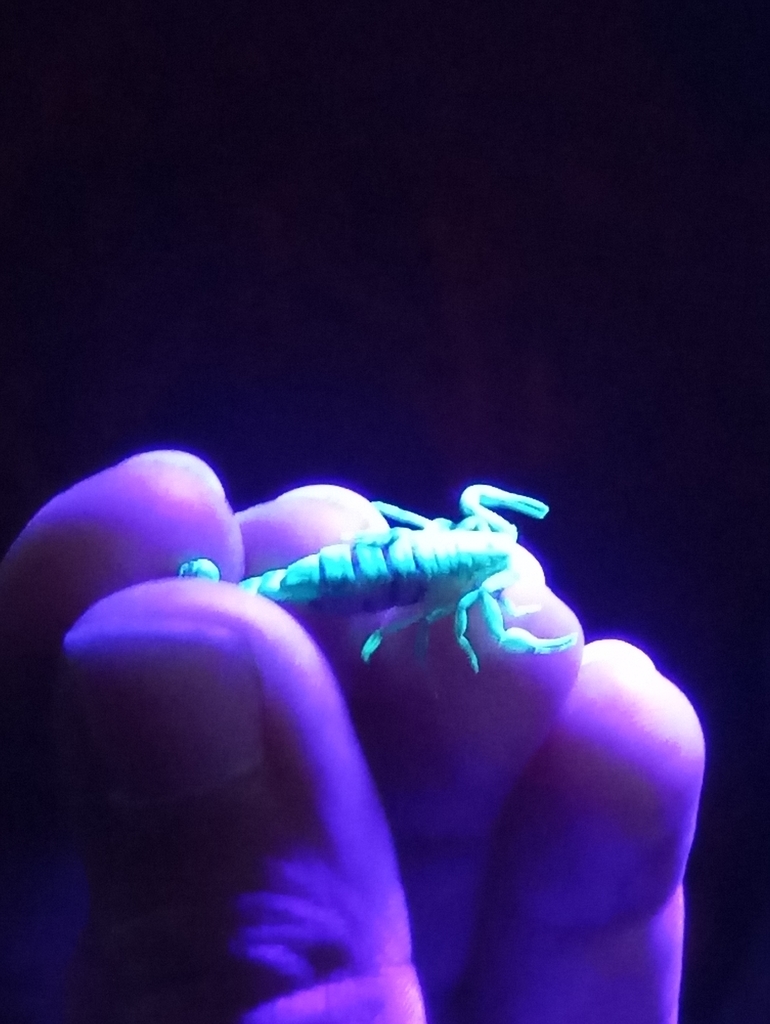
no rights reserved · CC0
Family: Vaejovidae · Class: Arachnida · Order: Scorpiones
Serradigitus gertschi (Sawfinger Scorpion) is a California animal in the Vaejovidae family.
The Sawfinger Scorpion (Serradigitus gertschi) is a small arachnid measuring approximately 20-40 mm in total length, with documented specimens ranging around 25 mm (BugGuide 2017). This species belongs to the family Vaejovidae and is distinguished by its characteristic sawblade-like appearance of the main row of denticles on the pedipalp fingers, which remain uninterrupted except by larger granules. The fixed finger displays trichobothria ib and it positioned approximately halfway down the finger length rather than at the base. In females, the proximalmost pectinal teeth are notably enlarged and typically lack sensillae. Serradigitus gertschi occurs in California, with documented populations in Los Angeles County (Simi Valley) and Santa Clara County (Mt. Hamilton), as well as Death Valley in Inyo County (BugGuide). The species' broader range extends from the Big Bend region of Texas westward through Arizona to California, and northward into Colorado, Utah, and possibly Idaho. Within California, the species appears distributed across both coastal and interior mountain ranges as well as desert regions. This scorpion inhabits rocky environments, showing a strong preference for areas with large boulders, roadcuts, and cliff faces (BugGuide). Observations indicate the species seeks shelter under rocks during daylight hours, emerging at night to hunt. The rocky habitat preference appears consistent across its range, from desert boulder fields to mountainous terrain. Elevation ranges vary considerably given the species' distribution from desert valleys to mountain slopes. Sawfinger Scorpions are nocturnal predators that feed primarily on small arthropods including insects and other arachnids. Like other scorpions, they use their pedipalps to capture prey and inject venom through their tail stinger. The species exhibits typical scorpion reproductive behavior, with males transferring sperm packets to females through elaborate courtship rituals. Females give birth to live young that initially ride on the mother's back until their first molt. Seasonal activity patterns likely follow typical scorpion cycles, with reduced activity during colder months and peak activity during warmer periods. Serradigitus gertschi does not appear on federal or state endangered species lists as of December 2025. The species is not listed in the USFWS ECOS database, indicating no current federal conservation concern. However, like many arachnids, this species may face localized threats from habitat modification, urbanization, and collection pressure in some areas. The species' apparent dependence on rocky habitats could make it vulnerable to quarrying operations and development in suitable habitat areas. Limited scientific study of this species means population trends and conservation needs remain poorly documented. Additional research is needed to better understand the species' distribution, population status, and ecological requirements within California.
Classification
Class: Arachnida · Order: Scorpiones · Family: Vaejovidae
Frequently asked questions
How is Serradigitus gertschi classified?
Serradigitus gertschi belongs to class Arachnida, order Scorpiones, family Vaejovidae.
What family does Serradigitus gertschi belong to?
Serradigitus gertschi is in the Vaejovidae family.
What is Serradigitus gertschi?
The Sawfinger Scorpion (Serradigitus gertschi) is a small arachnid measuring approximately 20-40 mm in total length, with documented specimens ranging around 25 mm (BugGuide 2017).
Is Serradigitus gertschi found in California?
Yes. Serradigitus gertschi is recorded in California in The California Species Project's catalogue.
Related species
Other California species in the same genus, family, or bioregion.
Data from The California Species Project — 14,000+ California species with verified data from CNPS, CDFW, USFWS, and more.