Setagrotis pallidicollis
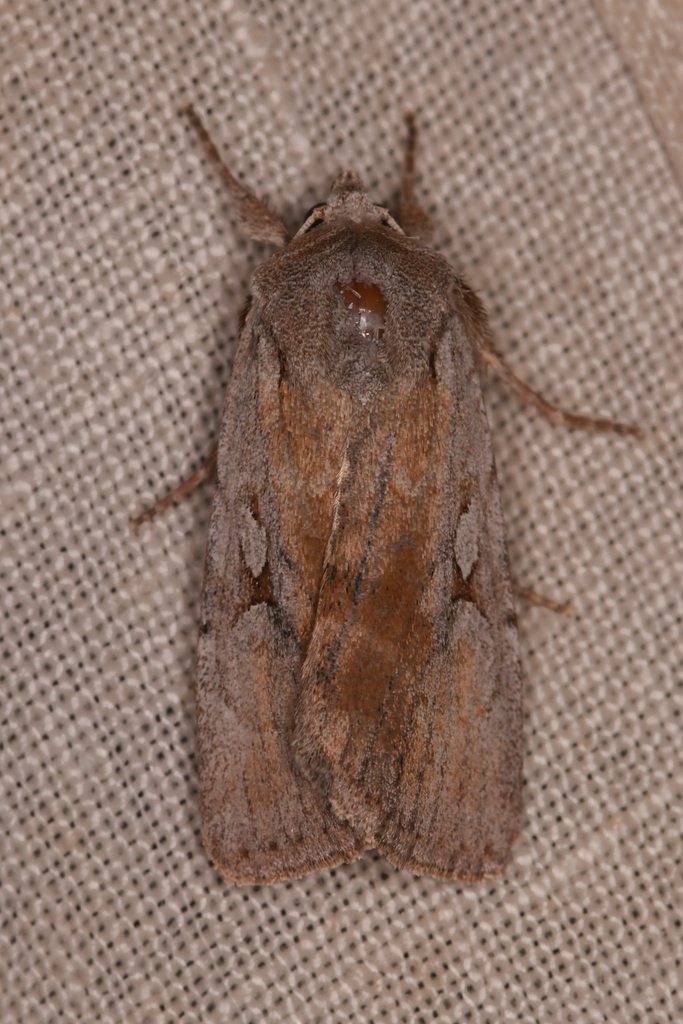
(c) Trevor Van Loon, some rights reserved (CC BY) · licence
Family: Noctuidae · Class: Insecta · Order: Lepidoptera
Setagrotis pallidicollis is a California animal in the Noctuidae family.
Setagrotis pallidicollis is a nocturnal moth in the family Noctuidae, commonly known as cutworm moths or owlet moths. This species belongs to a genus of moths whose larvae are typically associated with deciduous woody plants. Adults exhibit the characteristic features of noctuids, with forewings that are typically brownish or grayish and hindwings that are generally paler. The species displays sexual dimorphism common in many noctuid moths, with males typically having more feathered antennae used for detecting female pheromones. Setagrotis pallidicollis has a broad distribution across western North America, ranging from Alberta and British Columbia in Canada southward through Montana, Idaho, Washington, Oregon, and California in the United States. This extensive range suggests the species is adapted to various climatic conditions across different latitudes and elevations. The distribution spans multiple biogeographic regions, from boreal forests in the north to temperate zones in the south. The species inhabits areas where its host plants are present, primarily in riparian zones, forest edges, and mountainous regions where deciduous shrubs thrive. Setagrotis pallidicollis larvae feed on deciduous shrubs, particularly serviceberry (Amelanchier alnifolia) and alder (Alnus species). These host plants are commonly found in moist soils along streams, in canyons, and on mountain slopes at various elevations. The association with these specific host plants limits the moth's habitat to areas where these shrubs naturally occur or have been established. Adult moths are typically active during late spring through summer months, when they emerge to mate and lay eggs. Like other noctuids, adults are nocturnal and are attracted to artificial lights. Females deposit eggs on or near host plants, where larvae will feed upon hatching. The larvae likely overwinter as pupae in the soil, emerging as adults the following season. The species follows a univoltine life cycle, with one generation per year, which is typical for moths in temperate climates with distinct seasons. The larvae function as defoliators of their host plants, potentially affecting serviceberry and alder populations in localized areas when present in high densities. However, as native herbivores, they play a role in the natural ecosystem dynamics of their habitat. Adult moths serve as pollinators for various flowering plants and provide food for predators such as bats, spiders, and other insectivores. Currently, Setagrotis pallidicollis does not appear to have any special conservation status designations at federal or state levels. The species' wide distribution across multiple states and provinces suggests stable populations, though specific population data are not readily available. The primary conservation consideration relates to habitat preservation, particularly the maintenance of riparian areas and deciduous shrublands where host plants occur. Climate change and habitat fragmentation could potentially impact local populations by affecting the distribution and abundance of serviceberry and alder host plants.
Classification
Class: Insecta · Order: Lepidoptera · Family: Noctuidae
Frequently asked questions
How is Setagrotis pallidicollis classified?
Setagrotis pallidicollis belongs to class Insecta, order Lepidoptera, family Noctuidae.
What family does Setagrotis pallidicollis belong to?
Setagrotis pallidicollis is in the Noctuidae family.
What is Setagrotis pallidicollis?
Setagrotis pallidicollis is a nocturnal moth in the family Noctuidae, commonly known as cutworm moths or owlet moths.
Is Setagrotis pallidicollis found in California?
Yes. Setagrotis pallidicollis is recorded in California in The California Species Project's catalogue.
Related species
Other California species in the same genus, family, or bioregion.
Data from The California Species Project — 14,000+ California species with verified data from CNPS, CDFW, USFWS, and more.