Setophaga caerulescens
Black-throated Blue Warbler
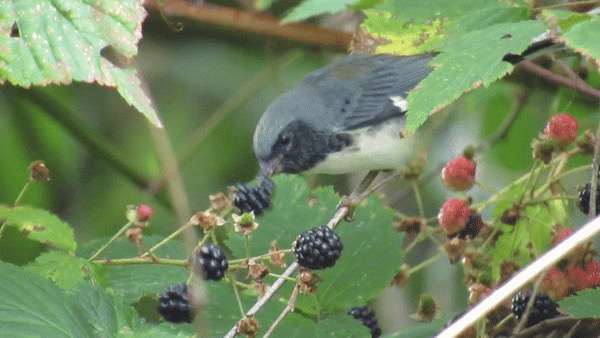
(c) Evan M. Raskin, some rights reserved (CC BY) · licence
Family: Parulidae · Class: Aves · Order: Passeriformes
Setophaga caerulescens (Black-throated Blue Warbler) is a California animal in the Parulidae family.
The Black-throated Blue Warbler is a medium-sized songbird measuring 13 cm (5.1 inches) in length with a wingspan of 19-20 cm (7.5-7.9 inches). Adults weigh approximately 8.4-12.4 grams. The species exhibits pronounced sexual dimorphism. Males display deep blue upperparts with black throat, sides, and flanks, contrasting sharply with white underparts. A distinctive white patch on the wing coverts creates a prominent field mark. Females are olive-brown above with pale yellow-buff underparts and a subtle whitish wing patch, making them considerably more cryptic than males. Both sexes have dark legs and a thin, pointed bill typical of insectivorous warblers. The Black-throated Blue Warbler breeds primarily in mature deciduous and mixed forests of eastern North America, from southeastern Canada south through the Appalachian Mountains to northern Georgia. In California, this species occurs as a rare vagrant, with documented records primarily during migration periods in coastal areas and desert oases. Most California sightings occur between September and November during fall migration, with occasional spring records from April to May. The species has been recorded in locations including Point Reyes, the Farallon Islands, and scattered desert locations such as Deep Springs Valley. Breeding habitat consists of mature forest with dense understory, typically at elevations between 300-1,200 meters in the eastern range. The species shows preference for forests dominated by deciduous trees including maple, beech, and birch, often with rhododendron or mountain laurel understory. During migration, Black-throated Blue Warblers utilize various wooded habitats including riparian corridors, parks, and gardens. In California, vagrants are most often detected in coastal scrub, urban parks with mature trees, and desert oases with water sources. Black-throated Blue Warblers are primarily insectivorous, foraging actively in the middle and lower canopy levels. Their diet consists mainly of caterpillars, beetles, flies, and other small arthropods during the breeding season. During migration and winter, they supplement their diet with berries and small fruits. The species exhibits territorial behavior during breeding, with males arriving on territories in late April to early May. Females construct cup-shaped nests 0.3-1.5 meters above ground in dense shrubs or understory vegetation. Clutch size ranges from 3-5 eggs, with incubation lasting 12-13 days. Young fledge after 10-12 days in the nest. The Black-throated Blue Warbler is not federally listed and maintains stable populations across its primary breeding range. According to the North American Breeding Bird Survey, populations have remained relatively stable over the past several decades, with some increases noted in certain regions. The species benefits from forest management practices that maintain mature canopy with dense understory. In California, the Black-throated Blue Warbler has no conservation designation as it occurs only as an occasional vagrant. Climate change may potentially affect migration timing and vagrant occurrence patterns, though the species' adaptability to various forest types provides some resilience.
Classification
Class: Aves · Order: Passeriformes · Family: Parulidae
Frequently asked questions
How is Setophaga caerulescens classified?
Setophaga caerulescens belongs to class Aves, order Passeriformes, family Parulidae.
What family does Setophaga caerulescens belong to?
Setophaga caerulescens is in the Parulidae family.
What is Setophaga caerulescens?
The Black-throated Blue Warbler is a medium-sized songbird measuring 13 cm (5.1 inches) in length with a wingspan of 19-20 cm (7.5-7.9 inches).
Is Setophaga caerulescens found in California?
Yes. Setophaga caerulescens is recorded in California in The California Species Project's catalogue.
Related species
Other California species in the same genus, family, or bioregion.
Data from The California Species Project — 14,000+ California species with verified data from CNPS, CDFW, USFWS, and more.