Setophaga castanea
Bay-breasted Warbler
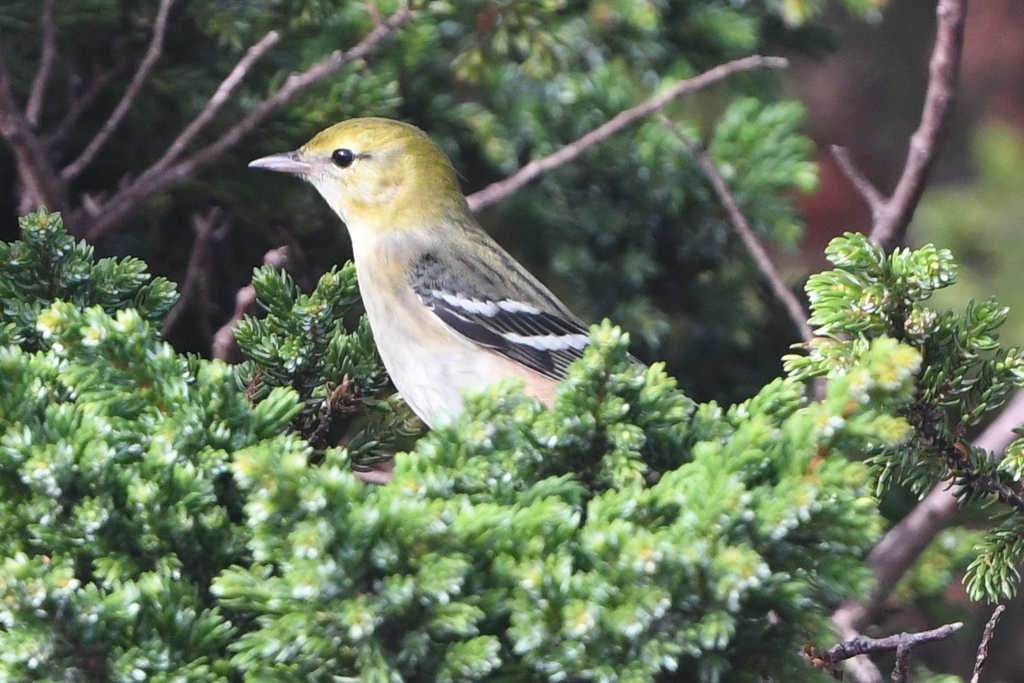
(c) Julien Renoult, some rights reserved (CC BY) · licence
Family: Parulidae · Class: Aves · Order: Passeriformes
Setophaga castanea (Bay-breasted Warbler) is a California animal in the Parulidae family.
The Bay-breasted Warbler is a medium-sized songbird measuring 13-15 cm (5.1-5.9 inches) in length with a wingspan of 20-23 cm (7.9-9.1 inches) and weighing 11-13 grams. During breeding season, males display distinctive chestnut-colored crown, throat, and flanks, with a black face mask and cream-colored neck patch. The back is streaked olive-green and black, while underparts are pale with chestnut extending along the sides. Females are more subdued, showing olive-green upperparts with faint streaking and pale yellow-buff underparts with minimal chestnut coloration. Non-breeding adults of both sexes resemble females but appear even more muted, making identification challenging and requiring careful observation of subtle field marks. The Bay-breasted Warbler breeds primarily in the boreal forests of Canada and the northernmost United States, with the core range extending from British Columbia east to Newfoundland and south to northern Minnesota, Wisconsin, Michigan, and New England. In California, this species occurs only as an uncommon to rare migrant and vagrant, typically appearing during fall migration from August through October. Most California records originate from coastal areas, particularly Point Reyes, the Farallon Islands, and other prominent migrant traps along the Pacific Coast. Spring records are exceptionally rare, with most sightings concentrated in September. This warbler inhabits mature boreal and mixed coniferous forests dominated by spruce, fir, and hemlock trees. During breeding, the species shows strong preference for areas with dense canopy cover and abundant epiphytic lichens. In California, migrants are typically found in coastal scrub, riparian woodlands, and urban parks with mature trees, often associating with mixed-species foraging flocks. The species forages primarily in the upper canopy, methodically searching bark crevices and foliage clusters. Bay-breasted Warblers are primarily insectivorous, specializing in caterpillars, particularly spruce budworm larvae during breeding season. They also consume beetles, moths, flies, and other arthropods, supplementing their diet with small fruits and berries during migration. Breeding occurs from May through July, with females constructing cup-shaped nests 4-9 meters above ground in coniferous trees. Clutch size ranges from 3-7 eggs, with incubation lasting 12-13 days. Both parents feed nestlings, which fledge after 10-12 days. The Bay-breasted Warbler is not federally or state listed in California, reflecting its status as a vagrant species rather than a resident or regular migrant. Continental populations appear stable, though the species experienced significant declines during the mid-20th century due to widespread use of DDT and forest management practices. According to the North American Breeding Bird Survey, populations have shown moderate recovery since the 1980s. Climate change poses potential long-term threats through alterations to boreal forest composition and spruce budworm outbreak cycles, which could affect breeding success and population dynamics.
Classification
Class: Aves · Order: Passeriformes · Family: Parulidae
Frequently asked questions
How is Setophaga castanea classified?
Setophaga castanea belongs to class Aves, order Passeriformes, family Parulidae.
What family does Setophaga castanea belong to?
Setophaga castanea is in the Parulidae family.
What is Setophaga castanea?
The Bay-breasted Warbler is a medium-sized songbird measuring 13-15 cm (5.1-5.9 inches) in length with a wingspan of 20-23 cm (7.9-9.1 inches) and weighing 11-13 grams.
Is Setophaga castanea found in California?
Yes. Setophaga castanea is recorded in California in The California Species Project's catalogue.
Related species
Other California species in the same genus, family, or bioregion.
Data from The California Species Project — 14,000+ California species with verified data from CNPS, CDFW, USFWS, and more.