Setophaga fusca
Blackburnian Warbler
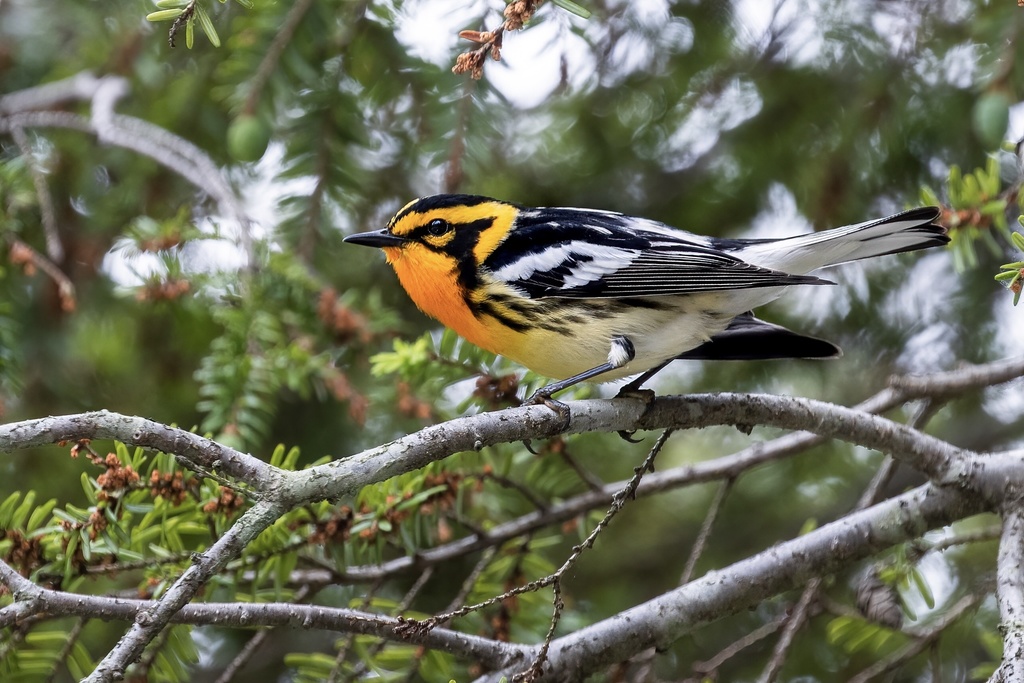
(c) Matt Felperin, some rights reserved (CC BY) · licence
Family: Parulidae · Class: Aves · Order: Passeriformes
Setophaga fusca (Blackburnian Warbler) is a California animal in the Parulidae family.
The Blackburnian Warbler is a small New World warbler measuring 11 to 13 cm (4.3 to 5.1 inches) in length with a wingspan of 19 to 22 cm (7.5 to 8.7 inches). Adult males during breeding season display distinctive orange-red throat and head markings that contrast sharply with black auriculars and crown stripes. The back is black with white streaking, while the underparts are white with black streaking along the sides. Two prominent white wing bars are visible on dark wings. Breeding females and non-breeding males show similar patterns but with yellow rather than orange throat coloration and more subdued markings. The species exhibits a thin, pointed bill typical of insectivorous warblers. The Blackburnian Warbler breeds primarily in the boreal and mixed coniferous forests of eastern North America, from southeastern Canada south through the Appalachian Mountains to northern Georgia. In California, this species occurs as an uncommon to rare migrant and vagrant, with most observations documented during fall migration from late August through October. Records exist from scattered locations throughout the state, including coastal areas, desert oases, and mountain regions, though sightings remain sporadic and unpredictable. During the breeding season, Blackburnian Warblers inhabit mature coniferous and mixed forests dominated by spruce, fir, and hemlock trees. They show a strong preference for forest canopy layers, typically foraging and nesting 15 to 24 meters (50 to 80 feet) above ground. On migration, including rare appearances in California, the species utilizes a broader range of habitats including riparian woodlands, oak groves, parks, and gardens with sufficient tree cover. Elevation preferences during breeding range from 300 to 1,200 meters (1,000 to 4,000 feet). Blackburnian Warblers are primarily insectivorous, gleaning small insects, larvae, and spiders from foliage and bark surfaces. They employ hover-gleaning techniques to capture prey from the undersides of leaves and occasionally engage in aerial foraging for flying insects. Breeding occurs from May through July, with females constructing cup-shaped nests on horizontal branches of coniferous trees. Clutch size typically ranges from 3 to 5 eggs, with an incubation period of 12 to 13 days. The species exhibits strong site fidelity to breeding territories. The Blackburnian Warbler is not federally listed and maintains stable populations across most of its breeding range. According to the North American Breeding Bird Survey, continental populations have remained relatively stable over the past several decades, though some regional declines have been documented in portions of the Appalachian range. The species faces threats from forest fragmentation, climate change effects on boreal forest ecosystems, and potential impacts from communication tower collisions during migration. In California, the species' rarity makes population assessment difficult, but it continues to appear as a vagrant species with no evidence of breeding activity within the state.
Classification
Class: Aves · Order: Passeriformes · Family: Parulidae
Frequently asked questions
How is Setophaga fusca classified?
Setophaga fusca belongs to class Aves, order Passeriformes, family Parulidae.
What family does Setophaga fusca belong to?
Setophaga fusca is in the Parulidae family.
What is Setophaga fusca?
The Blackburnian Warbler is a small New World warbler measuring 11 to 13 cm (4.3 to 5.1 inches) in length with a wingspan of 19 to 22 cm (7.5 to 8.7 inches).
Is Setophaga fusca found in California?
Yes. Setophaga fusca is recorded in California in The California Species Project's catalogue.
Related species
Other California species in the same genus, family, or bioregion.
Data from The California Species Project — 14,000+ California species with verified data from CNPS, CDFW, USFWS, and more.