Setophaga graciae
Grace's Warbler
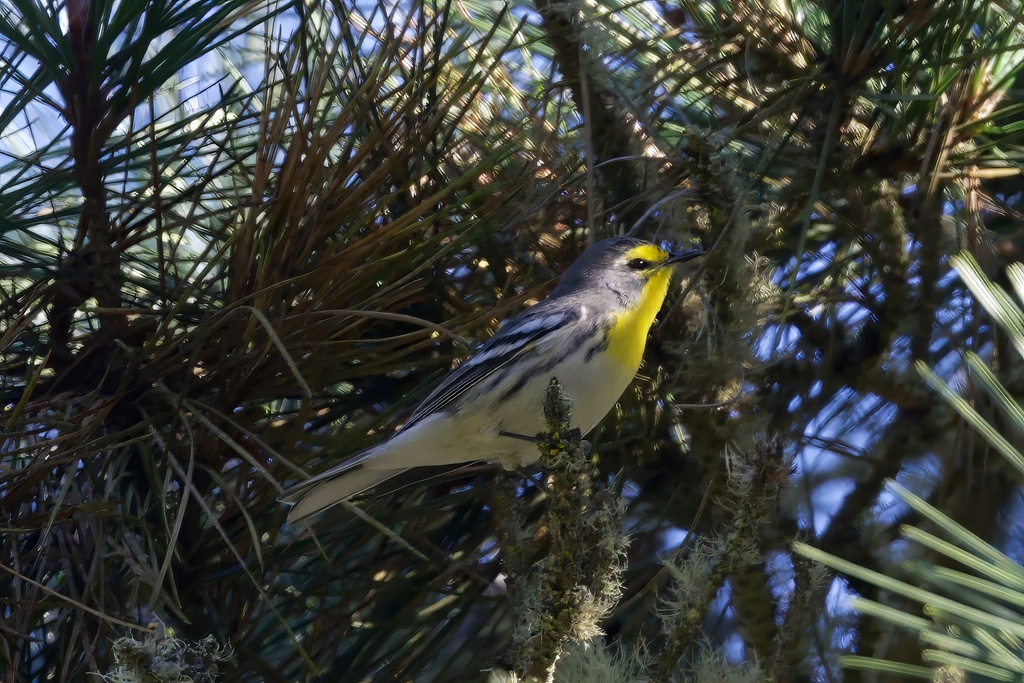
no rights reserved · CC0
Family: Parulidae · Class: Aves · Order: Passeriformes
Setophaga graciae (Grace's Warbler) is a California animal in the Parulidae family.
Grace's Warbler is a small songbird measuring 11.5 to 13 cm (4.5 to 5.1 inches) in length with a wingspan of approximately 20 cm (7.9 inches). Males display distinctive plumage with bright yellow throats and breasts, gray upperparts, and bold black streaking on the sides and flanks. A prominent black line extends through the eye, contrasting with the yellow supercilium above. Females and juveniles are similarly patterned but show more subdued coloration with pale yellow underparts and less distinct streaking. Both sexes exhibit white wing bars and white outer tail feathers visible in flight. Grace's Warbler has a limited breeding range in California, restricted primarily to the mountainous regions of the southeastern desert ranges. The species occurs in the Peninsular Ranges, including mountains of San Diego, Riverside, and Imperial counties, with populations documented in the Laguna Mountains, Cuyamaca Mountains, and desert mountain ranges extending toward the Colorado River. The breeding range extends south through Arizona, New Mexico, and into Mexico's Sierra Madre Occidental. During winter, the species migrates to Mexico and Central America. This warbler inhabits mature pine-oak woodlands and mixed coniferous forests at elevations ranging from 1,200 to 2,400 meters (3,900 to 7,900 feet). In California, Grace's Warbler shows a strong association with ponderosa pine forests and mixed stands containing Jeffrey pine, incense cedar, and various oak species. The species prefers areas with tall canopy trees and relatively open understory, often selecting territories on south-facing slopes and ridge tops where pine forests are well-developed. Grace's Warbler is primarily insectivorous, foraging in the upper canopy by gleaning insects and larvae from pine needles, bark crevices, and branch tips. The species employs hover-gleaning techniques to capture prey from the undersides of branches and occasionally makes short aerial sallies to catch flying insects. Breeding occurs from April through July, with females constructing cup-shaped nests on horizontal branches of large pines, typically 6 to 18 meters (20 to 59 feet) above ground. Clutch size ranges from three to five eggs, with incubation lasting 12 to 13 days. Young fledge after 8 to 10 days in the nest. Grace's Warbler is not federally or state-listed in California, and populations appear relatively stable within suitable habitat. However, the species faces ongoing threats from habitat loss due to logging, fire suppression altering forest structure, and climate change potentially shifting suitable elevation ranges upward. Forest management practices that maintain mature pine stands with complex vertical structure benefit this canopy-dwelling species. The limited California range makes local populations vulnerable to habitat disturbances, though connectivity with larger populations in Arizona and Mexico provides some demographic support.
Classification
Class: Aves · Order: Passeriformes · Family: Parulidae
Frequently asked questions
How is Setophaga graciae classified?
Setophaga graciae belongs to class Aves, order Passeriformes, family Parulidae.
What family does Setophaga graciae belong to?
Setophaga graciae is in the Parulidae family.
What is Setophaga graciae?
Grace's Warbler is a small songbird measuring 11.5 to 13 cm (4.5 to 5.1 inches) in length with a wingspan of approximately 20 cm (7.9 inches).
Is Setophaga graciae found in California?
Yes. Setophaga graciae is recorded in California in The California Species Project's catalogue.
Related species
Other California species in the same genus, family, or bioregion.
Data from The California Species Project — 14,000+ California species with verified data from CNPS, CDFW, USFWS, and more.