Setophaga magnolia
Magnolia Warbler
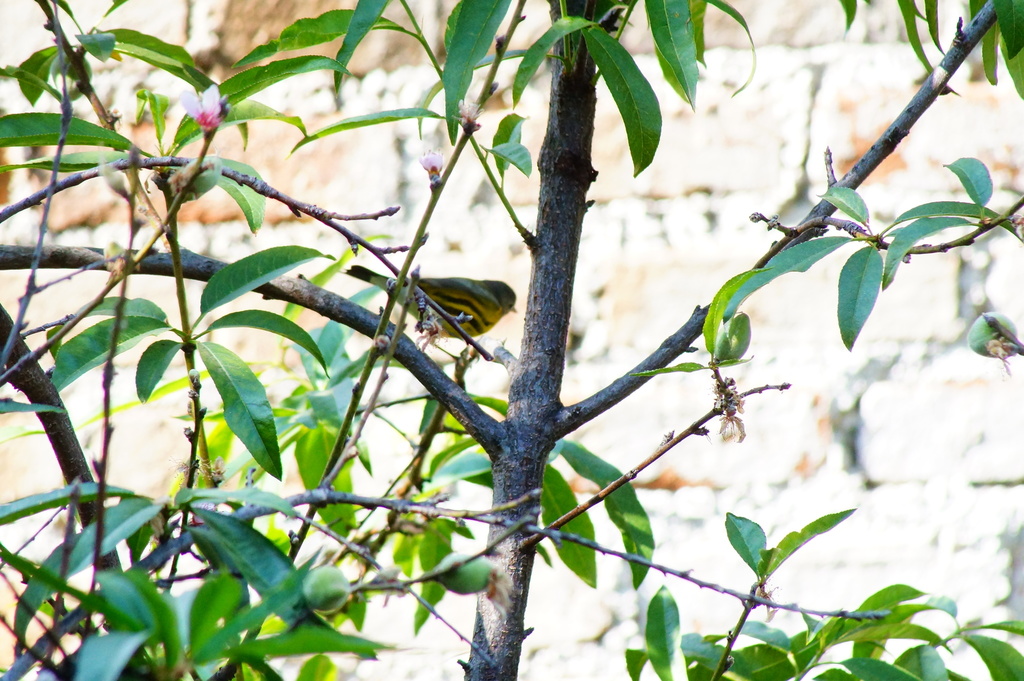
(c) Carlos Domínguez-Rodríguez, some rights reserved (CC BY) · licence
Family: Parulidae · Class: Aves · Order: Passeriformes
Setophaga magnolia (Magnolia Warbler) is a California animal in the Parulidae family.
The Magnolia Warbler is a small songbird measuring 11-13 cm (4.3-5.1 inches) in length with a wingspan of 16-20 cm (6.3-7.9 inches) and weighing 6-15 grams. Adult males in breeding plumage display a distinctive black mask across the eyes and cheeks, contrasting with a white supercilium. The upperparts are blackish-gray with prominent white wing patches, while the underparts are bright yellow with bold black streaking across the breast and flanks. The rump shows a distinctive yellow patch, and the tail exhibits white patches on the outer feathers when viewed from below. Adult females and non-breeding males are duller, with grayish upperparts, reduced black markings, and less distinct streaking on pale yellow underparts. The Magnolia Warbler breeds primarily in the boreal forests of Canada and the northern United States, with its range extending from British Columbia east to Nova Scotia and south through the Great Lakes region to northern Pennsylvania and New York. In California, this species occurs as a rare but regular migrant, primarily during spring migration from late April through May and fall migration from August through September. Most California records come from coastal areas, mountain ranges, and desert oases, with sightings reported from locations including Point Reyes, the Sierra Nevada, and southeastern desert regions. During breeding season, Magnolia Warblers inhabit dense coniferous and mixed forests, particularly favoring young spruce-fir stands, forest edges, and areas with thick understory vegetation. They typically nest at elevations from sea level to 1,500 meters in their breeding range. In California, migrants are found in a variety of habitats including riparian woodlands, oak groves, coniferous forests, and desert oases with suitable vegetation for foraging. Magnolia Warblers are primarily insectivorous, gleaning insects and larvae from foliage, bark, and occasionally catching prey in flight. Their diet consists mainly of caterpillars, beetles, flies, aphids, and spiders. During migration and winter, they supplement their diet with berries and nectar. Breeding occurs from May through July, with females constructing cup-shaped nests typically 1-9 meters above ground in dense coniferous vegetation. Clutches contain 3-5 eggs, which are incubated for 11-13 days. Young fledge after 8-10 days and depend on parents for several weeks. The Magnolia Warbler is not federally or state-listed in California and maintains stable global populations. According to the North American Breeding Bird Survey, populations have remained relatively stable over recent decades. The species faces typical challenges associated with Neotropical migrants, including habitat loss on breeding grounds due to logging and development, habitat degradation in wintering areas in Central America and northern South America, and threats during migration such as collisions with buildings and communication towers. Climate change may affect the species by altering the timing of insect emergence relative to breeding cycles and shifting suitable habitat ranges northward.
Classification
Class: Aves · Order: Passeriformes · Family: Parulidae
Frequently asked questions
How is Setophaga magnolia classified?
Setophaga magnolia belongs to class Aves, order Passeriformes, family Parulidae.
What family does Setophaga magnolia belong to?
Setophaga magnolia is in the Parulidae family.
What is Setophaga magnolia?
The Magnolia Warbler is a small songbird measuring 11-13 cm (4.3-5.1 inches) in length with a wingspan of 16-20 cm (6.3-7.9 inches) and weighing 6-15 grams.
Is Setophaga magnolia found in California?
Yes. Setophaga magnolia is recorded in California in The California Species Project's catalogue.
Related species
Other California species in the same genus, family, or bioregion.
Data from The California Species Project — 14,000+ California species with verified data from CNPS, CDFW, USFWS, and more.