Setophaga nigrescens
Black-throated Gray Warbler
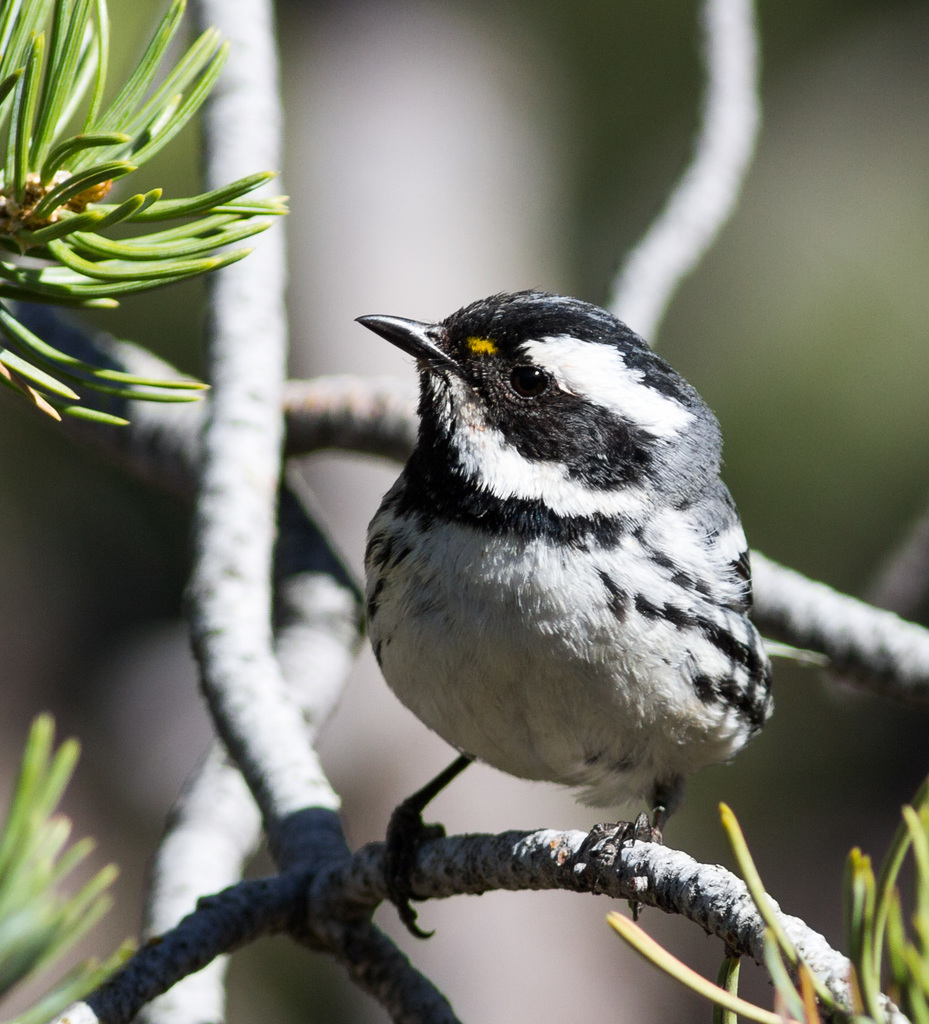
(c) Fyn Kynd, some rights reserved (CC BY-SA) · licence
Family: Parulidae · Class: Aves · Order: Passeriformes
Setophaga nigrescens (Black-throated Gray Warbler) is a California animal in the Parulidae family.
The Black-throated Gray Warbler is a small songbird measuring 11.5 to 13 cm (4.5 to 5.1 inches) in length with a wingspan of 17 to 19 cm (6.7 to 7.5 inches). Adults weigh 7 to 10 grams. Males display distinctive black and white plumage with a black throat, black crown stripes, and black ear patches contrasting sharply with white cheeks and underparts. A prominent white stripe extends above the eye, and the wings show white wing bars. Females and juveniles have similar patterns but with grayer tones and less distinct markings. The species has a thin, pointed bill typical of insectivorous warblers and shows a small yellow spot in front of the eye, visible at close range. The Black-throated Gray Warbler breeds throughout western North America from British Columbia south to Baja California and east to Colorado and New Mexico. In California, the species occurs primarily in mountainous regions including the Sierra Nevada, Coast Ranges, Cascade Range, and higher elevations of southern California mountains. During migration and winter, populations move south to Mexico and Central America, with some individuals remaining in southern California and Arizona. The species shows altitudinal migration, moving from higher breeding elevations to lower elevations or southern latitudes during winter months. Breeding habitat consists primarily of mixed coniferous and deciduous forests, oak woodlands, and chaparral communities. The species typically occupies elevations from 300 to 2,400 meters (1,000 to 7,900 feet), showing preference for areas with dense canopy cover and diverse understory vegetation. Breeding territories are established in areas with Douglas fir, ponderosa pine, oak species, and manzanita. During migration and winter, Black-throated Gray Warblers utilize a broader range of habitats including riparian corridors, desert washes with trees, and suburban areas with mature vegetation. Black-throated Gray Warblers are primarily insectivorous, gleaning insects, spiders, and larvae from foliage and bark surfaces. They employ various foraging techniques including hovering, fly-catching, and probing bark crevices. The species demonstrates acrobatic foraging behavior, often hanging upside down to reach prey on leaf undersides. Breeding occurs from April through July, with females constructing compact cup nests in shrubs or small trees, typically 1 to 4 meters above ground. Clutch size ranges from 3 to 5 eggs, which are incubated for 11 to 12 days. Young fledge after 8 to 10 days in the nest. The Black-throated Gray Warbler is not federally or state listed and maintains stable populations across most of its range. According to the North American Breeding Bird Survey, populations have remained relatively stable over the past several decades, though some regional declines have been documented. Primary threats include habitat loss due to urbanization, timber harvest, and fire suppression that alters natural forest structure. Climate change may affect the species through shifts in suitable habitat elevation and changes in insect prey availability. The species benefits from forest management practices that maintain diverse canopy structure and mixed-age forest stands.
Classification
Class: Aves · Order: Passeriformes · Family: Parulidae
Frequently asked questions
How is Setophaga nigrescens classified?
Setophaga nigrescens belongs to class Aves, order Passeriformes, family Parulidae.
What family does Setophaga nigrescens belong to?
Setophaga nigrescens is in the Parulidae family.
What is Setophaga nigrescens?
The Black-throated Gray Warbler is a small songbird measuring 11.5 to 13 cm (4.5 to 5.1 inches) in length with a wingspan of 17 to 19 cm (6.7 to 7.5 inches).
Is Setophaga nigrescens found in California?
Yes. Setophaga nigrescens is recorded in California in The California Species Project's catalogue.
Related species
Other California species in the same genus, family, or bioregion.
Data from The California Species Project — 14,000+ California species with verified data from CNPS, CDFW, USFWS, and more.