Setophaga occidentalis
Hermit Warbler
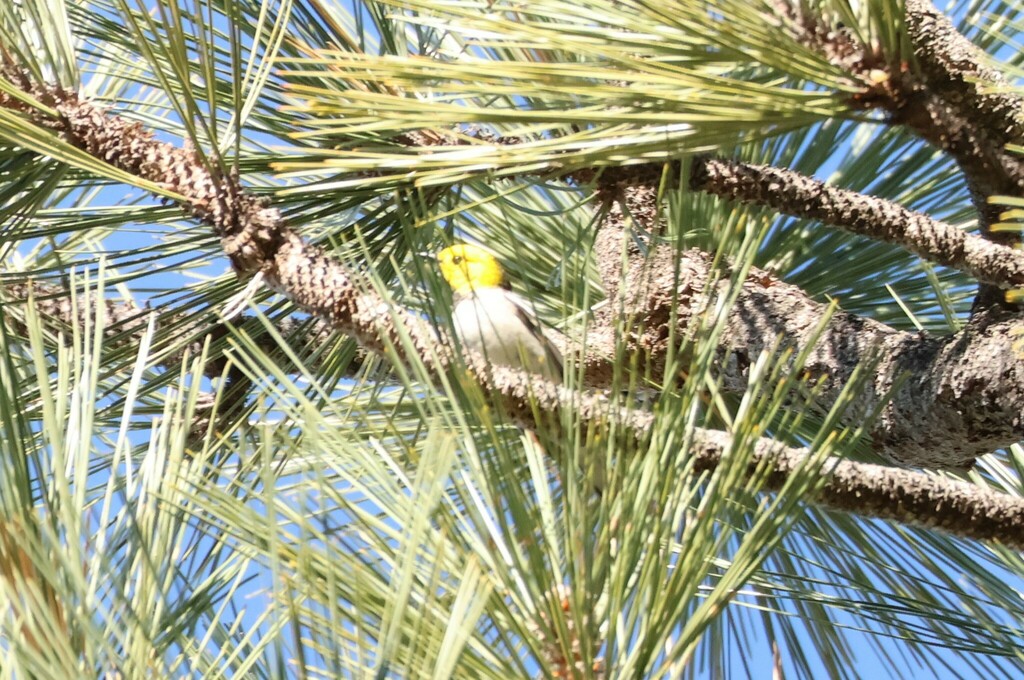
(c) Millie Basden, some rights reserved (CC BY) · licence
Family: Parulidae · Class: Aves · Order: Passeriformes
Setophaga occidentalis (Hermit Warbler) is a California animal in the Parulidae family.
The Hermit Warbler is a small passerine bird measuring 11 to 13 centimeters (4.3 to 5.1 inches) in length with a wingspan of 19 to 20 centimeters (7.5 to 7.9 inches) and weighing 8 to 10 grams (0.28 to 0.35 ounces). Males in breeding plumage display a distinctive bright yellow head contrasting with a black throat and nape. The back is gray with black streaking, while the underparts are white. Females and non-breeding males show similar patterns but with duller yellow coloration and reduced black markings. Two white wing bars are prominent on both sexes. The species can be distinguished from similar warblers by its yellow head combined with white underparts and the male's distinctive black throat patch. The Hermit Warbler breeds in coniferous forests from southwestern British Columbia through Washington, Oregon, and California, extending south through the Sierra Nevada to Tulare County and in coastal ranges to Santa Barbara County. In California, the species occurs primarily in the Cascade Range, Sierra Nevada, and Coast Ranges. During migration, Hermit Warblers pass through lowland areas and can be found in various habitats. The species winters from central Mexico south to Nicaragua, with some individuals remaining in California's coastal regions. Breeding habitat consists of mature and old-growth coniferous forests dominated by Douglas fir, true firs, and pines at elevations ranging from 300 to 2,400 meters (1,000 to 7,900 feet). The species shows a preference for tall canopy forests with dense foliage and minimal understory. During migration, Hermit Warblers utilize oak woodlands, riparian forests, and parks. Winter habitat in Mexico includes pine-oak and cloud forests at similar elevations to breeding areas. Hermit Warblers are insectivorous, foraging primarily in the upper canopy by gleaning insects from leaves, bark, and needle clusters. Their diet consists mainly of caterpillars, beetles, aphids, and small flies. Males establish territories upon arrival at breeding grounds in late April to early May. The species constructs cup-shaped nests 4 to 18 meters (13 to 59 feet) above ground on horizontal branches of conifers. Females lay 3 to 5 eggs in late May to June, with incubation lasting 12 days. Young fledge after 8 to 10 days in the nest. Most populations are migratory, departing breeding areas in August and September. The Hermit Warbler is not federally or state listed and maintains stable populations throughout most of its range. According to the North American Breeding Bird Survey, populations have remained relatively stable since 1970, though some local declines have been documented in heavily logged areas. Primary conservation concerns include habitat loss from logging, particularly of old-growth forests, and potential climate change impacts on montane forest ecosystems. The species benefits from forest management practices that maintain mature canopy structure and from protected areas within national parks and wilderness areas throughout its range.
Classification
Class: Aves · Order: Passeriformes · Family: Parulidae
Frequently asked questions
How is Setophaga occidentalis classified?
Setophaga occidentalis belongs to class Aves, order Passeriformes, family Parulidae.
What family does Setophaga occidentalis belong to?
Setophaga occidentalis is in the Parulidae family.
What is Setophaga occidentalis?
The Hermit Warbler is a small passerine bird measuring 11 to 13 centimeters (4.3 to 5.1 inches) in length with a wingspan of 19 to 20 centimeters (7.5 to 7.9 inches) and weighing 8 to 10 grams (0.28 to 0.35 ounces).
Is Setophaga occidentalis found in California?
Yes. Setophaga occidentalis is recorded in California in The California Species Project's catalogue.
Related species
Other California species in the same genus, family, or bioregion.
Data from The California Species Project — 14,000+ California species with verified data from CNPS, CDFW, USFWS, and more.