Setophaga palmarum
Palm Warbler
no rights reserved · CC0
Family: Parulidae · Class: Aves · Order: Passeriformes
Setophaga palmarum (Palm Warbler) is a California animal in the Parulidae family.
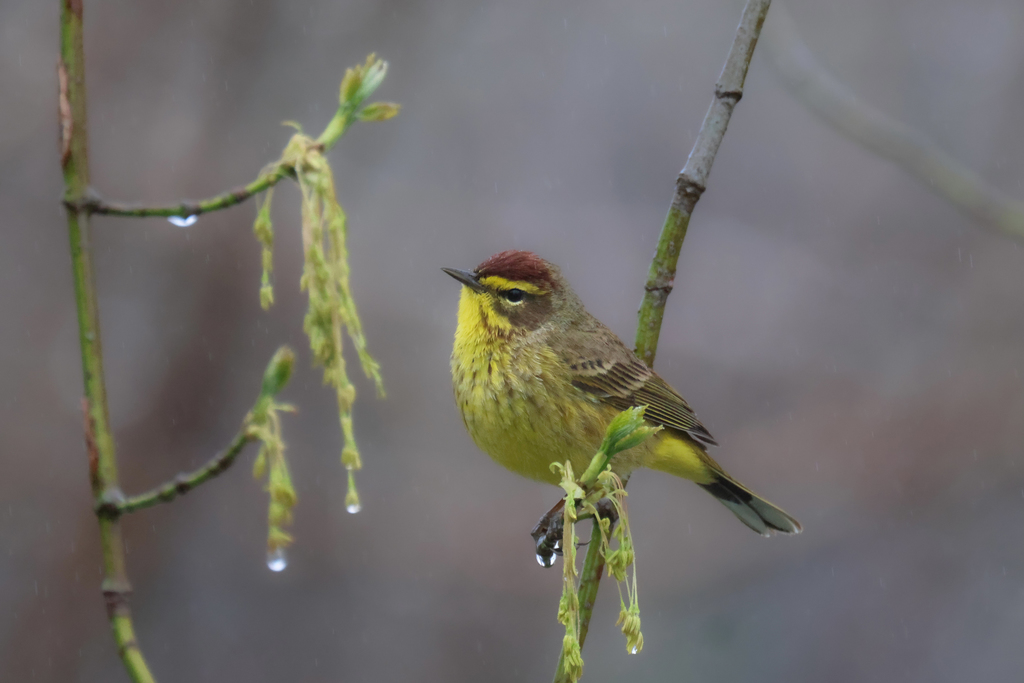
The Palm Warbler is a small songbird measuring 12-14 cm (4.7-5.5 inches) in length with a wingspan of 19-21 cm (7.5-8.3 inches). Adults typically weigh 7-12 grams. During breeding season, the species displays a distinctive rusty-red cap and yellow underparts with dark streaking on the breast and flanks. The back is olive-brown with darker streaking. Non-breeding adults show more subdued plumage with a brownish cap and pale yellow restricted to the undertail coverts and throat. Both subspecies show white outer tail feathers and a pale supercilium. The species exhibits distinctive tail-wagging behavior while foraging, pumping the tail up and down almost constantly. Palm Warblers breed primarily in the boreal forests of Canada and Alaska, with two distinct subspecies showing different breeding ranges. The eastern subspecies breeds from southeastern Canada to the Maritime Provinces, while the western subspecies breeds from central Canada to Alaska. During migration and winter, Palm Warblers occur throughout much of the eastern and central United States. In California, the species is primarily a rare but regular vagrant, with most records occurring during fall migration from September through November. Birds have been documented along the coast and in desert areas, particularly at migrant traps and oases. Breeding habitat consists of open bogs, fens, and muskegs with scattered spruce and tamarack trees. The species favors areas with low shrub cover and standing water. During migration, Palm Warblers utilize a variety of habitats including parks, gardens, brushy areas, and woodland edges. In California, vagrants are typically found in riparian areas, desert oases, and coastal scrub habitats where they associate with other migrant warblers. Palm Warblers are primarily insectivorous, gleaning insects and larvae from foliage, bark, and the ground. During winter and migration, they supplement their diet with seeds and berries. The species frequently forages on the ground, unlike most other warblers, and often feeds in more open areas. Breeding occurs from May through July, with females constructing cup-shaped nests on the ground or in low shrubs. Clutch size ranges from 4-5 eggs, which are incubated for 12-13 days. Young fledge after 10-11 days. The Palm Warbler is not federally listed and maintains stable populations across its range. According to the North American Breeding Bird Survey, populations have remained relatively stable since 1970, though some regional variations exist. The species benefits from forest management practices that create early successional habitats. In California, the Palm Warbler remains an uncommon vagrant with no established breeding population. Climate change may affect the species' northern breeding range, potentially altering migration patterns and wintering distribution in the future.
Classification
Class: Aves · Order: Passeriformes · Family: Parulidae
Frequently asked questions
How is Setophaga palmarum classified?
Setophaga palmarum belongs to class Aves, order Passeriformes, family Parulidae.
What family does Setophaga palmarum belong to?
Setophaga palmarum is in the Parulidae family.
What is Setophaga palmarum?
The Palm Warbler is a small songbird measuring 12-14 cm (4.7-5.5 inches) in length with a wingspan of 19-21 cm (7.5-8.3 inches).
Is Setophaga palmarum found in California?
Yes. Setophaga palmarum is recorded in California in The California Species Project's catalogue.
Related species
Other California species in the same genus, family, or bioregion.
Data from The California Species Project — 14,000+ California species with verified data from CNPS, CDFW, USFWS, and more.