Setophaga pensylvanica
Chestnut-sided Warbler
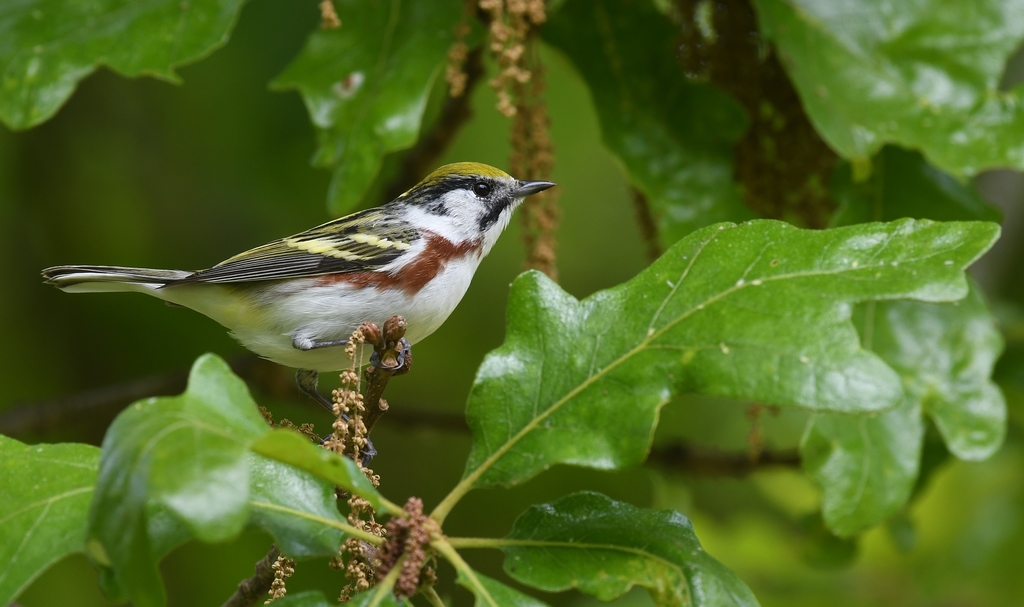
no rights reserved · CC0
Family: Parulidae · Class: Aves · Order: Passeriformes
Setophaga pensylvanica (Chestnut-sided Warbler) is a California animal in the Parulidae family.
The Chestnut-sided Warbler is a small songbird measuring 11.4 to 13 cm (4.5 to 5.1 inches) in length with a wingspan of 16 to 21 cm (6.3 to 8.3 inches). Adults weigh 8 to 13 grams. Breeding males display distinctive chestnut-brown streaking along the sides, a bright yellow crown, and white underparts. The face is marked by a black stripe extending from the bill through the eye and curving down toward the neck. Females and non-breeding males are more subdued, with olive-green upperparts, pale yellow wing bars, and faint chestnut side streaks. Both sexes have white eye rings and dark bills. Historically, Chestnut-sided Warblers bred primarily in eastern North America from southeastern Canada south to northern Georgia and west to the Great Plains. In California, this species occurs as an uncommon to rare migrant and winter visitor, with most records from coastal areas and the Central Valley during fall migration from August through October. Spring migration records are less frequent, typically occurring from April through May. The species has been documented in multiple California counties including Los Angeles, Orange, San Diego, Santa Barbara, and Monterey. During migration and winter in California, Chestnut-sided Warblers utilize a variety of habitats including riparian woodlands, oak woodlands, urban parks, and coastal scrub. They show particular preference for areas with dense understory vegetation and edge habitats where forest meets open areas. The species forages primarily in the lower to middle canopy levels, typically 3 to 15 meters above ground. Chestnut-sided Warblers are primarily insectivorous, gleaning caterpillars, aphids, beetles, and other small arthropods from leaves and bark surfaces. During migration and winter, they supplement their diet with small fruits and seeds. The species exhibits active foraging behavior, frequently hovering to pick insects from leaf surfaces and occasionally making short aerial sallies to capture flying prey. In their breeding range, pairs construct cup-shaped nests in shrubs or small trees, typically 0.3 to 4.6 meters above ground. Females lay 3 to 5 eggs, which are incubated for 11 to 13 days. The Chestnut-sided Warbler is not federally listed and maintains stable populations across most of its range. According to the North American Breeding Bird Survey, populations have remained relatively stable over the past several decades, though some regional declines have been noted in parts of the species' core breeding range. Climate change may affect future distribution patterns, potentially shifting suitable breeding habitat northward. In California, the species faces typical challenges associated with habitat loss and fragmentation, particularly in riparian areas. The species benefits from forest management practices that maintain diverse age structure and preserve understory vegetation in forested landscapes.
Classification
Class: Aves · Order: Passeriformes · Family: Parulidae
Frequently asked questions
How is Setophaga pensylvanica classified?
Setophaga pensylvanica belongs to class Aves, order Passeriformes, family Parulidae.
What family does Setophaga pensylvanica belong to?
Setophaga pensylvanica is in the Parulidae family.
What is Setophaga pensylvanica?
The Chestnut-sided Warbler is a small songbird measuring 11.4 to 13 cm (4.5 to 5.1 inches) in length with a wingspan of 16 to 21 cm (6.3 to 8.3 inches).
Is Setophaga pensylvanica found in California?
Yes. Setophaga pensylvanica is recorded in California in The California Species Project's catalogue.
Related species
Other California species in the same genus, family, or bioregion.
Data from The California Species Project — 14,000+ California species with verified data from CNPS, CDFW, USFWS, and more.