Setophaga ruticilla
American Redstart
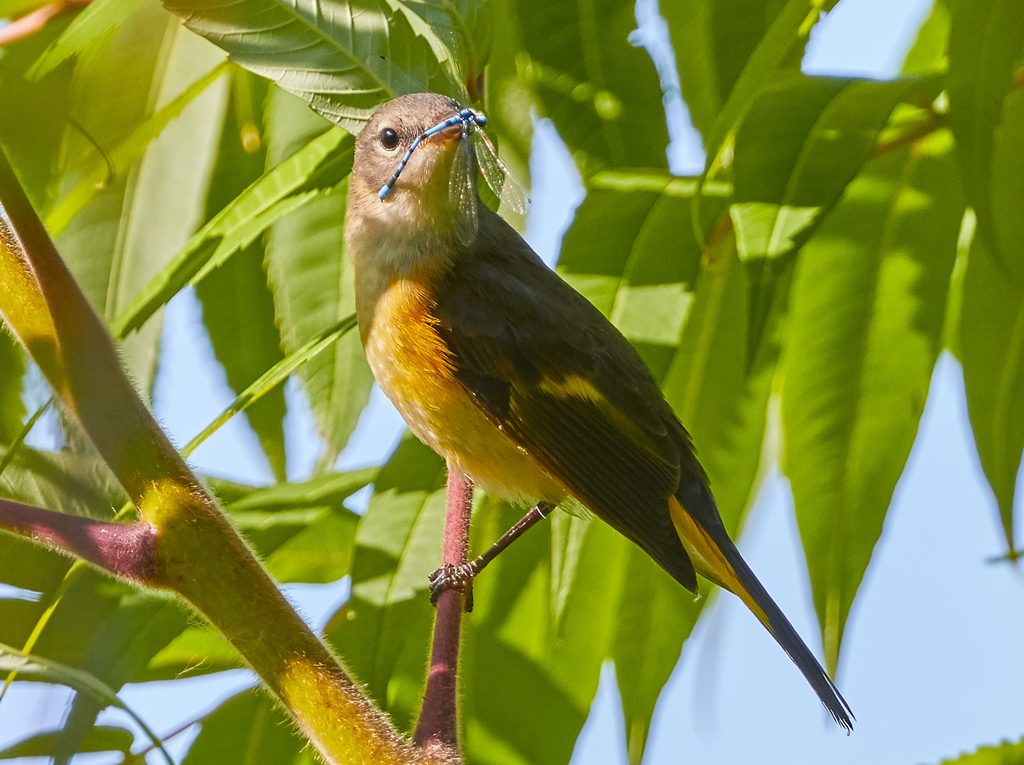
no rights reserved · CC0
Family: Parulidae · Class: Aves · Order: Passeriformes
Setophaga ruticilla (American Redstart) is a California animal in the Parulidae family.
The American Redstart is a small wood-warbler measuring 11 to 14 centimeters (4.3 to 5.5 inches) in length with a wingspan of 16 to 23 centimeters (6.3 to 9.1 inches). Adult males display striking black plumage with bright orange patches on the wings, tail, and sides. The orange markings are particularly prominent on the outer tail feathers and wing coverts. Females and immature males are olive-brown above with white underparts and yellow patches where males show orange. Both sexes have a relatively long, squared tail that they frequently fan and spread during foraging displays. The American Redstart breeds across much of Canada and the northern United States, with its range extending south through the Appalachian Mountains. In California, this species occurs primarily as a migrant and winter visitor along the coast and in riparian areas of the Central Valley. Small numbers may breed in northern California's montane forests, though breeding populations are limited and irregular. The species is most commonly observed during spring and fall migration periods from April through May and August through September. During migration and winter residence in California, American Redstarts inhabit riparian woodlands, oak groves, and mixed deciduous forests. They show a preference for areas with dense understory vegetation and are frequently found in willow thickets along streams and rivers. The species typically forages at heights of 3 to 15 meters (10 to 50 feet) above ground, though they may feed at various levels depending on insect availability. In breeding areas outside California, they prefer mature deciduous and mixed forests with open understory. American Redstarts are active insectivores that employ a distinctive foraging strategy combining hawking and gleaning techniques. They frequently spread their tail and wings while foraging, using the colorful patches to startle insects into flight before capturing them. Their diet consists primarily of flying insects including flies, moths, caterpillars, beetles, and aphids. During breeding season, females construct cup-shaped nests in tree forks 1.5 to 6 meters (5 to 20 feet) above ground. Clutches typically contain 2 to 5 eggs, with incubation lasting 11 to 12 days. The American Redstart is not federally or state-listed and maintains stable populations across most of its range. According to the North American Breeding Bird Survey, populations have remained relatively stable over the past several decades, though some regional declines have been documented in portions of the breeding range. The species benefits from forest management practices that maintain diverse age classes and structural complexity. In California, habitat loss in riparian corridors poses the primary conservation concern for migrating and wintering individuals. Climate change may affect migration timing and habitat availability, though current population trends suggest the species remains adaptable to changing conditions.
Classification
Class: Aves · Order: Passeriformes · Family: Parulidae
Frequently asked questions
How is Setophaga ruticilla classified?
Setophaga ruticilla belongs to class Aves, order Passeriformes, family Parulidae.
What family does Setophaga ruticilla belong to?
Setophaga ruticilla is in the Parulidae family.
What is Setophaga ruticilla?
The American Redstart is a small wood-warbler measuring 11 to 14 centimeters (4.3 to 5.5 inches) in length with a wingspan of 16 to 23 centimeters (6.3 to 9.1 inches).
Is Setophaga ruticilla found in California?
Yes. Setophaga ruticilla is recorded in California in The California Species Project's catalogue.
Related species
Other California species in the same genus, family, or bioregion.
Data from The California Species Project — 14,000+ California species with verified data from CNPS, CDFW, USFWS, and more.