Setophaga tigrina
Cape May Warbler
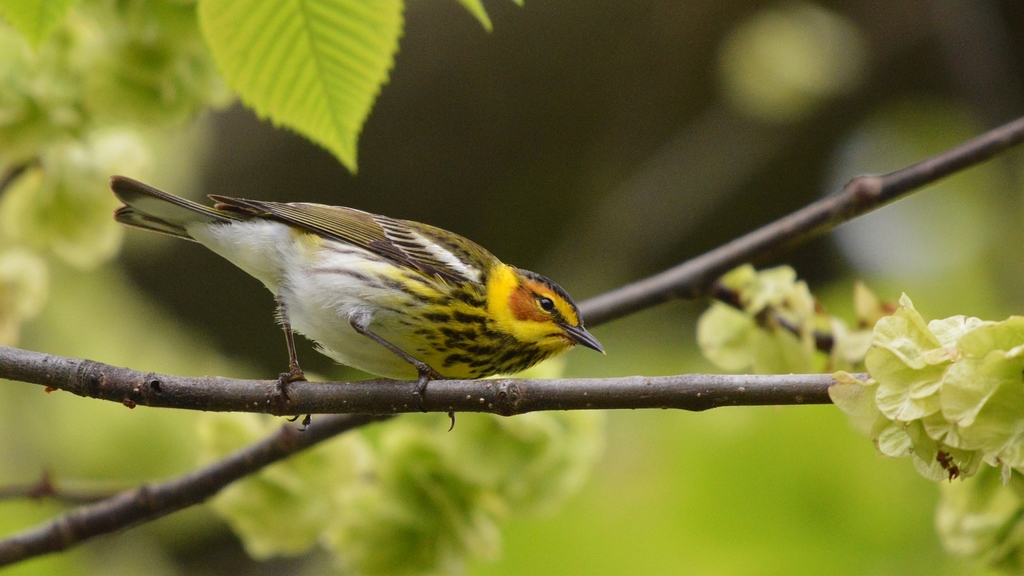
no rights reserved · CC0
Family: Parulidae · Class: Aves · Order: Passeriformes
Setophaga tigrina (Cape May Warbler) is a California animal in the Parulidae family.
The Cape May Warbler is a small songbird measuring 12 to 13 cm (4.7 to 5.1 inches) in length with a wingspan of 19 to 22 cm (7.5 to 8.7 inches). Males in breeding plumage display a distinctive chestnut patch on the cheek, bright yellow underparts with dark streaking, and a yellow rump. The crown and back are olive-yellow with dark streaking, and the wings show prominent white wing bars. Females and non-breeding males are duller, with grayish-olive upperparts, pale yellow underparts with faint streaking, and less distinct facial markings. Both sexes have a thin, slightly decurved bill adapted for nectar feeding and a distinctive tail-pumping behavior. The Cape May Warbler breeds primarily in the boreal forests of Canada and the northern United States, from Alberta east to Nova Scotia and south to northern Minnesota, Wisconsin, and Maine. In California, the species occurs as a rare vagrant during migration, primarily in fall from September through November. Records exist from scattered coastal and inland locations, including Point Reyes, the Farallon Islands, and desert oases in the southeastern desert regions. Most California observations involve single individuals, typically immature birds or females. During breeding season, Cape May Warblers inhabit mature coniferous forests, particularly those dominated by spruce and fir. They show a strong association with areas experiencing spruce budworm outbreaks, which provide abundant food resources. In California, vagrant individuals are typically found in riparian woodlands, park settings with mature trees, or desert oases with flowering plants that provide nectar sources. Cape May Warblers are primarily insectivorous, specializing in small caterpillars, aphids, and other soft-bodied insects. Unlike most warblers, they also regularly feed on nectar and fruit, particularly during migration and winter. Their semi-tubular tongue is uniquely adapted among wood-warblers for nectar extraction. Breeding occurs from May through July, with females constructing cup-shaped nests in the outer branches of coniferous trees, typically 9 to 18 meters (30 to 60 feet) above ground. Clutch size ranges from 4 to 7 eggs, with an incubation period of 11 to 12 days. The Cape May Warbler is not federally listed and maintains stable populations throughout most of its breeding range. According to the North American Breeding Bird Survey, populations have shown relatively stable trends since 1970, though with significant annual fluctuations linked to spruce budworm cycles. The species benefits from forest management practices that maintain mature coniferous stands. Climate change poses potential long-term threats through shifts in boreal forest composition and insect prey availability. In California, the species remains a sought-after vagrant among birders, with most records concentrated along the coast during peak migration periods.
Classification
Class: Aves · Order: Passeriformes · Family: Parulidae
Frequently asked questions
How is Setophaga tigrina classified?
Setophaga tigrina belongs to class Aves, order Passeriformes, family Parulidae.
What family does Setophaga tigrina belong to?
Setophaga tigrina is in the Parulidae family.
What is Setophaga tigrina?
The Cape May Warbler is a small songbird measuring 12 to 13 cm (4.7 to 5.1 inches) in length with a wingspan of 19 to 22 cm (7.5 to 8.7 inches).
Is Setophaga tigrina found in California?
Yes. Setophaga tigrina is recorded in California in The California Species Project's catalogue.
Related species
Other California species in the same genus, family, or bioregion.
Data from The California Species Project — 14,000+ California species with verified data from CNPS, CDFW, USFWS, and more.