Setophaga townsendi
Townsend's Warbler
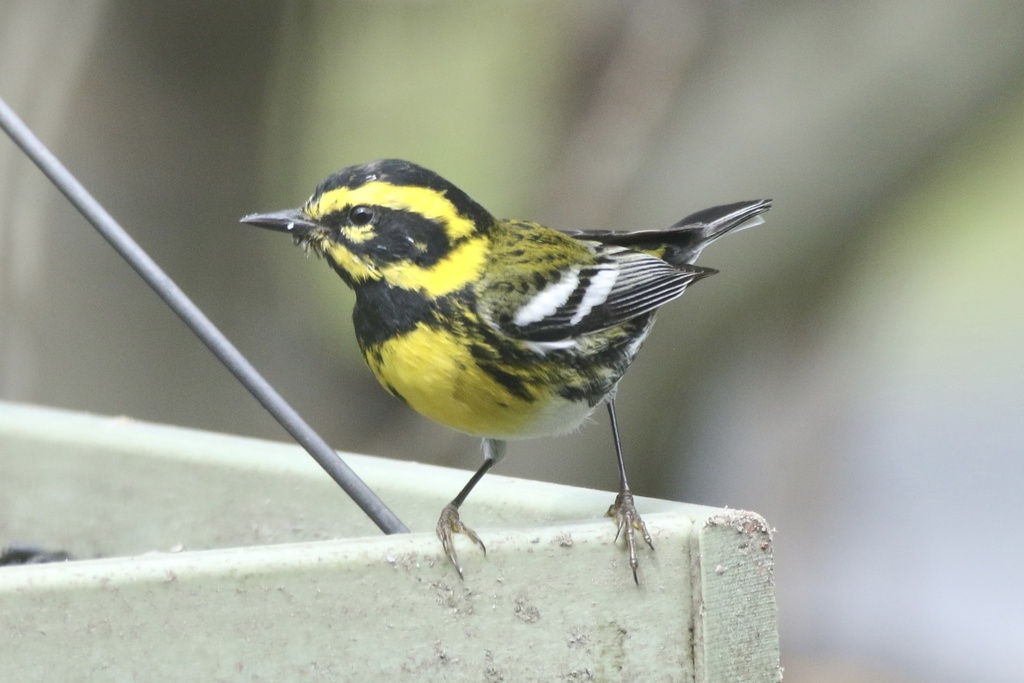
(c) Cricket Raspet, some rights reserved (CC BY) · licence
Family: Parulidae · Class: Aves · Order: Passeriformes
Setophaga townsendi (Townsend's Warbler) is a California animal in the Parulidae family.
Townsend's Warbler is a small songbird measuring 11.5 to 13 cm (4.5 to 5.1 inches) in length with a wingspan of 19 to 22 cm (7.5 to 8.7 inches). Males in breeding plumage display a distinctive black crown, cheek patch, and throat that contrasts sharply with bright yellow underparts and face. The back is olive-green with dark streaking, and the wings show two prominent white wing bars. Females and non-breeding males are more subdued, with gray replacing the black markings and duller yellow coloration. Both sexes exhibit yellow undertail coverts and a thin, pointed bill typical of insectivorous warblers. Townsend's Warbler breeds primarily in mature coniferous forests of the Pacific Northwest, with California representing the southern extent of its breeding range. In California, breeding populations are restricted to the northwestern counties, particularly Humboldt, Del Norte, and portions of Siskiyou County. The species also occurs as a migrant throughout much of California during spring and fall passage, with regular winter populations established along the coast from Sonoma County south to Los Angeles County. Winter habitat includes parks, gardens, and oak woodlands in addition to coniferous areas. Breeding habitat consists of tall, mature coniferous forests dominated by Douglas fir, western hemlock, and Sitka spruce at elevations typically ranging from sea level to 1,500 meters (4,900 feet). The species shows strong preference for forests with well-developed canopy structure and minimal understory. During migration and winter, Townsend's Warblers utilize a broader range of habitats including mixed woodlands, riparian areas, and suburban landscapes with mature trees. Winter populations in California often associate with oak woodlands and eucalyptus groves. Townsend's Warblers are primarily insectivorous, gleaning insects, larvae, and spiders from foliage and bark surfaces. Their foraging behavior involves methodical searching through needle clusters and branch tips in the forest canopy. During winter, they supplement their diet with nectar and occasionally small fruits. Breeding occurs from May through July, with females constructing cup-shaped nests of twigs, moss, and animal hair on horizontal conifer branches 3 to 30 meters above ground. Clutch size ranges from 3 to 5 eggs, with an incubation period of 12 to 13 days. Pairs typically produce one brood per season. Townsend's Warbler is not federally or state listed and maintains stable populations across most of its range. The species is classified as Least Concern by the International Union for Conservation of Nature. However, breeding populations in California represent a small portion of the global range and face potential threats from habitat loss due to logging and development in coastal forests. Climate change may affect the species through alterations in forest composition and shifts in suitable breeding habitat. The North American Breeding Bird Survey indicates relatively stable long-term population trends, though data for California breeding populations are limited due to the species' restricted range within the state.
Classification
Class: Aves · Order: Passeriformes · Family: Parulidae
Frequently asked questions
How is Setophaga townsendi classified?
Setophaga townsendi belongs to class Aves, order Passeriformes, family Parulidae.
What family does Setophaga townsendi belong to?
Setophaga townsendi is in the Parulidae family.
What is Setophaga townsendi?
Townsend's Warbler is a small songbird measuring 11.5 to 13 cm (4.5 to 5.1 inches) in length with a wingspan of 19 to 22 cm (7.5 to 8.7 inches).
Is Setophaga townsendi found in California?
Yes. Setophaga townsendi is recorded in California in The California Species Project's catalogue.
Related species
Other California species in the same genus, family, or bioregion.
Data from The California Species Project — 14,000+ California species with verified data from CNPS, CDFW, USFWS, and more.