Setophaga virens
Black-throated Green Warbler
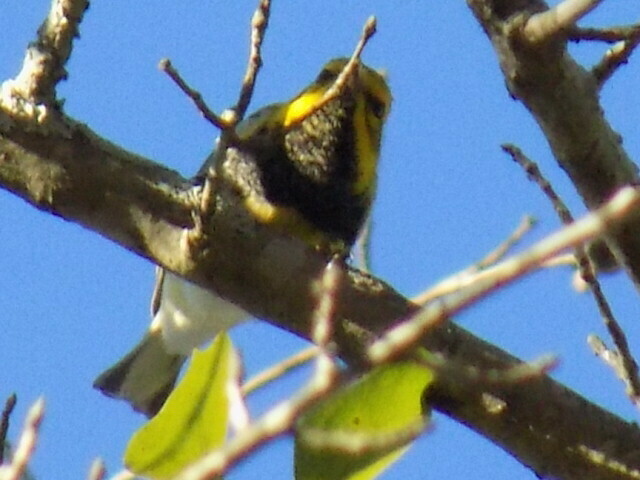
(c) Luke, some rights reserved (CC BY) · licence
Family: Parulidae · Class: Aves · Order: Passeriformes
Setophaga virens (Black-throated Green Warbler) is a California animal in the Parulidae family.
The Black-throated Green Warbler is a small songbird measuring 11.4 to 12.7 cm (4.5 to 5.0 inches) in length with a wingspan of 19 to 20 cm (7.5 to 7.9 inches). Adults weigh 7 to 10 grams. Breeding males display a distinctive black throat and upper breast contrasting with bright yellow face and sides of the head. The back and crown are olive-green, while the underparts are white with black streaking on the flanks. Two prominent white wing bars mark the dark wings. Females and non-breeding males show reduced black on the throat, which may appear as fine streaking or be entirely absent, but retain the characteristic yellow face pattern. The species breeds across the boreal forests of Canada and the northeastern United States, with the range extending south through the Appalachian Mountains to northern Georgia. In California, the Black-throated Green Warbler is an uncommon to rare migrant and vagrant, typically observed during spring and fall migration periods from late April through May and August through September. Most California records come from coastal areas and offshore islands, particularly during fall migration when individuals occasionally appear after being displaced by weather systems. Breeding habitat consists of mature coniferous and mixed forests, with a preference for areas dominated by spruce, fir, pine, and hemlock. The species favors forest edges, openings, and areas with varied canopy structure. During migration, Black-throated Green Warblers utilize diverse habitats including riparian woodlands, parks, and gardens. They typically forage in the upper and middle canopy levels, rarely descending to ground level. Black-throated Green Warblers are primarily insectivorous, feeding on caterpillars, moths, flies, aphids, and other small arthropods gleaned from foliage and bark surfaces. They employ various foraging techniques including hover-gleaning and occasional aerial capture of flying insects. The species is highly active and acrobatic while foraging, often hanging upside down to reach prey on leaf undersides. Breeding occurs from May through July, with females constructing cup-shaped nests placed on horizontal branches typically 1.5 to 18 meters above ground in coniferous trees. Clutches contain 3 to 5 eggs, which are incubated for 12 to 13 days. Both parents feed nestlings, which fledge after 8 to 10 days. The Black-throated Green Warbler is not federally listed and maintains stable populations across most of its range. The species is classified as Least Concern by the International Union for Conservation of Nature. North American Breeding Bird Survey data indicate relatively stable population trends over the past several decades, though some regional declines have been documented in portions of the Appalachian range. Primary threats include habitat loss due to logging and development in breeding areas, as well as collisions with communication towers and buildings during migration. Climate change may affect the species through shifts in suitable breeding habitat and altered insect prey availability.
Classification
Class: Aves · Order: Passeriformes · Family: Parulidae
Frequently asked questions
How is Setophaga virens classified?
Setophaga virens belongs to class Aves, order Passeriformes, family Parulidae.
What family does Setophaga virens belong to?
Setophaga virens is in the Parulidae family.
What is Setophaga virens?
The Black-throated Green Warbler is a small songbird measuring 11.4 to 12.7 cm (4.5 to 5.0 inches) in length with a wingspan of 19 to 20 cm (7.5 to 7.9 inches).
Is Setophaga virens found in California?
Yes. Setophaga virens is recorded in California in The California Species Project's catalogue.
Related species
Other California species in the same genus, family, or bioregion.
Data from The California Species Project — 14,000+ California species with verified data from CNPS, CDFW, USFWS, and more.